
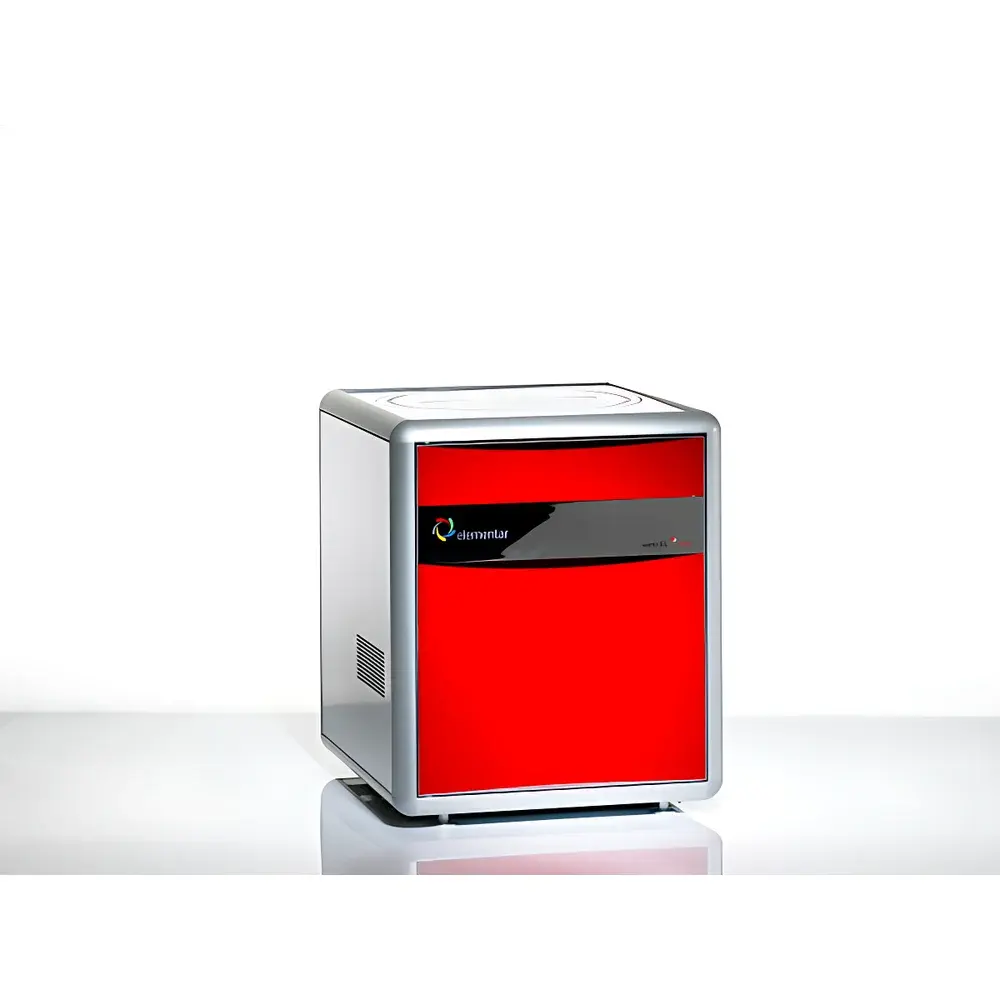
Elementar vario EL cube Organic Elemental Analyzer
| Brand | Elementar |
|---|---|
| Origin | Germany |
| Model | vario EL cube |
| Measured Elements | C, H, O, N, S |
| Sample Mass Range | 0.01–500 mg |
| C/N Ratio Capability | up to 7000:1 |
| C/S Ratio Capability | up to 5000:1 |
| Detection Principle | High-Temperature Combustion (1150 °C) + Thermal Conductivity Detection (TCD) for H₂, CO₂, N₂, SO₂, CO |
| Carrier Gas Options | Helium or Argon |
| Automation | Integrated 80-position autosampler |
| Furnace & TCD Warranty | 10 years |
| Compliance | Designed for GLP/GMP environments |
Overview
The Elementar vario EL cube is a high-precision, benchtop organic elemental analyzer engineered for quantitative determination of carbon (C), hydrogen (H), nitrogen (N), sulfur (S), and oxygen (O) in solid and liquid organic samples. It operates on the principle of high-temperature combustion—optimized at 1150 °C—followed by gas-phase separation and detection via thermal conductivity detectors (TCD). Unlike infrared-based systems, the vario EL cube employs dual TCDs for simultaneous, interference-free quantification of H₂, CO₂, N₂, SO₂, and CO, ensuring robust accuracy for hydrogen—even in challenging matrices where water vapor or halogenated compounds may compromise IR-based methods. Its patented “purge-and-trap adsorption column” technology eliminates memory effects and baseline drift, enabling reliable analysis across extreme elemental ratios (e.g., C/N up to 7000:1, C/S up to 5000:1) without manual method reconfiguration.
Key Features
- High-temperature ceramic furnace with dense oxygen injection for complete, matrix-independent sample oxidation—guaranteeing quantitative conversion of all organic-bound elements into measurable gaseous species.
- Dual thermal conductivity detectors (TCDs) calibrated for H₂, CO₂, N₂, SO₂, and CO—eliminating cross-sensitivity from H₂O, halogens, or volatile organics that commonly affect IR-based H detection.
- Heated gas pathways throughout the entire post-combustion train—including water traps and transfer lines—to prevent condensation of trace moisture and ensure stable baseline integrity over extended unattended runs.
- Patented ball-valve sample introduction system delivering zero-blank sample transfer and eliminating carryover between analyses.
- Standard 80-position autosampler with programmable weighing integration and sample cup recognition—enabling fully automated, overnight operation under GLP-compliant conditions.
- 10-year warranty on combustion furnace and TCD detectors—reflecting the instrument’s robust architecture and long-term calibration stability.
Sample Compatibility & Compliance
The vario EL cube accommodates an exceptionally broad sample spectrum: pharmaceutical actives and excipients (0.01–5 mg), polymers and monomers (1–50 mg), petrochemicals (e.g., gasoline, lubricants), environmental solids (soils, sediments, sludges up to 500 mg), and fluorinated compounds (e.g., PFAS precursors). Its combustion chemistry tolerates halogens, metals, and inorganic salts without requiring pre-treatment or catalyst dilution. The system meets core requirements for regulated environments: hardware design supports 21 CFR Part 11-compliant electronic records when paired with optional Elementar LECO-compatible software; full audit trail logging, user access controls, and electronic signature capability are available. Instrument performance aligns with ASTM D5291, ISO 14852, USP , and EN 15407 for elemental composition verification.
Software & Data Management
Control and evaluation are performed via Elementar’s proprietary UNICUBE software—a Windows-based platform supporting method development, real-time chromatogram visualization, peak integration, and stoichiometric calculation of elemental mass percentages. Data export complies with ASTM E1382 and ISO/IEC 17025 reporting formats. Optional modules enable automated uncertainty propagation per GUM guidelines, batch report generation with LIMS integration (via ASTM E1482-compliant XML), and secure multi-user workflow management with role-based permissions. All raw signal data, calibration logs, and maintenance records are timestamped and digitally signed—ensuring full traceability for internal QA audits or external regulatory inspections.
Applications
The vario EL cube serves as a reference-grade tool across R&D and QC laboratories in pharmaceuticals (API purity verification, excipient characterization), polymer science (monomer ratio validation, copolymer composition), energy (biofuel carbon content, sulfur speciation in fuels), agrochemicals (formulation consistency), and environmental monitoring (TOC/TN in soils, sediment organic load assessment). Its ability to analyze low-H samples (e.g., highly aromatic pharmaceuticals) and high-sulfur materials (e.g., coal derivatives) without recalibration makes it indispensable for labs managing diverse sample portfolios with minimal method development overhead.
FAQ
Can the vario EL cube analyze oxygen directly?
Yes—it uses pyrolytic reduction with tungsten carbide to convert oxygen to CO, which is then quantified by TCD.
Is helium mandatory as carrier gas?
No—argon is a validated alternative, reducing operational cost while maintaining precision for C, H, N, and S.
How does the system handle samples containing fluorine?
The high-temperature ceramic reactor and quartz-lined combustion tube resist corrosion from HF and other fluorinated combustion byproducts.
What is the typical analysis time per sample?
Standard C/H/N/S analysis takes 6–8 minutes; O determination adds ~3 minutes due to separate reduction step.
Does the instrument require daily calibration?
No—calibration stability exceeds 72 hours under routine use; single-point verification with certified standards is recommended before each analytical batch.






