
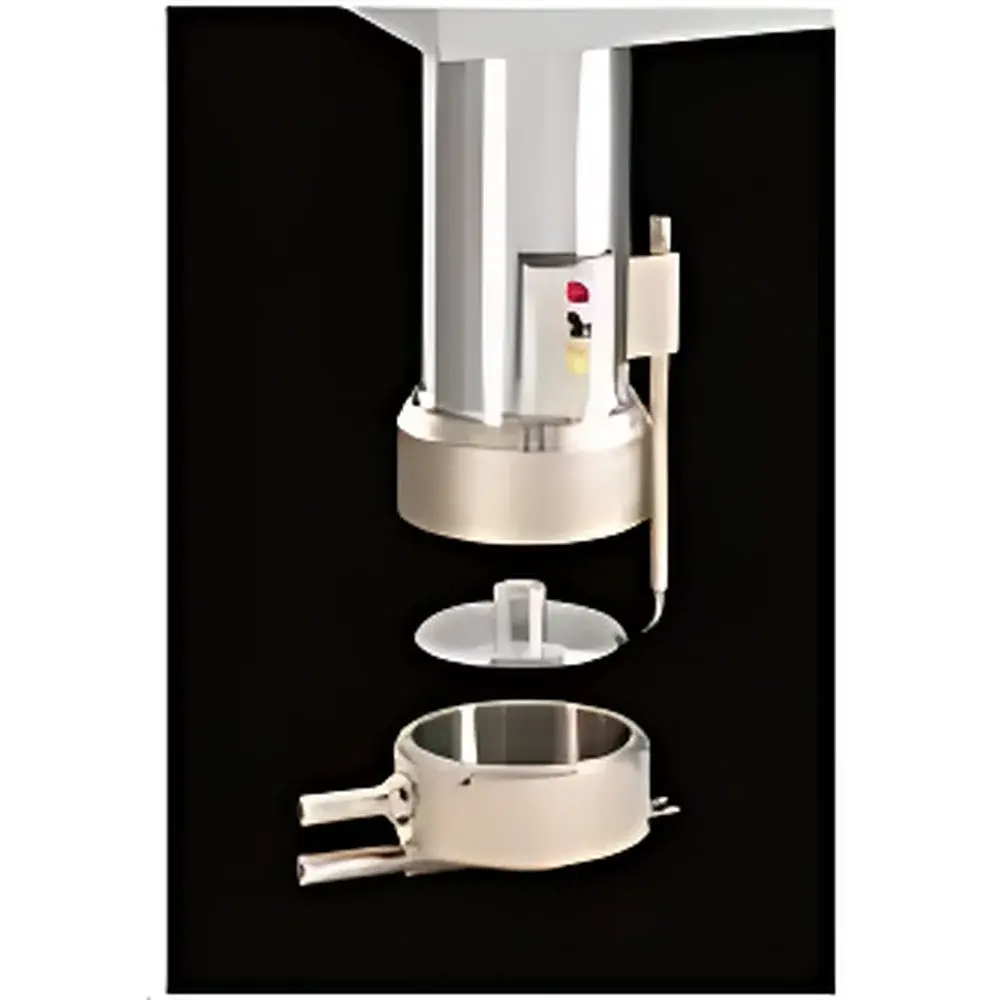
Brookfield CP Series Cone-Plate Viscometers
| Brand | Brookfield |
|---|---|
| Origin | USA |
| Model | CP Series (LV/RV/HA/HB) |
| Viscosity Range | 1–10⁶ mPa·s (model-dependent) |
| Sample Volume | 0.5–2.0 mL |
| Accuracy | ±1.0% of reading |
| Repeatability | ±0.2% |
| Temperature Control | Optional RTD-integrated sample cup |
| Cone/Plate Geometry Options | 5 standard configurations |
| Software Compatibility | RheoCalc32 (DV-III Ultra/Pro), WinGather |
| Compliance | ASTM D2196, ISO 2555, USP <911>, GLP/GMP-ready audit trail support (with validated software) |
Overview
The Brookfield CP Series Cone-Plate Viscometers are precision-engineered rotational viscometers designed for absolute viscosity measurement under controlled shear rate conditions. Operating on the fundamental principle of cone-and-plate rheometry—where a rotating conical spindle shears a thin, uniform film of sample against a stationary flat plate—the CP series delivers highly reproducible shear-rate-controlled data critical for material characterization in R&D and quality control laboratories. Unlike coaxial cylinder (cup-and-bob) geometries, the cone-plate configuration ensures a constant shear rate across the entire sample volume, eliminating edge effects and enabling true Newtonian and non-Newtonian flow behavior analysis. This architecture is particularly advantageous for low-to-medium volume samples (0.5–2.0 mL), where material scarcity, cost, or volatility preclude bulk testing. The CP platform integrates seamlessly with Brookfield’s DV-series digital viscometers—including DV3T, DV2T, and legacy DV-I+/DV-II+/DV-III+ models—offering modular adaptability without compromising metrological integrity.
Key Features
- Constant-shear-rate geometry: Precision-machined cone angles (e.g., 0.5°, 1°, 2°, 4°, 6°) paired with matching plates ensure linear shear rate distribution and eliminate wall-slip artifacts.
- Minimal sample requirement: Validated for reliable measurements using only 0.5–2.0 mL of fluid, reducing reagent consumption and enabling high-value or hazardous sample evaluation.
- Real-time gap monitoring: Motorized or manual cone-lift mechanisms with tactile feedback and visual indicators ensure repeatable, operator-independent gap setting—critical for absolute viscosity accuracy.
- Temperature-sensitive measurement capability: Optional RTD-integrated sample cups provide direct, contact-based temperature sensing at the measurement interface (±0.1 °C resolution), supporting Arrhenius modeling and thermal stability assessment.
- Modular spindle compatibility: Five standardized cone/plate sets (LV, RV, HA, HB configurations) allow systematic selection based on expected viscosity range—LV for sub-100 mPa·s fluids (e.g., solvents, juices), RV for 100–10⁴ mPa·s (paints, emulsions), HA/HB for >10⁴ mPa·s (pastes, gels, adhesives).
- Calibration traceability: Supplied with NIST-traceable calibration oils and documented uncertainty budgets per ISO/IEC 17025 guidelines.
Sample Compatibility & Compliance
The CP Series accommodates a broad spectrum of Newtonian and time-independent non-Newtonian fluids across pharmaceutical, chemical, food, and materials science domains. LV models are routinely applied to low-viscosity Newtonian liquids such as ethanol, mineral oil, and aqueous buffers; RV variants characterize shear-thinning systems like latex dispersions, cosmetic lotions, and starch slurries; HA/HB configurations handle yield-stress materials including toothpaste, epoxy pastes, and roofing mastics. All configurations comply with ASTM D2196 (Standard Test Methods for Rheological Properties of Non-Newtonian Materials Using a Rotational Viscometer), ISO 2555 (Plastics—Resins in the Liquid State or as Emulsions or Dispersions—Determination of Apparent Viscosity), and USP (Rheology). When deployed with validated RheoCalc32 or WinGather software under 21 CFR Part 11-compliant configurations, the system supports full audit trails, electronic signatures, and data integrity requirements for GLP and GMP environments.
Software & Data Management
Data acquisition and analysis are supported via Brookfield’s RheoCalc32 (for DV-III Ultra and Pro instruments) and WinGather (for DV2T/DV3T platforms). Both applications enable real-time viscosity vs. shear rate plotting, thixotropy loop analysis, yield stress estimation (via Herschel-Bulkley or Casson models), and automated temperature ramping protocols. Export formats include CSV, Excel, and PDF reports compliant with laboratory information management systems (LIMS). For regulated environments, optional 21 CFR Part 11 validation packages include role-based access control, electronic signature workflows, and immutable audit logs—ensuring full traceability from raw torque/speed readings to final report generation.
Applications
- Pharmaceutical formulation: Quantifying viscosity of ophthalmic solutions, suspensions, and hydrogels under physiologically relevant shear rates.
- Coatings & inks: Evaluating sag resistance, leveling behavior, and spray atomization characteristics through controlled shear sweeps.
- Food science: Characterizing mouthfeel-relevant rheology of yogurts, sauces, and fruit pulps using low-volume, temperature-stabilized protocols.
- Adhesives & sealants: Determining open time, bond strength correlation, and thixotropic recovery kinetics in paste-grade materials.
- Polymer processing: Screening molecular weight distribution proxies via zero-shear viscosity extrapolation from multi-point shear rate data.
FAQ
How does cone-plate geometry improve measurement accuracy compared to spindle-based viscometry?
Cone-plate geometry establishes a mathematically defined, constant shear rate across the entire sample film—unlike cylindrical spindles, which generate variable shear rates radially. This eliminates interpolation errors and enables direct calculation of absolute viscosity without geometric correction factors.
Can I use the same CP spindle across different DV-series instruments?
Yes—CP spindles are mechanically and electronically compatible across all Brookfield DV-series viscometers (DV-I+, DV-II+, DV-III+, DV2T, DV3T), provided firmware and driver versions are current.
What determines whether I select an LV, RV, HA, or HB CP configuration?
Selection is governed by the expected dynamic viscosity range at the target test temperature and shear rate. LV (low torque) suits <100 mPa·s; RV (medium torque) covers ~100–10⁴ mPa·s; HA/HB (high torque) extends to 10⁶ mPa·s, with HB optimized for very high yield stresses.
Is temperature control mandatory for accurate CP measurements?
While not mandatory, temperature control is strongly recommended—viscosity exhibits exponential dependence on temperature (Arrhenius behavior). The optional RTD-integrated cup provides direct interfacial temperature measurement, minimizing thermal lag and gradient-induced error.
Does Brookfield offer IQ/OQ/PQ documentation for regulated labs?
Yes—validated installation qualification (IQ), operational qualification (OQ), and performance qualification (PQ) protocols are available upon request for systems configured with 21 CFR Part 11-compliant software and calibrated transducers.



