
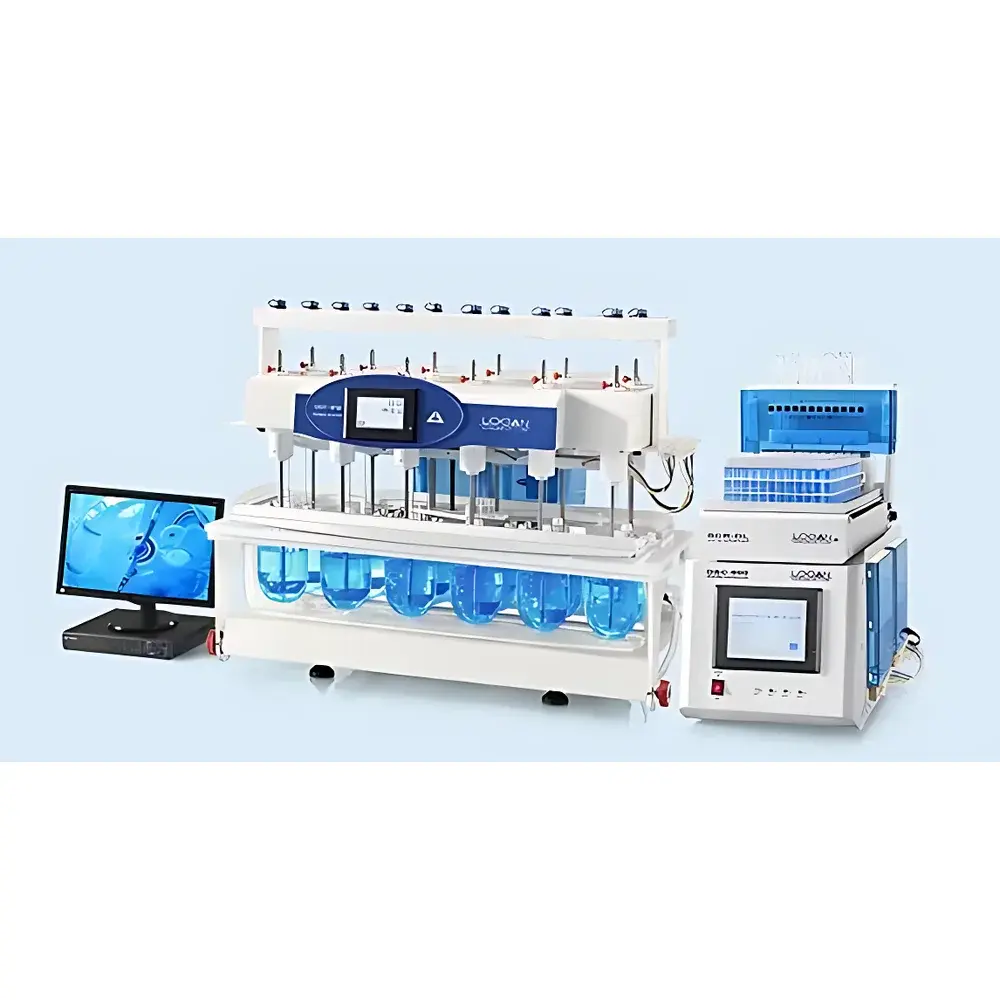
LOGAN SYSTEM 860CDL 12-Position Automated Dissolution Sampling System with Integrated Imaging
| Brand | LOGAN |
|---|---|
| Origin | USA |
| Model | SYSTEM 860CDL |
| Instrument Type | Online Dissolution Tester |
| Number of Vessels | 12 |
| Temperature Range | 20–60°C |
| Temperature Accuracy | ±0.1°C |
| Rotational Speed Range | 25–250 rpm (±1 rpm) |
| Paddle Wobble | ≤0.5 mm |
| Basket Wobble | ≤1.0 mm |
| Water Bath Temperature Range | Ambient to 45°C |
| Water Bath Temperature Resolution | 0.1°C |
| Water Bath Volume | 30 L |
Overview
The LOGAN SYSTEM 860CDL is a fully automated, modular 12-position dissolution testing system engineered for regulatory-compliant pharmaceutical development and quality control. It operates on the principles of USP Apparatus 1 (basket) and Apparatus 2 (paddle), delivering precise hydrodynamic conditions required for reproducible drug release assessment. Designed in accordance with ICH Q5A(R2), Q5C, and Q6A guidelines, the system integrates real-time sampling, temperature-controlled dissolution vessels, and synchronized high-resolution imaging to capture dynamic dissolution behavior—enabling quantitative evaluation of tablet disintegration, capsule erosion, and sustained-release matrix degradation. Its architecture supports both static and dynamic dissolution protocols, including sequential sampling with automatic medium replenishment, making it suitable for extended-duration studies up to 24 hours without operator intervention.
Key Features
- Simultaneous operation of 12 dissolution vessels with independent temperature monitoring via 12 embedded Pt100 sensors—ensuring vessel-to-vessel thermal uniformity within ±0.1°C.
- Motor-driven paddle/basket assembly with mechanical wobble compensation: paddle radial deviation ≤0.5 mm; basket radial deviation ≤1.0 mm—meeting USP mechanical calibration requirements.
- Integrated SCR-DL sample collector with dual-stage filtration (0.45 µm pre-filter + optional 0.22 µm final filter), minimizing particulate carryover and protecting downstream analytical instrumentation.
- SYP-12L precision syringe pump (10 mL capacity) delivering volumetric accuracy ±0.5% across full range—validated per ASTM E2503-22 for volumetric delivery consistency.
- DSC-800 central controller with embedded audit trail, electronic signatures, and role-based access control (three-tier permission structure)—fully compliant with FDA 21 CFR Part 11 and EU Annex 11 data integrity requirements.
- Dedicated coaxial LED illumination module and high-frame-rate CMOS camera system enabling real-time visualization of dosage form behavior—including swelling, cracking, floating, or sedimentation—synchronized with dissolution timepoints.
- Double-lid vessel configuration reducing solvent evaporation by >90% over standard open-bath designs, critical for low-volume or volatile media (e.g., ethanol/water mixtures).
Sample Compatibility & Compliance
The SYSTEM 860CDL accommodates solid oral dosage forms (immediate- and extended-release tablets, capsules, orally disintegrating tablets), semisolid formulations (gels, patches), and suspensions. It supports all USP-approved apparatus configurations—Apparatus 1 (basket), Apparatus 2 (paddle), Apparatus 3 (reciprocating cylinder), Apparatus 4 (flow-through cell), and miniaturized small-volume methods (e.g., microdissolution per USP ). All hardware components comply with ISO 9001-certified manufacturing standards; temperature and rotational performance are verified against NIST-traceable references. The system meets GLP/GMP environmental monitoring requirements through continuous logging of vessel temperature, rotation speed, sampling timing, and user activity—each timestamped and digitally signed.
Software & Data Management
Control and data acquisition are managed via LOGAN’s proprietary DSC-800 software platform, validated per GAMP 5 Category 3 criteria. The software provides full traceability: every parameter change, sample event, and instrument alarm is recorded with user ID, timestamp, and reason-for-change annotation. Raw dissolution profiles (concentration vs. time) are exportable in CSV, XML, and SDTM-compliant formats for integration into statistical analysis tools (e.g., Phoenix WinNonlin, JMP). Remote monitoring is enabled via secure HTTPS web interface compatible with iOS and Android mobile devices—allowing real-time status checks and emergency pause/resume commands without local workstation access. Optional API integration supports direct data ingestion into LIMS and ELN platforms.
Applications
- Comparative dissolution profiling for generic product development and bioequivalence (BE) support studies.
- Formulation robustness assessment under variable pH, surfactant concentration, or agitation intensity.
- In vitro-in vivo correlation (IVIVC) model development using dissolution-permeation coupling with parallel artificial membrane permeability assay (PAMPA) or Caco-2 systems.
- Stability-indicating method development for forced degradation studies involving oxidative, hydrolytic, or photolytic stress.
- Quality-by-Design (QbD) workflows requiring multivariate process parameter mapping (e.g., DoE-driven dissolution optimization).
- Regulatory submission support: generates ALCOA+ compliant datasets for FDA, EMA, PMDA, and Health Canada filings.
FAQ
Does the SYSTEM 860CDL support USP Apparatus 4 (flow-through cell)?
Yes—via optional flow cell modules and peristaltic pump integration, enabling continuous medium replacement and sink condition maintenance.
Can the imaging system be calibrated for quantitative morphometric analysis?
The camera system includes pixel-to-mm calibration routines and supports third-party image analysis plugins (e.g., ImageJ macros) for area-based erosion quantification.
Is validation documentation provided with the system?
Yes—factory-issued IQ/OQ protocols, as well as a comprehensive URS and risk assessment report aligned with Annex 15, are included in the delivery package.
What analytical instruments can be directly interfaced?
UV-Vis spectrophotometers (via TTL trigger), HPLC autosamplers (RS-232/485), fiber-optic UV probes, and dilution workstations (e.g., Gilson GX-271) are supported through standardized hardware I/O ports.
How is data backup and disaster recovery handled?
The system supports scheduled encrypted backups to network-attached storage (NAS) or cloud repositories (AWS S3, Azure Blob), with versioned archive retention configurable up to 10 years.






