
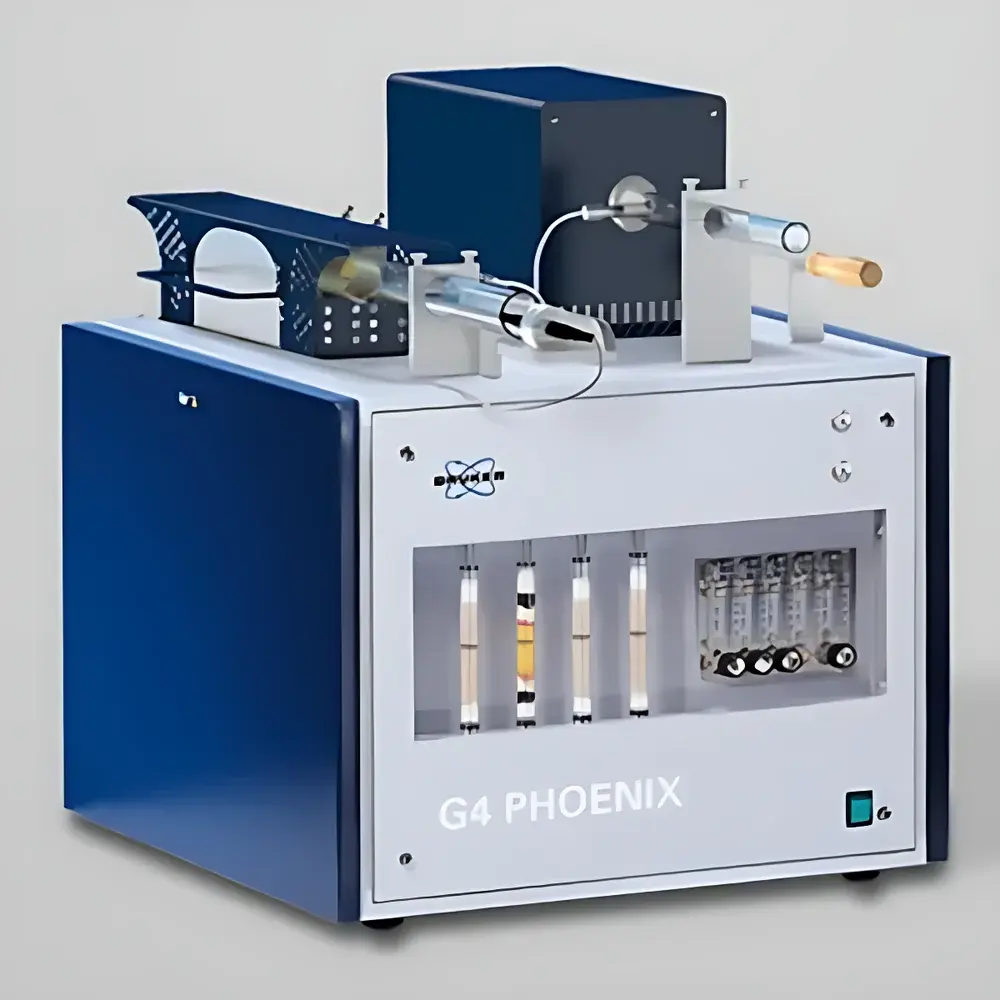
Bruker G4 PHOENIX DH Diffusible Hydrogen Analyzer
| Brand | Bruker |
|---|---|
| Origin | Germany |
| Model | G4 PHOENIX DH |
| Detection Principle | Thermal Desorption Mass Spectrometry (TDMS) & Thermal Conductivity Detection (TCD) |
| Detection Limit | <1 ng/g (with optional quadrupole MS) / <50 ng/g (standard TCD) |
| Furnace Max Temp | 900 °C (IR-heated, low thermal mass) |
| Sample Chamber Diameter | 30 mm |
| Calibration | 10-volume automated gas standard system |
| Compliance | Fully compatible with ISO 3690, AWS A4.3, ASTM E1442, EN ISO 17025 |
Overview
The Bruker G4 PHOENIX DH Diffusible Hydrogen Analyzer is a high-precision, laboratory-grade instrument engineered for the quantitative determination of diffusible hydrogen in metallic materials—primarily steels, weld metals, and high-strength alloys. It operates on the principle of thermal desorption coupled with dual detection modalities: a high-stability, reference-channel thermal conductivity detector (TCD) for routine ppm-level quantification, and an optional integrated quadrupole mass spectrometer (QMS) for sub-ng/g sensitivity and isotopic resolution. The system extracts hydrogen by controlled heating under inert carrier gas (typically helium or argon), followed by real-time detection of evolved H₂ molecules. This method conforms to internationally recognized standards including ISO 3690 (determination of diffusible hydrogen in steel weld metal), AWS A4.3 (standard test method for determining hydrogen in titanium and titanium alloys), ASTM E1442 (standard practice for hydrogen analysis of titanium and titanium alloys), and supports GLP/GMP traceability requirements through full audit trail and 21 CFR Part 11–compliant software options.
Key Features
- Two-tier detection architecture: Standard high-reproducibility TCD with dedicated reference gas channel and heat exchanger; optional QMS module delivering >10× lower detection limit and enabling H-isotope ratio analysis (e.g., H/D exchange studies)
- Low-thermal-mass infrared furnace with programmable ramp rates (up to 100 °C/s) and precise temperature control from ambient to 900 °C; optional resistive furnace extends range to 1100 °C for refractory alloys
- 30 mm internal diameter sample tube—designed to accommodate full-thickness weld coupons, ASTM E1442 specimens, and large-section metallurgical samples per AWS A4.3
- 10-volume automated gas calibration unit providing NIST-traceable, linear response across five orders of magnitude (ng/g to µg/g)
- Direct sample temperature monitoring via optional thermocouple probe kit—critical for validating thermal desorption profiles and kinetic modeling
- External sampling interface available for integration with GC-based methods per ISO 3690 Annex B (gas chromatography separation prior to detection)
Sample Compatibility & Compliance
The G4 PHOENIX DH accepts solid metallic samples—including as-welded joints, machined tensile bars, powder metallurgy compacts, and electroplated substrates—without requiring dissolution or chemical pretreatment. Sample mass ranges from 0.1 g to 50 g depending on matrix density and expected hydrogen content. The system meets ISO/IEC 17025 requirements for accredited testing laboratories when operated with documented SOPs, calibration records, and uncertainty budgets. Its analytical workflow supports regulatory submissions under FDA, DoD, and ASME Section IX frameworks where hydrogen-induced cracking (HIC), hydrogen-assisted cracking (HAC), or delayed fracture assessment is mandated. All hardware and firmware are CE-marked and RoHS-compliant.
Software & Data Management
Bruker’s proprietary DH-Analyzer software provides full instrument control, method development, peak integration, calibration management, and report generation. Each analysis includes timestamped metadata (operator ID, sample ID, furnace profile, gas flow rate, detector gain), raw signal traces, and integrated area quantification against multi-point calibration curves. Audit trails record all user actions, parameter changes, and data exports. Optional 21 CFR Part 11 compliance package adds electronic signatures, role-based access control, and immutable archival of raw and processed datasets. Export formats include CSV, PDF, XML, and LIMS-compatible ASTM E1382 structures.
Applications
- Pre-weld qualification testing of filler metals, base plates, and consumables per ISO 15614-1 and AWS D1.1
- Post-weld hydrogen monitoring to validate bake-out procedures and assess residual embrittlement risk
- Research into hydrogen trapping mechanisms in advanced high-strength steels (AHSS), martensitic stainless steels, and nickel-based superalloys
- Failure analysis of catastrophic fractures in pressure vessels, pipelines, and aerospace components
- Development of low-hydrogen welding processes, flux-cored wires, and shielding gas formulations
- Validation of hydrogen permeation barriers and surface coatings in nuclear and hydrogen energy applications
FAQ
What is the difference between diffusible and total hydrogen measurement?
Diffusible hydrogen refers specifically to atomic H that migrates interstitially through the lattice and can be extracted below 200 °C; total hydrogen includes trapped H at irreversible sites (e.g., TiC, VN precipitates) requiring higher temperatures (>600 °C) or acid dissolution.
Can the G4 PHOENIX DH analyze non-ferrous metals such as aluminum or titanium?
Yes—the system is validated for aluminum alloys (per ASTM E1442), titanium grades (per ASTM F136), and zirconium, with appropriate calibration and desorption protocols.
How does the 10-volume calibration system improve accuracy?
It eliminates manual dilution errors and ensures linearity across the entire dynamic range (1–10,000 ng/g) using certified gas standards traceable to NIST SRM 1633c.
Is method validation support available for ISO/IEC 17025 accreditation?
Bruker provides comprehensive validation documentation packages—including LOD/LOQ studies, precision/repeatability reports, and uncertainty calculation templates—as part of its Application Support Program.
Does the system require liquid nitrogen or other cryogenic consumables?
No—the TCD and QMS operate at ambient or thermoelectrically cooled conditions; no LN₂, dry ice, or external chillers are required.




