
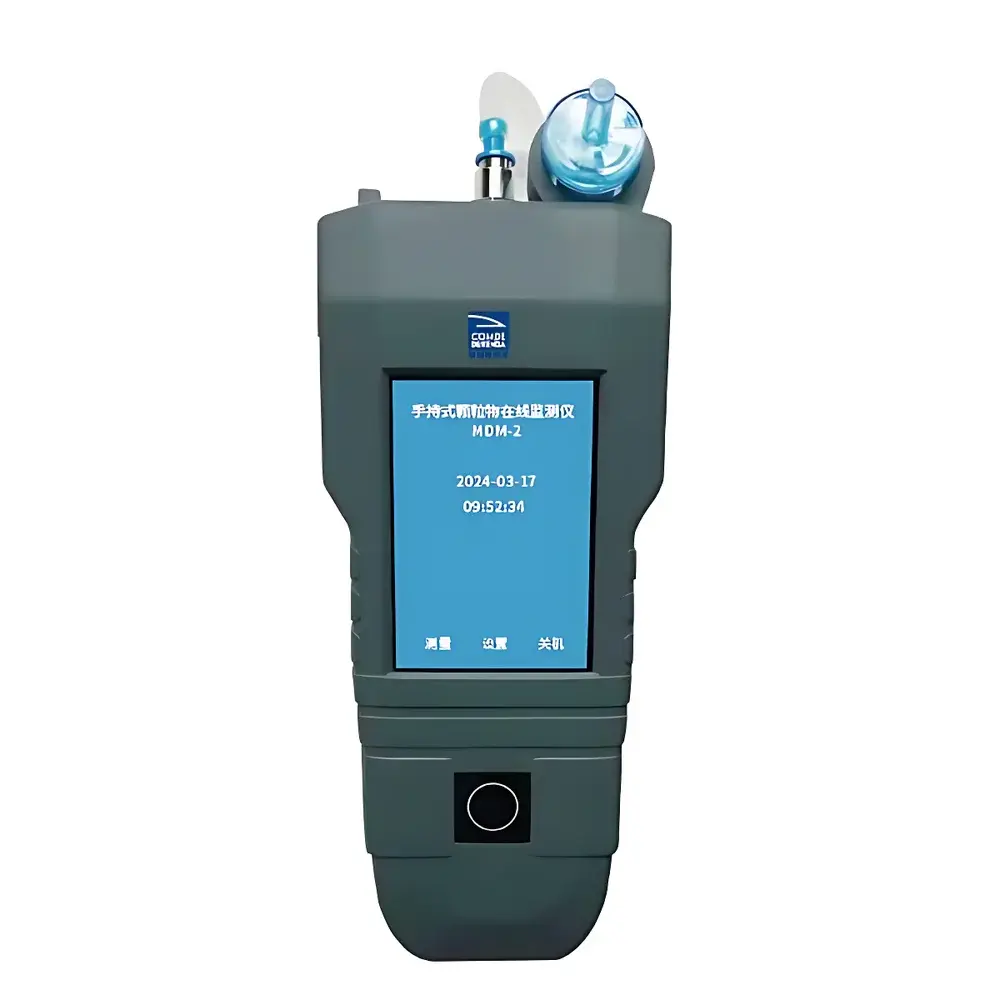
Derenda MDM-2 Handheld Real-Time Atmospheric Particulate Matter Monitor
| Brand | Derenda |
|---|---|
| Model | MDM-2 |
| Measurement Principle | Laser Light Scattering (Nephelometry) |
| Measured Parameters | PM₁, PM₂.₅, PM₁₀ |
| PM₂.₅ Range | 0–2500 µg/m³ |
| PM₁₀ Range | 0–5000 µg/m³ (calculated from PM₂.₅) |
| Minimum Detection Limit | 2 µg/m³ |
| Resolution | 0.1 µg/m³ |
| Sampling Flow Rate | ≥0.15 L/min (typical 0.3 L/min) |
| Measurement Interval | 2 s |
| Response Time | ≤5 s |
| Accuracy (24-hr avg) | ±15% |
| Power Supply | Rechargeable Li-ion Battery |
| Battery Life | Up to 8 h |
| Dimensions | 220 mm × 90 mm × 85 mm |
| Weight | ~600 g |
| Data Storage & Transmission | microSD card, 3G/4G module |
| Integrated Sensors | Barometric Pressure, Altitude |
| Display | Color TFT Touchscreen |
| Expected Photometer Lifetime | 5 years |
| Compliance | Designed for field-deployable ambient air monitoring per ISO 12103-1 reference aerosol compatibility and aligned with EPA EQPM-0709-192 performance expectations for portable PM monitors |
Overview
The Derenda MDM-2 Handheld Real-Time Atmospheric Particulate Matter Monitor is an engineered solution for rapid, on-site quantification of airborne particulate mass concentrations in ambient environments. Based on the physical principle of laser light scattering (nephelometry), the MDM-2 illuminates sampled air with a stable 650 nm semiconductor laser diode and detects angularly resolved scattered intensity using a high-sensitivity photodiode array. The instrument applies empirically validated calibration curves—traceable to gravimetric reference methods—to convert raw scattering signals into mass concentration values for PM₁, PM₂.₅, and PM₁₀. Unlike fixed-station beta attenuation or tapered element oscillating microbalance (TEOM) systems, the MDM-2 leverages real-time optical detection to deliver sub-5-second response times and continuous 2-second measurement cycles—making it suitable for dynamic exposure assessment, mobile surveys, and time-resolved spatial mapping where temporal resolution is critical.
Key Features
- Laser-based nephelometric detection with factory-calibrated response to ISO 12103-1 A2 test dust and urban aerosol surrogates
- Integrated barometric pressure and altitude sensors enabling real-time environmental compensation during elevation-varying deployments (e.g., drone-based vertical profiling)
- High-resolution 4.3-inch color TFT capacitive touchscreen with intuitive GUI for live trend visualization, parameter configuration, and local data review
- Dual-mode data handling: onboard microSD card (up to 128 GB) for autonomous logging + embedded 3G/4G LTE modem for remote telemetry and cloud synchronization
- Compact ergonomic form factor (220 × 90 × 85 mm) and lightweight design (~600 g) optimized for handheld operation, vehicle-mounted surveys, and UAV integration
- Rechargeable lithium-ion battery system supporting up to 8 hours of continuous operation under standard sampling conditions (0.3 L/min flow, 2 s interval)
Sample Compatibility & Compliance
The MDM-2 is designed for direct sampling of ambient outdoor air and indoor environments without pre-separation or conditioning. Its inlet geometry and internal flow path minimize particle loss for aerodynamic diameters ≤10 µm, consistent with ISO 25548-1 guidance for portable PM monitor inlets. While not certified as a Federal Reference Method (FRM) or Federal Equivalent Method (FEM) device per U.S. EPA 40 CFR Part 53, the MDM-2 meets technical benchmarks outlined in EPA’s “Performance Targets for Low-Cost Sensors” (2021) for portable optical PM monitors—including detection limit ≤5 µg/m³, precision 0.95 across 0–2500 µg/m³ for PM₂.₅. It supports GLP-aligned field documentation via timestamped, GPS-tagged data files compliant with ISO/IEC 17025 traceability requirements when used with external calibration verification protocols.
Software & Data Management
Data output conforms to UTF-8 encoded CSV format with UTC timestamps, GPS coordinates (when enabled), pressure, altitude, temperature, and all three PM mass concentrations. The embedded firmware supports configurable logging intervals (2 s default), alarm thresholds, and automatic file rollover. Optional desktop software (Derenda DataLink v3.x) enables spectral deconvolution diagnostics, batch calibration adjustment, and export to common environmental reporting formats (e.g., EPA AirNow XML, EU CITEAIR-compliant JSON). All firmware updates are delivered over-the-air (OTA) via HTTPS-secured channels. Audit trails—including user login history, configuration changes, and sensor diagnostic logs—are retained locally and exportable for regulatory review under ISO 17025 Clause 7.7.
Applications
- Emergency response monitoring during wildfire smoke events, industrial fugitive emissions, or construction-related dust plumes
- Regulatory compliance support for localized PM hot-spot identification and mitigation validation
- Mobile source emission characterization via vehicle-mounted or bicycle-mounted transects
- Unmanned aerial system (UAS) payloads for vertical concentration profiling and boundary layer studies
- Educational field campaigns and citizen science initiatives requiring rugged, low-training-entry instrumentation
- Indoor air quality audits in schools, hospitals, and office buildings with time-weighted average (TWA) analysis capability
FAQ
Is the MDM-2 compliant with U.S. EPA or EU reference method standards?
No—it is not designated as a FRM/FEM device under 40 CFR Part 53 or EN 12341:2014. It is intended for indicative, screening-level measurements and supplementary data collection.
How is PM₁₀ derived from PM₂.₅ measurements?
The instrument applies a site-adaptable ratio algorithm (default PM₁₀/PM₂.₅ = 1.8–2.2) based on regional aerosol composition models; users may input custom ratios via configuration menu.
What maintenance is required to ensure long-term accuracy?
Annual verification against a NIST-traceable calibrator is recommended; optical window cleaning every 30 days in high-dust environments; photometer zero-check using clean-air purge function.
Can the MDM-2 operate continuously while charging?
Yes—the unit supports pass-through power operation: external DC input (5 V / 2 A) powers the system and charges the battery simultaneously.
Does the device store GPS metadata with each measurement?
Yes—integrated GNSS module records latitude, longitude, altitude, and UTC time stamp for every data point when enabled in settings.
Related Products







