Derenda MWS-2 Manual Temperature- and Humidity-Controlled Weighing System
| Brand | Derenda |
|---|---|
| Origin | Germany |
| Manufacturer Type | Authorized Distributor |
| Product Category | Imported Instrument |
| Model | MWS-2 Manual Temperature- and Humidity-Controlled Weighing System |
| Instrument Type | Ultra-Micro Precision Balance |
| Weighing Range | 20–100 g (standard configuration with 22 g max capacity balance) |
| Readability | 0.1 µg (10⁻⁷ g) |
| Calibration | Automatic and Manual Modes |
| Repeatability | < ±3 µg |
| Temperature Control Range | 15–30 °C (±0.5 °C accuracy) |
| Relative Humidity Control Range | 40–55 %RH (±5 %RH accuracy) |
| Dew Point Stability | ±0.1 °C |
| Air Cleanliness Class | ISO 5 (Class 1,000) |
| RFID Encoding | Optional integrated RF tag read/write on sample holder ring |
| Electrostatic Discharge | High-voltage non-radiative U-bar system (≥90% neutralization efficiency per cycle) |
| Vibration Isolation | Four-stage passive isolation with dedicated floating island mount for balance |
| Balance Specifications (optional) | 50 g capacity, 0.01 mg readability, ≤6 s stabilization time, linearity deviation ≤0.05 mg |
| Dimensions (L×W×H) | 1182 × 926 × 1993 mm |
| Power Requirement | <2000 VA, 220 V ±10%, 50 Hz |
| Net Weight | <500 kg |
Overview
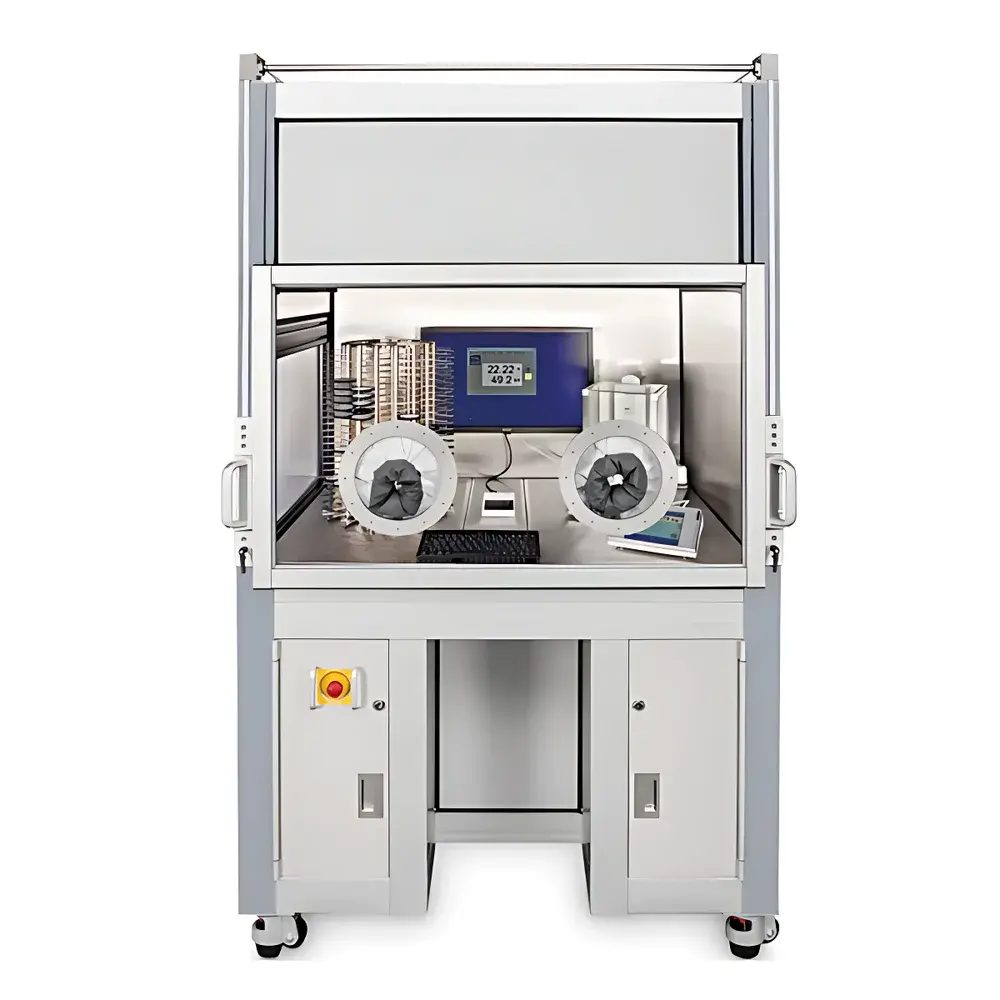
The Derenda MWS-2 Manual Temperature- and Humidity-Controlled Weighing System is an engineered solution for gravimetric analysis of airborne particulate matter (PM) filters in environmental monitoring laboratories. Designed to comply with stringent regulatory protocols—including HJ 618, HJ 656, and HJ 836-2017—the system provides a self-contained, ISO 5-class (Class 1,000) weighing environment that eliminates dependency on dedicated climate-controlled rooms. Its core functionality integrates high-stability microbalance operation with tightly regulated thermal and hygroscopic conditioning (15–30 °C ±0.5 °C; 40–55 %RH ±5 %RH), enabling standardized equilibration and manual weighing of PM1, PM2.5, PM10, TSP filters, low-concentration sampling heads, and ASTM-standardized glass fiber or quartz filter media. The system operates on the principle of controlled mass measurement under stabilized thermodynamic conditions—ensuring compliance with EPA Method IO-4.2, EN 12341, and ISO 12103-1 requirements for filter-based aerosol mass determination.
Key Features
- Modular sample storage architecture: Individual filter positions with interchangeable sample holders optimized for diverse membrane geometries (e.g., 47 mm, 90 mm, 110 mm diameter filters and 3# glass fiber tubes)
- Integrated FFU (Fan Filter Unit) air recirculation system delivering continuous HEPA-filtered airflow at ≥99.99% efficiency (0.3 µm particles), maintaining ISO 5 cleanroom conditions inside the weighing chamber
- Pull-out sample loading drawer: Enables external handling of filters without opening the main chamber door—minimizing thermal/humidity perturbation and contamination risk
- Optional RFID-enabled sample management: Embedded RF tags in sample rings support automated logging, traceability, and audit-ready chain-of-custody records
- Dual-mode electrostatic mitigation: Non-ionizing, radiation-free U-shaped high-voltage discharge bar achieves ≥90% static reduction per exposure cycle, critical for low-mass (<100 µg) filter measurements
- Four-tier passive vibration isolation: Combines structural damping, pneumatic leveling feet, mass-spring decoupling, and a dedicated floating island platform for the balance—ensuring sub-microgram stability even in non-dedicated lab spaces
- Ergonomic workstation design: Large transparent acrylic viewport (≥800 × 500 mm), anthropometric glove ports, and intuitive control panel placement reduce operator fatigue during extended batch workflows
- Future-ready expandability: Pre-wired I/O interfaces and mechanical mounting rails allow seamless integration of robotic arms, auto-loader modules, or barcode scanners for transition to semi-automated or fully automated configurations
Sample Compatibility & Compliance
The MWS-2 accommodates standard environmental filter formats including cellulose ester, polytetrafluoroethylene (PTFE), quartz fiber, and borosilicate glass fiber membranes—ranging from 37 mm to 110 mm in diameter. It supports both gravimetric pre- and post-sampling conditioning per HJ 656 and US EPA Reference Method 201A. All operational parameters—including temperature setpoint, humidity target, dwell time, and chamber pressure differential—are logged with timestamped metadata in accordance with GLP and ISO/IEC 17025 documentation requirements. The system meets JJF 1101 calibration traceability standards for environmental chambers and complies with JJG 1036-2008 for ultra-micro balance verification. Its temperature and humidity control architecture conforms to GB/T 10586 specifications for wet-heat test equipment, while its clean-air performance satisfies ISO 14644-1 Class 5 criteria.
Software & Data Management
The embedded control software provides real-time visualization of chamber conditions (temperature, RH, dew point), balance output, and FFU status. Users define multi-step equilibration profiles—including ramp-hold cycles and humidity stabilization delays—with configurable tolerances. All weighings are automatically timestamped and associated with operator ID, filter ID (RFID or manual entry), and environmental context. Data is stored in a local SQL database supporting export to CSV, PDF, or XML formats compliant with FDA 21 CFR Part 11 requirements (when configured with electronic signature and audit trail modules). Historical logs—including chamber deviation events, balance calibration history, and static neutralization cycles—are retained for ≥12 months and support forensic query by date range, operator, or sample ID.
Applications
- Manual gravimetric analysis of PM2.5/PM10 filters per Chinese national standard HJ 618 and HJ 656
- Weighing of low-concentration stack emission samples (e.g., HJ 836-2017-compliant 3# filter tubes)
- Pre- and post-sampling conditioning of quartz and Teflon filters for organic carbon/elemental carbon (OC/EC) analysis
- Calibration verification of cascade impactors and virtual impactors using certified reference aerosols
- Reference laboratory use in metrological intercomparisons requiring sub-µg repeatability under controlled hygrothermal conditions
- Research-scale studies of hygroscopic growth factors and water adsorption kinetics on atmospheric particulates
FAQ
What balance resolution is supported by the MWS-2 system?
The system accommodates optional ultra-micro balances with 0.1 µg (10⁻⁷ g) readability—configured with a 22 g maximum capacity as standard, or upgradable to 50 g with 0.01 mg (10 µg) readability.
Does the system meet ISO/IEC 17025 requirements for accredited laboratories?
Yes—when operated with documented procedures, calibrated sensors (traceable to NIM or DAkkS-certified references), and enabled audit-trail logging, the MWS-2 fulfills data integrity and environmental control clauses in ISO/IEC 17025:2017 Clause 7.5 and 7.8.
Can the MWS-2 be used for non-PM applications such as pharmaceutical filter testing?
While optimized for environmental filter weighing, the system’s stable humidity control, static mitigation, and ISO 5 cleanliness make it suitable for high-precision gravimetry of hydrophilic/hygroscopic pharmaceutical filters—provided validation per USP and ICH Q5C is performed.
Is remote monitoring or network integration possible?
The system includes Ethernet and RS-232 interfaces; OPC UA and Modbus TCP protocols are available via optional firmware upgrade, enabling integration into LIMS or centralized facility monitoring platforms.
How often does the FFU filter require replacement?
HEPA filter service life is typically 12–18 months under continuous operation; the system monitors cumulative runtime and alerts users at 90% of rated service interval.