
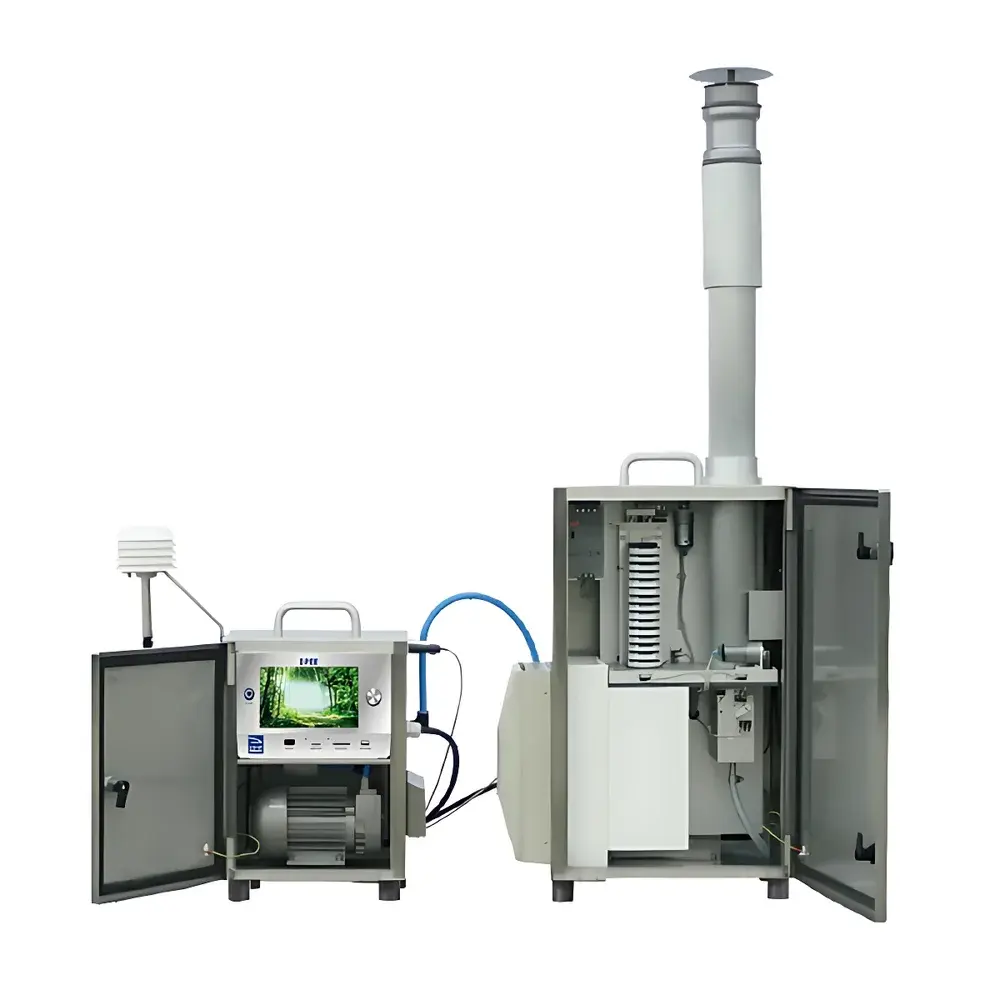
Derenda MVS+AFC Split-Configuration Automatic Filter-Changing Particulate Sampler
| Brand | Derenda |
|---|---|
| Origin | Germany |
| Model | MVS+AFC |
| Instrument Type | 24-Hour Constant-Temperature Constant-Flow Gas Sampler |
| Instrument Architecture | Multi-Channel Gas Sampler |
| Flow Range | 1.0–4.5 m³/h (adjustable) |
| Vacuum Pressure Capability | >800 hPa |
| Nominal Flow Rate | 2.3 m³/h |
| Flow Stability | ±2.0% deviation over 24 h |
| Operating Duration at Max Flow & Backpressure | 1 min–999 h |
| Service Life Under Max Flow & Backpressure | >50,000 h |
| Filter Diameter | 47 mm |
| Power Supply | 220 V ±10%, 50 Hz |
| Power Consumption | 350 VA |
| Dimensions (MVS) | 300 × 250 × 450 mm |
| Dimensions (AFC) | 440 × 310 × 700 mm |
| Weight (MVS) | 22 kg |
| Weight (AFC) | 24.5 kg |
| Noise Level | <62 dB(A) (per DIN 2058, measured at 8 m) |
| Operating Temperature | −30 °C to +50 °C |
| Operating Humidity | 0–100 %RH |
| Ingress Protection Rating | IP55 |
Overview
The Derenda MVS+AFC Split-Configuration Automatic Filter-Changing Particulate Sampler is a precision-engineered environmental monitoring system designed for compliant, long-term gravimetric sampling of airborne particulate matter—including PM10 and PM2.5—in accordance with CEN EN 12341:2014. Unlike monolithic samplers, the MVS+AFC adopts a modular architecture: the MVS unit serves as a portable low-flow particulate sampler, while the AFC (Automatic Filter Changer) functions as a standalone, mechanically actuated filter magazine and exchange mechanism. The two units interconnect via a dedicated suction hose and RS-485 data cable, enabling flexible deployment—either as independent single-filter samplers or as an integrated 16-filter sequential system. This split configuration enhances field mobility, simplifies maintenance, and supports unattended operation across diverse ambient conditions—from arctic winters (−30 °C) to desert summers (+50 °C). The system’s constant-temperature, constant-flow control ensures metrological traceability in mass concentration determination, forming the physical foundation for subsequent ion chromatography, elemental analysis (e.g., ICP-MS), organic carbon speciation (OC/EC), and particle size distribution studies.
Key Features
- Mechanically driven AFC module with zero reliance on pneumatic or electro-magnetic actuators—eliminating membrane jamming risks and ensuring operational stability over extended deployments.
- 16-position stainless-steel filter magazine with spring-loaded retention plates; each 47 mm filter holder is clamped against the magazine’s polished inner wall to prevent particle re-entrainment during multi-day sampling cycles.
- Embedded RFID reader/writer integrated into each filter holder slot—enabling optional intelligent filter tracking, automated assignment of gravimetric weighing records, and seamless synchronization with cloud-based LIMS platforms.
- Dual GNSS positioning (GPS + BeiDou) with sub-5 m horizontal accuracy under open-sky conditions, supporting regulatory-grade site verification and spatial metadata tagging per EU Directive 2008/50/EC Annex II.
- Real-time on-device visualization of critical process parameters: ambient temperature/humidity, filter pressure drop, barometric pressure, and flow rate—all rendered as time-series curves with configurable logging intervals (1–60 min).
- Optional Peltier-cooled filter storage compartment maintaining ≤20 °C internal temperature—critical for preserving semi-volatile organic compounds (SVOCs), nitrates, and ammonium salts during warm-weather campaigns.
Sample Compatibility & Compliance
The MVS+AFC accommodates standard 47 mm quartz fiber, Teflon®, or cellulose ester filters certified for EPA Method IO-3.1, EN 12341:2014, and ISO 7708:1995. Its flow control architecture meets the ±2.0% 24-hour stability requirement specified in EN 12341 Annex B for reference method equivalence. The system’s vacuum capability (>800 hPa) ensures reliable operation under high-resistance filter loading—common when sampling urban aerosols rich in sulfate and organic carbon. All electronics comply with EMC Directive 2014/30/EU and Low Voltage Directive 2014/35/EU. The IP55-rated enclosure guarantees dust resistance and protection against water jets—validated for continuous outdoor deployment without sheltering. Data integrity adheres to ALCOA+ principles (Attributable, Legible, Contemporaneous, Original, Accurate, Complete, Consistent, Enduring, Available), supporting GLP/GMP-aligned QA/QC workflows.
Software & Data Management
Firmware supports dual-mode communication: local USB-C interface for configuration and diagnostics, plus optional embedded 4G LTE module (Cat-M1/NB-IoT compatible) for encrypted MQTT or HTTPS telemetry transmission. Configuration files, raw sensor logs, and event timestamps (e.g., filter change, power interruption, door opening) are stored in non-volatile memory with cyclic overwrite protection. Remote command execution—including start/stop sampling, flow calibration override, and firmware updates—is authenticated via TLS 1.2 and role-based access control. Audit trails record all parameter modifications with operator ID, timestamp, and pre-/post-values—fully compliant with FDA 21 CFR Part 11 requirements for electronic records and signatures when paired with validated cloud infrastructure.
Applications
- Regulatory ambient air quality monitoring networks requiring uninterrupted PM2.5/PM10 gravimetric data for compliance reporting under national implementation plans (NIPs).
- Source apportionment studies where synchronized meteorological data (wind speed/direction, temperature, RH)—via optional integrated sensors—enable receptor modeling (e.g., PMF, CMB).
- Long-term trend analysis in remote or unmanned sites, leveraging the system’s 50,000+ hour service life under maximum load and its robust cold-weather performance.
- Laboratory validation of optical or beta-attenuation monitors (BAMs), where the MVS+AFC provides reference-grade filter samples for parallel chemical analysis.
- Indoor air quality assessments in sensitive environments (hospitals, cleanrooms), utilizing the Peltier-cooled AFC to minimize artifact formation from volatile organics.
FAQ
Does the MVS+AFC require external calibration gas or reference standards for flow verification?
No—the system employs a factory-calibrated thermal mass flow sensor with NIST-traceable certificate; field verification uses a primary-standard dry calibrator (e.g., Gilibrator) per EN 12341 Section 7.2.
Can the AFC operate independently without the MVS unit?
Yes—the AFC module includes standalone power input, status LEDs, and mechanical self-test functionality; it can be deployed with third-party samplers via custom adapter interfaces.
Is the RFID system compatible with existing laboratory LIMS platforms?
Yes—RFID tag data (EPC Gen2 UHF) is exported via CSV or JSON over Modbus TCP; integration with Thermo Fisher SampleManager, LabVantage, or custom SQL databases is supported through documented API endpoints.
What maintenance intervals are recommended for long-term unattended operation?
Filter magazine springs and sealing gaskets require inspection every 6 months; flow sensor recalibration is advised annually or after 10,000 operating hours—whichever occurs first.
How does the system handle power interruptions during multi-day sampling?
On power restoration, the controller resumes the original sampling schedule from the last completed filter position, preserving temporal continuity and preventing duplicate or skipped cycles.







