
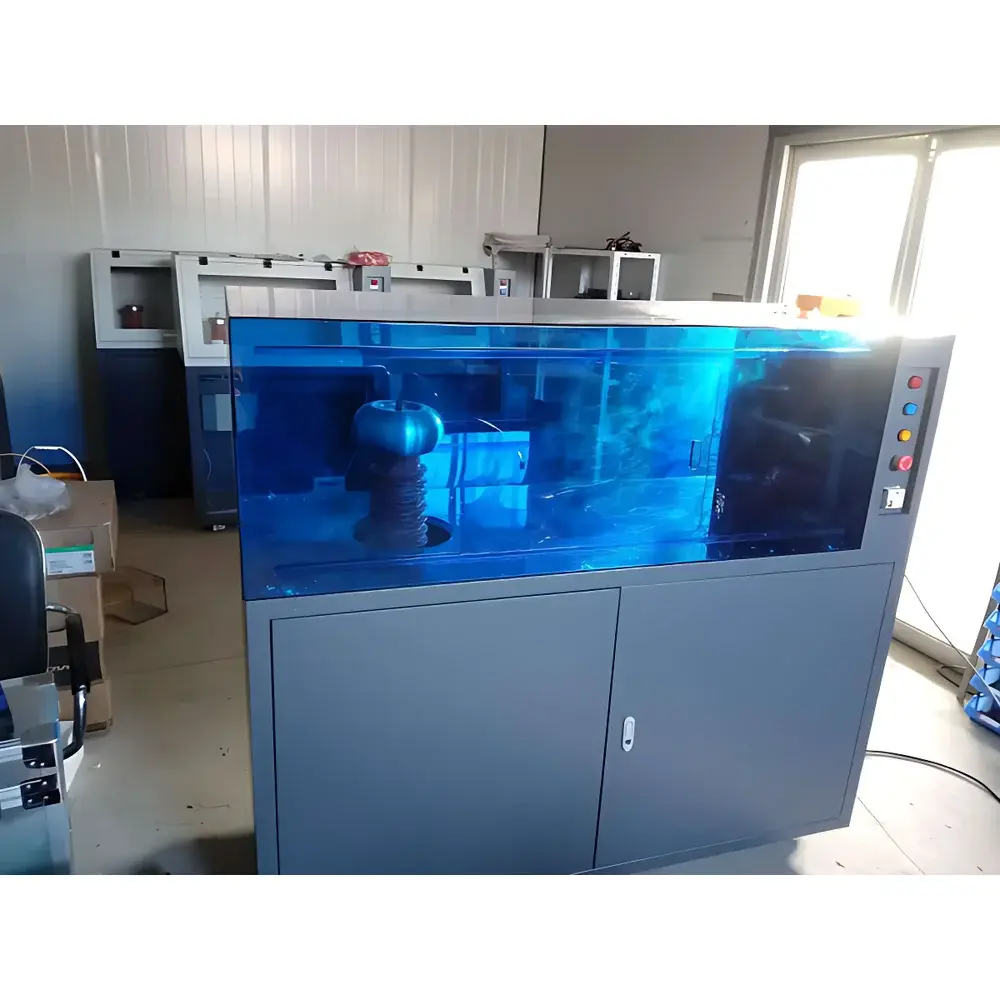
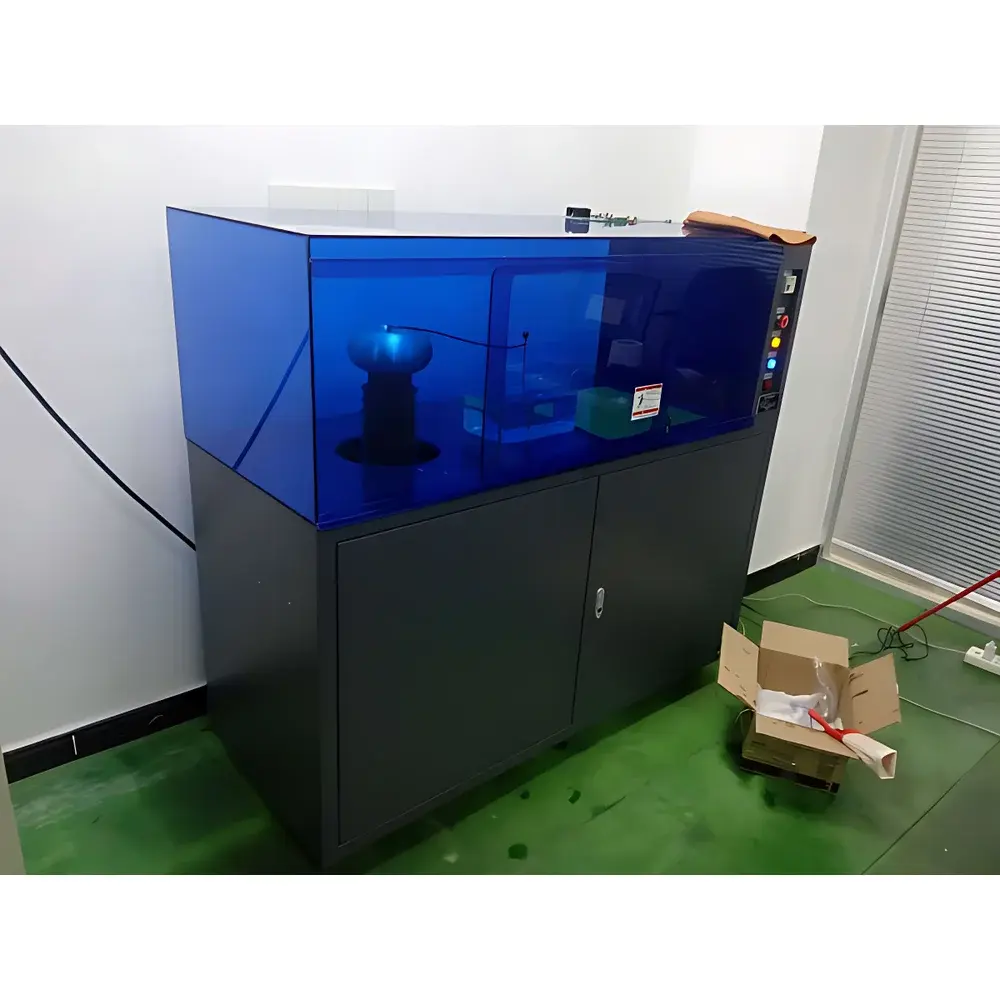
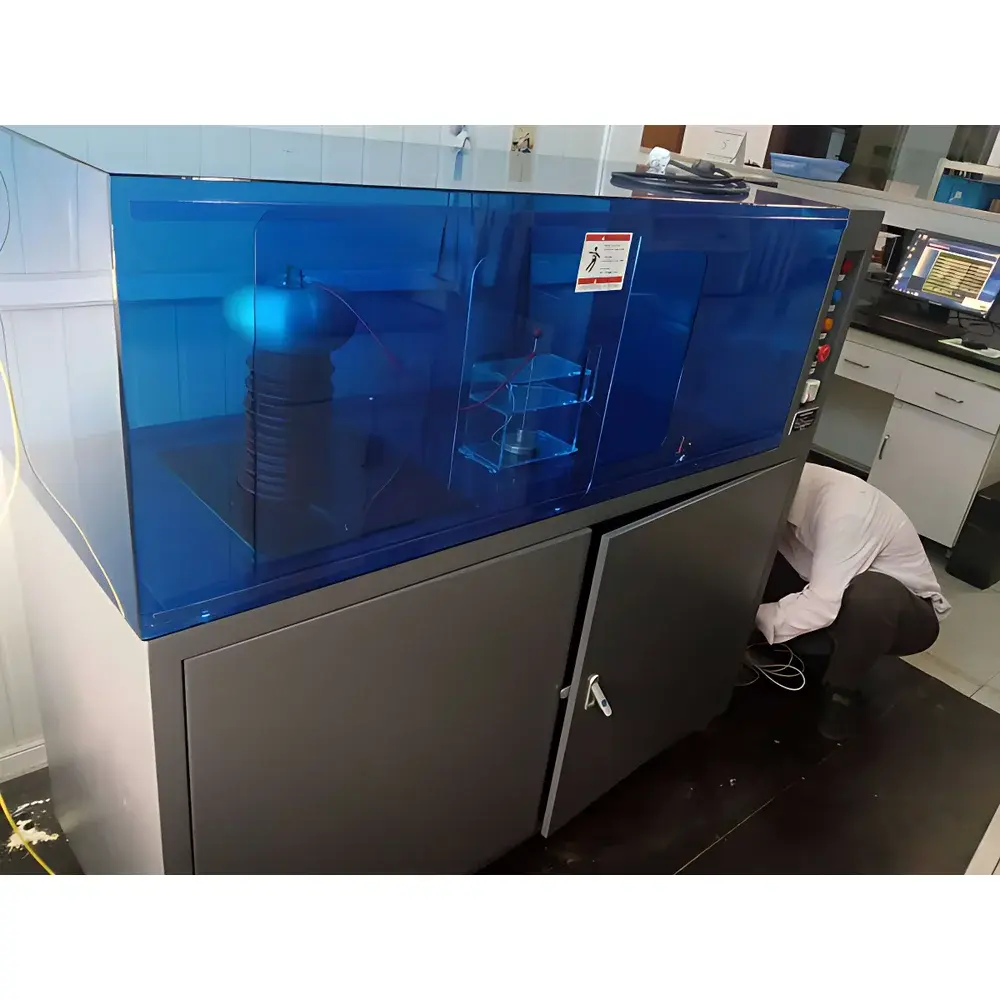
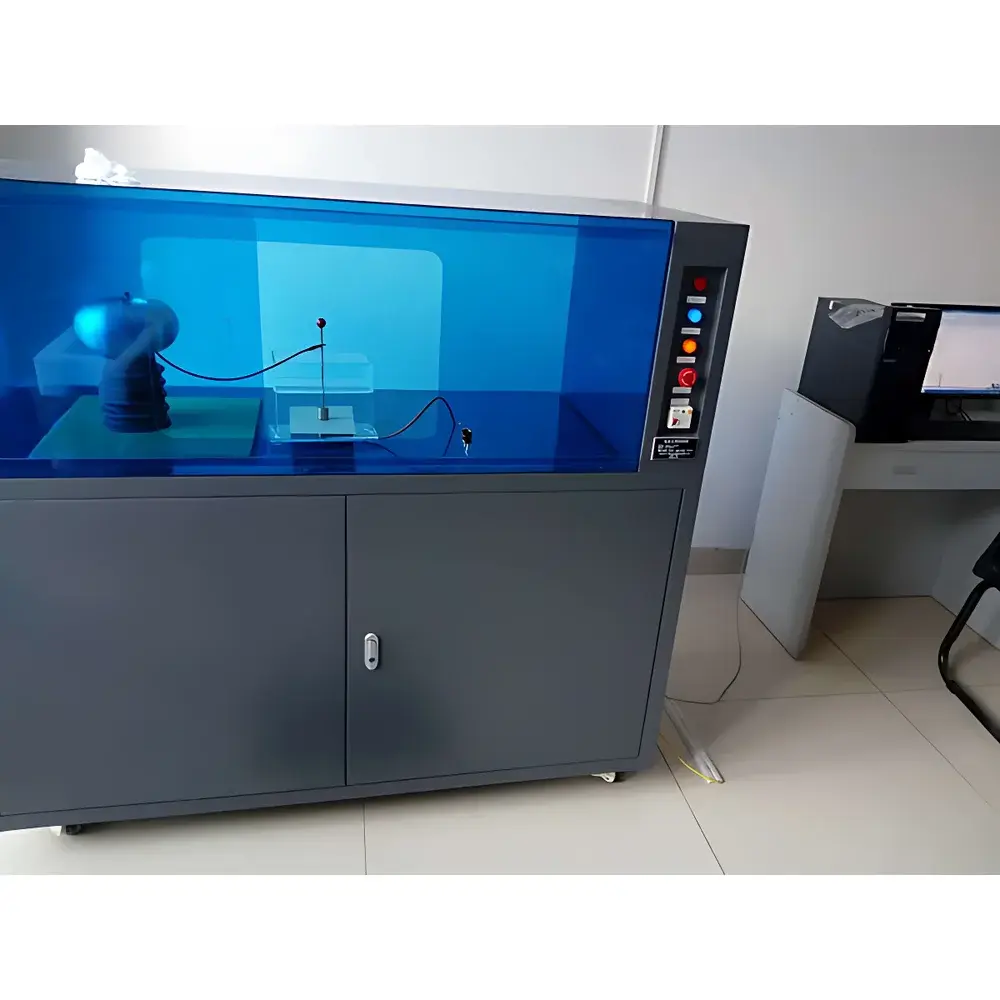
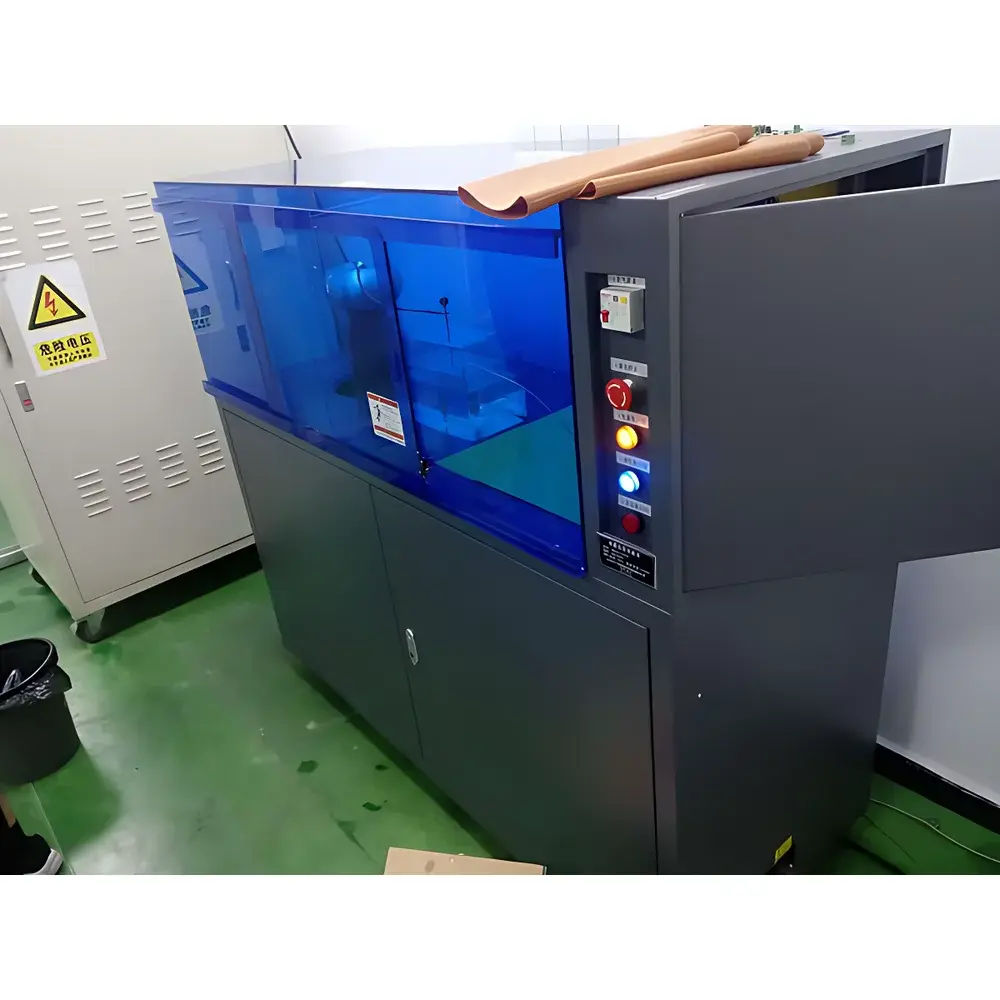
North Guangjing Precision BDJC-100 Voltage Breakdown Tester
| Brand | North Guangjing Precision Instrument |
|---|---|
| Origin | Beijing, China |
| Manufacturer Type | Direct Manufacturer |
| Model | BDJC-100 |
| Rated Breakdown Voltage | 100 kV AC/DC |
| Input Voltage | 220 V AC ±10%, 50 Hz ±1% |
| Output Voltage Range | 0–100 kV AC/DC |
| Power Rating | 10 kVA |
| Voltage Ramp Rate | 0.1–5 kV/s (adjustable) |
| Test Modes | Continuous ramp-up, stepwise ramp-up, withstand voltage test |
| Test Media | Air or insulating oil |
| Voltage Measurement Accuracy | ≤2% |
| Withstand Time Range | 0–7 h (software-controlled) |
| Leakage Current Threshold | 0–100 mA |
| Sample Types | Solid and liquid dielectric materials |
| Control Interface | Bluetooth wireless control (human-machine separation) |
| Communication Ports | RS-232, USB, regional Ethernet port |
| Breakdown Detection Criteria | Dual-criteria — voltage threshold + leakage current threshold |
| Safety Features | Arc suppression & automatic pressure release, integrated fuse and RCD protection, bidirectional EMI/RFI suppression, leakage guard mesh |
| Compliance Standards | GB/T 1408.1–2006, GB/T 1695–2005, GB/T 3333, HG/T 3330, GB 12656, ASTM D149 |
| Software Platform | Windows-based GUI with real-time curve plotting, Excel export, customizable report templates, user role management, audit-trail-enabled parameter logging, self-diagnostic and pre-alarm functions |
| Calibration | Traceable to China National Institute of Metrology (CNIM) |
Overview
The North Guangjing Precision BDJC-100 Voltage Breakdown Tester is an industrial-grade dielectric strength testing system engineered for precise determination of electrical breakdown voltage and dielectric withstand performance of solid and liquid insulating materials under AC (48–62 Hz) or DC stress conditions. Operating on the fundamental principle of controlled voltage escalation until disruptive discharge occurs—either via avalanche ionization in gases or conduction path formation in solids—the instrument delivers repeatable, metrologically traceable results essential for quality assurance in electrical insulation manufacturing, R&D laboratories, and third-party certification facilities. Its dual-mode architecture supports both continuous ramp-up (for breakdown strength evaluation per ASTM D149 and GB/T 1408.1) and fixed-voltage hold (for time-dependent withstand validation per IEC 60243-1), enabling full compliance with international standard test protocols across power transmission, cable, transformer, and electronic component industries.
Key Features
- True dual-media capability: Validated operation in ambient air and standardized insulating oils (e.g., ASTM D877-compliant mineral oil), supporting comparative analysis of surface vs. bulk dielectric behavior.
- High-fidelity voltage regulation: Solid-state, contactless step-up transformer with microprocessor-driven PWM control ensures linear, jitter-free ramp profiles from 0.1 to 5 kV/s—critical for eliminating transient overshoot and ensuring reproducible breakdown onset detection.
- Dual-criterion breakdown recognition: Simultaneous monitoring of applied voltage and leakage current enables unambiguous event classification—rejecting false positives caused by surface flashover, corona discharge, or transient coupling noise.
- Hardware-enforced safety architecture: Integrated arc-quenching circuitry, dynamic pressure-release valve, Class II double-insulated HV enclosure, and redundant overcurrent protection (fast-blow fuse + electronic RCD) conform to EN 61010-1 requirements for laboratory high-voltage equipment.
- Wireless operational separation: Bluetooth 5.0–enabled remote control allows operator positioning beyond arc-flash boundary distances (per IEEE 1584), reducing occupational exposure without compromising real-time supervision or intervention capability.
- Bidirectional EMI suppression: Active filtering on both HV output and signal acquisition paths minimizes electromagnetic interference during breakdown events—preserving integrity of analog-to-digital conversion and preventing port-level damage during high-dI/dt transients.
Sample Compatibility & Compliance
The BDJC-100 accommodates standardized specimens per multiple national and international standards—including cylindrical rods (GB/T 1695), thin films (ASTM D149 Type I), laminated sheets (IEC 60243-2), and liquid cells (GB/T 507). Its electrode configuration (25 mm spherical or 25 mm flat brass electrodes per GB/T 1408.1 Annex A) is mechanically adjustable to meet thickness-specific gap requirements. All test sequences are fully configurable to enforce standard-mandated dwell times, voltage rise rates, and environmental conditioning intervals. The system’s firmware and software logs maintain complete digital audit trails—including operator ID, timestamped parameter sets, raw voltage/current waveforms, and final pass/fail determinations—supporting GLP/GMP-aligned documentation and FDA 21 CFR Part 11 readiness when deployed with optional electronic signature modules.
Software & Data Management
Running on a native Windows 10/11 platform, the BDJC-100’s C++-based control suite provides deterministic real-time data acquisition at ≥10 kHz sampling rate. Dynamic oscillographic display visualizes voltage, current, and dV/dt simultaneously during test execution. Post-test analysis includes automatic peak detection, statistical summary (mean, SD, CV%), and Weibull distribution fitting for batch reliability assessment. Export functionality supports CSV, XML, and native Excel (.xlsx) formats with embedded metadata (standard ID, sample ID, test date, operator, ambient T/RH). Role-based access control enforces ISO/IEC 17025–compliant workflow segregation—administrators configure method templates, technicians execute tests, and QA reviewers approve reports—all within a single validated environment. Remote diagnostic ports allow secure technician-assisted troubleshooting without physical site access.
Applications
- Qualification testing of polymer insulators (EPDM, silicone rubber, polyethylene) used in overhead line hardware and bushings.
- Batch verification of transformer oil dielectric integrity prior to commissioning.
- R&D evaluation of nanocomposite dielectrics for next-generation capacitors and printed electronics.
- Failure analysis of aged cable insulation exhibiting water treeing or oxidation-induced embrittlement.
- Regulatory submission support for UL, CE, and CCC certification of consumer appliance internal wiring and PCB substrates.
- Teaching labs requiring safe, repeatable demonstration of Paschen’s law and Townsend discharge mechanisms.
FAQ
Does the BDJC-100 comply with ASTM D149 and GB/T 1408.1 for reporting dielectric strength in kV/mm?
Yes—its calibrated voltage divider, temperature-compensated current sensing, and standardized electrode geometry satisfy all metrological prerequisites for calculating dielectric strength per both standards.
Can the system perform step-stress testing with programmable hold durations at intermediate voltages?
Yes—up to 10 user-defined voltage steps with independent dwell times (1 s to 7 h) and auto-proceed logic are supported in gradient mode.
Is calibration traceability provided with delivery?
Each unit ships with a CNIM-issued calibration certificate covering HV output, leakage current measurement, and timing accuracy—valid for 12 months under normal operating conditions.
What safety certifications does the instrument carry?
It meets EN 61010-1:2010 for electrical safety and EN 61326-1:2013 for EMC; CE marking is affixed following EU Declaration of Conformity.
Can test data be integrated into LIMS or ERP systems?
Yes—via configurable ODBC drivers and RESTful API endpoints supporting JSON/XML payloads for automated ingestion into enterprise data infrastructure.



