
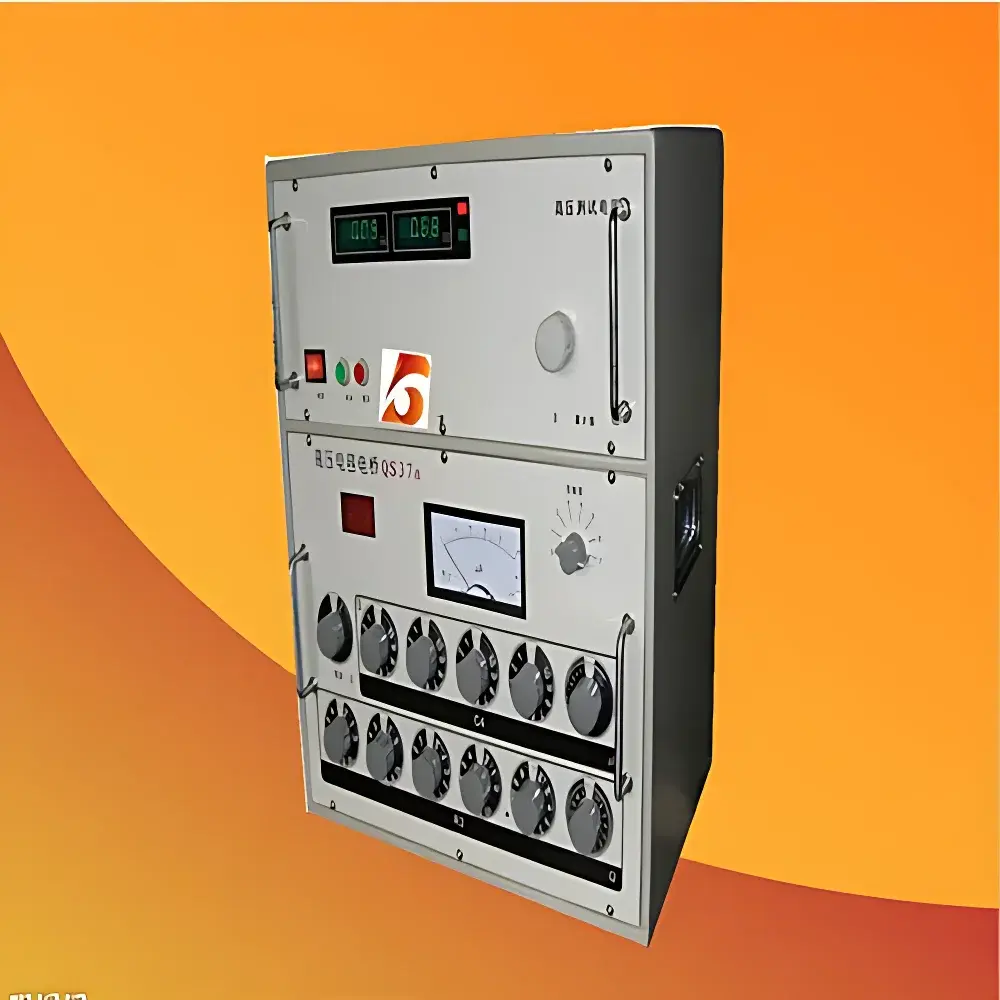
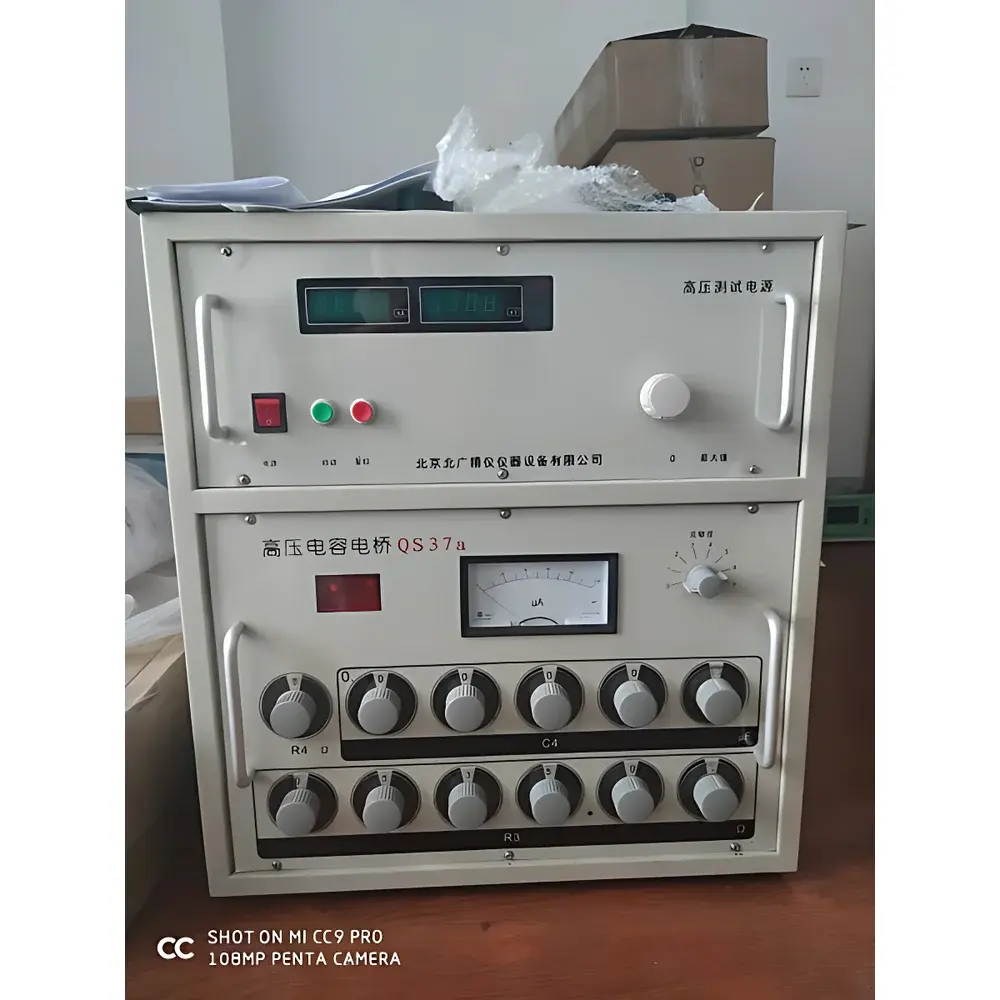
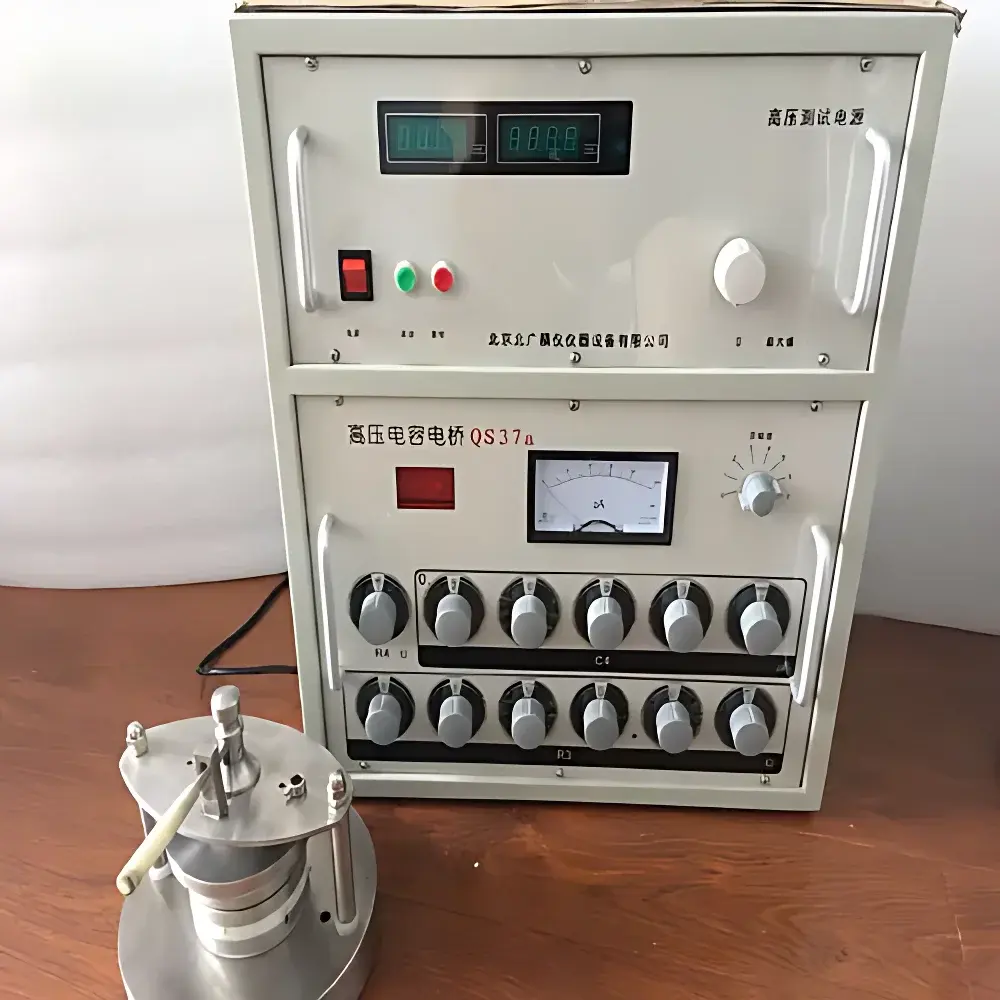
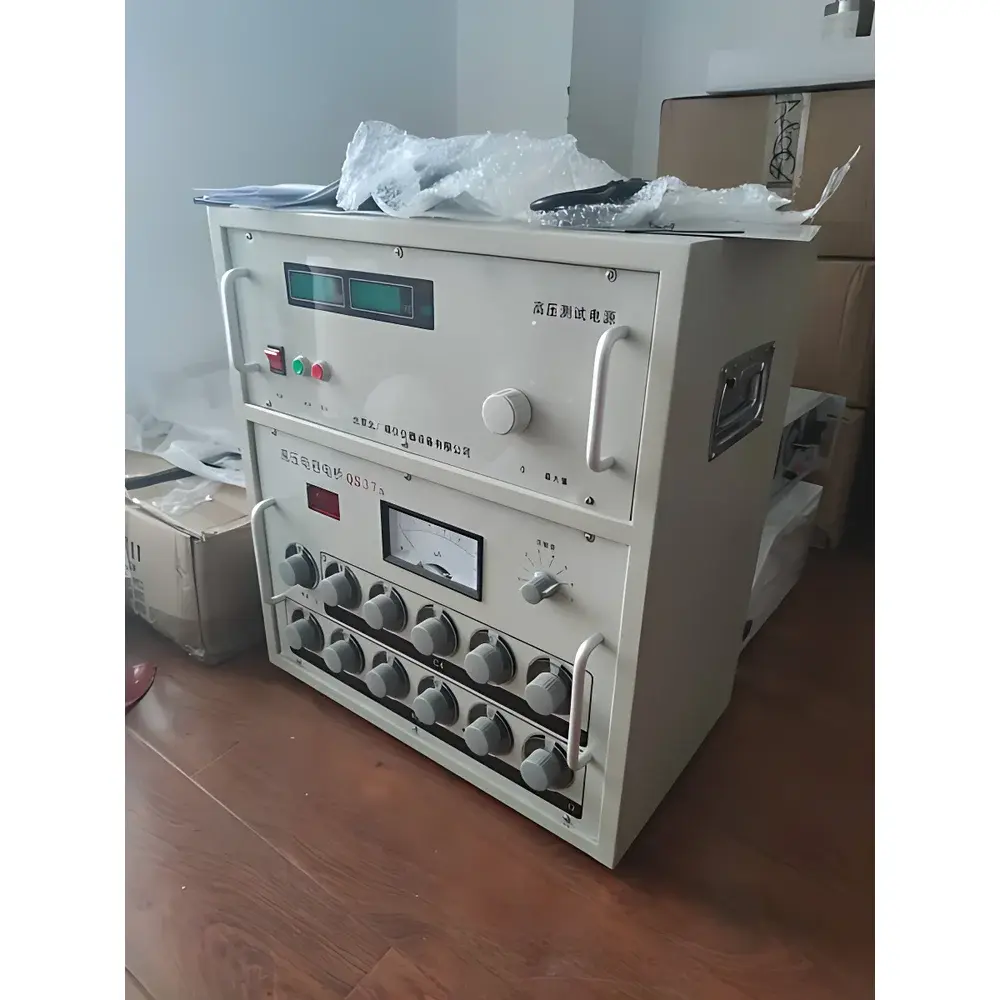
Beiguang BQS-37A High-Voltage Schering Bridge
| Brand | Beiguang Precision Instrument |
|---|---|
| Origin | Beijing, China |
| Manufacturer Type | Manufacturer |
| Country of Origin | China |
| Model | BQS-37A |
| Price | USD 3,500 (FOB Beijing) |
Overview
The Beiguang BQS-37A High-Voltage Schering Bridge is a precision AC impedance measuring instrument engineered for the accurate determination of dielectric constant (εr) and dissipation factor (tan δ) of solid insulating materials under high-voltage AC excitation. Based on the classical Schering bridge topology—optimized for 50 Hz power-frequency operation—the system employs a balanced four-arm configuration with a built-in 0–2500 V digitally displayed high-voltage source, a 100 pF internal standard capacitor, and provision for external standard capacitor integration. Designed in strict compliance with GB 1409, GB 5654, GB/T 1693, and ASTM D150–1998 (reapproved 2004), it supports standardized testing of electrical insulation performance in accordance with international quality assurance frameworks including IEC 60250 and ISO/IEC 17025-accredited laboratories. The bridge operates under controlled environmental conditions (20 ± 5 °C, 30–80 % RH) to ensure metrological traceability and repeatability in routine QC and R&D environments.
Key Features
- Classical Schering bridge architecture with dual-range measurement capability: Cx = 4–2000 pF (R4 = 318.3 Ω) and 40–20,000 pF (R4 = 3183.2 Ω), both with ±0.5% Cx ±2/3 pF accuracy
- Dissipation factor resolution down to ±1.5% tan δ ±0.0001 across full 0–1 range, validated at 50 Hz sinusoidal excitation
- Integrated high-voltage source (0–2500 V DC/AC, adjustable ramp rate) with overvoltage protection; maximum A/B-to-V potential ≤11 V RMS
- Four-decade resistance arm (10 × [1 kΩ + 100 Ω + 10 Ω + 1 Ω + 0.1 Ω]) and capacitance arm (10 × [0.1 + 0.01 + 0.001 + 0.0001] µF + 100 pF variable) for fine null adjustment
- Null detector with voltage sensitivity ≥1 × 10⁻⁶ V/div and current sensitivity ≥2 × 10⁻⁹ A/div at 50 Hz; harmonic suppression >25 dB (2nd) and >50 dB (3rd)
- Fixed R4 configuration (10 kΩ/π or 1 kΩ/π) enabling direct tan δ readout without post-calculation
- Frequency correction algorithm included for non-50 Hz operation: tan δactual = (f′/f) × tan δmeasured
Sample Compatibility & Compliance
The BQS-37A accommodates solid dielectric specimens—including epoxy resins, transformer oils (when used with compatible test cells), polymeric films, ceramic substrates, and molded insulators—mounted in standardized electrode configurations per ASTM D150 Annex A1. Sample geometry must conform to parallel-plate or guarded-electrode arrangements with minimum thickness ≥0.5 mm and surface area ≥25 cm² to minimize fringing field errors. All measurements adhere to GLP-compliant documentation requirements: raw balance settings (R3, C4), applied voltage, ambient temperature/humidity, and operator ID are manually recorded per test. The instrument satisfies electromagnetic compatibility (EMC) criteria per GB/T 18268.1 and safety requirements per GB 4793.1 (equivalent to IEC 61010-1), including mandatory grounding verification, interlocked high-voltage enclosure protocols, and stepwise voltage ramping to prevent dielectric breakdown during conditioning.
Software & Data Management
While the BQS-37A is an analog-nulling bridge requiring manual balancing, its design supports full auditability for regulated environments. Each test record includes: measured R3 (Ω), C4 (pF), applied voltage (V), frequency (Hz), ambient T/RH, and calculated Cx and tan δ using the standardized formulas Cx = R4·Cn/R3 and tan δ = ω·R4·C4. Laboratories implementing 21 CFR Part 11 compliance may integrate manual entries into LIMS via structured CSV templates. Calibration certificates (traceable to NIM, China) are provided annually, covering standard capacitor stability (<±0.02% per year), HV source linearity (±0.3% full scale), and null detector drift (<5 × 10⁻⁷ V/h). Full maintenance logs—including resistor/capacitor arm verification and grounding resistance checks (<10 Ω)—are retained for GMP audits.
Applications
- Quality control of insulating varnishes, impregnating resins, and laminated pressboards in transformer manufacturing
- Research-grade characterization of high-k dielectrics for semiconductor packaging substrates
- Evaluation of aging effects in cable insulation polymers (XLPE, EPR) under thermal/electrical stress
- Validation of dielectric homogeneity in ceramic capacitors and RF substrate materials
- Compliance testing per IEC 60674-2 for electrical insulating sheets and films
- Supporting failure analysis in high-voltage equipment where partial discharge inception correlates with tan δ elevation
FAQ
What is the maximum recommended test voltage for routine operation?
The bridge’s internal high-voltage circuitry is rated for continuous operation up to 2500 V peak. However, the A/B-to-V terminal voltage must not exceed 11 V RMS during null detection to preserve bridge arm integrity.
Can external standard capacitors be used—and what tolerance is required?
Yes, the BQS-37A includes dedicated terminals for external Cn integration. Certified Class 0.05 or better (e.g., IET Labs 100 pF Standard) is required to maintain stated accuracy; calibration certificates must be current and NIST-traceable.
How does temperature affect measurement validity?
Measurements are specified only within 20 ± 5 °C. For materials with strong thermo-dielectric response (e.g., PET, PEEK), tests must be conducted in temperature-stabilized chambers; results outside this range require empirical correction per ASTM D150 Section 10.
Is the instrument suitable for liquid dielectric testing?
Only when paired with a compliant ASTM D924-compliant test cell (e.g., spherical electrode assembly). Direct immersion of the bridge body is prohibited; all liquid handling must occur externally with proper shielding and grounding.
What maintenance intervals are recommended for GLP compliance?
Annual full calibration by an ISO/IEC 17025-accredited lab is mandatory. Quarterly functional checks—including null detector sensitivity verification, HV source ripple measurement (<2%), and grounding resistance validation—must be documented in the instrument logbook.



