
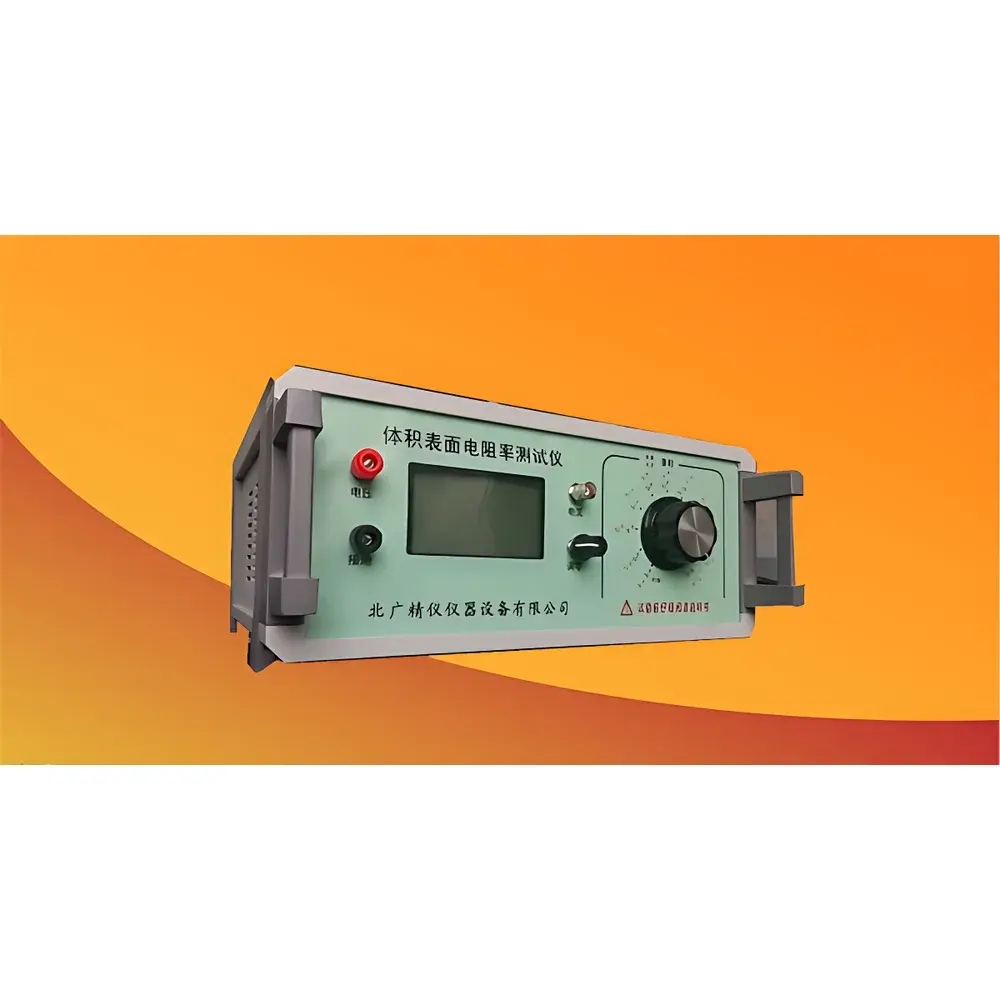
North Guang Precision Instruments BE ST-121 Volume and Surface Resistivity Tester for Vulcanized Rubber
| Brand | North Guang Precision Instruments (All Precision Instrument) |
|---|---|
| Origin | Beijing, China |
| Manufacturer Type | Direct Manufacturer |
| Product Category | Domestic |
| Model | BE ST-121 |
| Price | USD 2,800 (FOB Beijing) |
| Test Voltage Range | DC 10 V, 50 V, 100 V, 250 V, 500 V, 1000 V |
| Resistance Measurement Range | 1×10⁴ Ω to 1×10¹⁸ Ω |
| Current Measurement Range | 2×10⁻⁴ A to 1×10⁻¹⁶ A |
| Input Impedance | >10¹⁵ Ω |
| Power Supply | AC 220 V ±10%, 50 Hz |
| Operating Temperature | 0–40 °C |
| Relative Humidity | ≤70% RH |
| Continuous Operation Time | 8 h |
| Power Consumption | ~10 W |
| Dimensions (L×W×D) | 355 mm × 320 mm × 145 mm |
| Net Weight | ~6 kg |
Overview
The North Guang Precision Instruments BE ST-121 Volume and Surface Resistivity Tester is a precision electrometric instrument engineered for the quantitative characterization of electrical insulation performance in vulcanized rubber and other solid dielectric materials. It operates on the fundamental principle of Ohm’s Law (R = V/I), employing a dual-sensing architecture that simultaneously measures applied DC test voltage and resulting leakage current across the specimen. Unlike conventional analog high-resistance meters—whose nonlinear scale and sensitivity to supply fluctuations limit accuracy—the BE ST-121 utilizes a high-input-impedance (>10¹⁵ Ω) DC amplifier coupled with integrated digital signal processing to compute resistance in real time via A/D conversion. This architecture ensures linear, drift-free digital readout across its full measurement range (1×10⁴ Ω to 1×10¹⁸ Ω), independent of minor variations in source voltage or electrode polarization. The instrument is explicitly designed to meet the metrological rigor required by international standards governing insulating material qualification, including ASTM D257, IEC 60093, and ISO 3915, while remaining fully compliant with China’s national standard GB/T 1692–2008 for vulcanized rubber resistivity testing.
Key Features
- Simultaneous digital display of both applied test voltage and measured current—eliminating manual scaling and reducing operator error.
- Six selectable DC test voltages (10 V, 50 V, 100 V, 250 V, 500 V, 1000 V) to accommodate diverse material conductivity classes and regulatory test protocols.
- True high-impedance input stage (>10¹⁵ Ω) minimizing loading effects and ensuring fidelity in ultra-high-resistance measurements.
- Integrated guard terminal (G-terminal) and three-electrode configuration support for volume resistivity testing per ASTM D257 Annex A2 and GB/T 1410–2006, effectively eliminating surface leakage contributions.
- Stable thermal design enabling continuous 8-hour operation at ambient temperatures up to 40 °C and relative humidity ≤70 % RH.
- Compact benchtop form factor (355 × 320 × 145 mm) with lightweight aluminum chassis (~6 kg), optimized for QC laboratories and R&D environments with space constraints.
Sample Compatibility & Compliance
The BE ST-121 is validated for use with vulcanized rubber compounds, elastomeric composites, antistatic polymers, conductive fillers, and other non-metallic insulators conforming to GB/T 1692–2008, GB/T 1410–2006, and GB 12014 (ESD workwear). Its guard-enabled three-electrode setup supports standardized sample geometries per ASTM D257 and IEC 60093—including disk-shaped specimens (typically 100 mm diameter × 2–4 mm thickness) and rectangular slabs with defined electrode spacing. The system satisfies critical requirements for GLP-compliant electrical safety testing, including traceable calibration paths, stable zero-drift performance, and documented uncertainty budgets. All electrical safety circuits adhere to IEC 61010-1:2010 Class II protection principles; high-voltage outputs are internally current-limited and interlocked to prevent accidental exposure during operation.
Software & Data Management
While the BE ST-121 operates as a standalone bench instrument with direct digital readout, its analog output (0–1 V proportional to log₁₀(R)) and RS-232 interface enable integration into automated test stations. When paired with optional PC-based acquisition software (sold separately), users can log time-stamped resistance values, generate compliance reports aligned with GB/T 22042–2008 (footwear ESD testing) or GB/T 26825–2011 (antistatic corrosion-resistant coatings), and export CSV-formatted datasets for statistical process control (SPC) analysis. Audit trails—including operator ID, test voltage selection, timestamp, and environmental metadata—can be embedded for FDA 21 CFR Part 11–aligned workflows when deployed in regulated manufacturing environments.
Applications
- Quality control of automotive and aerospace-grade vulcanized rubber seals, gaskets, and bushings per GB/T 1692–2008 and SAE J2238.
- Verification of antistatic properties in cleanroom flooring, ESD-safe footwear (GB 4385–1995), and conductive conveyor belts (GB/T 18044–2008).
- Resistivity mapping of carbon-black–filled rubber compounds during formulation development.
- Failure analysis of insulation breakdown in high-voltage cable jackets and transformer bushings.
- Validation of electrostatic dissipation (ESD) performance in polymer-based medical device housings per IEC 61340-5-1.
- Research on humidity-dependent conduction mechanisms in hydrophilic elastomers using controlled environmental chambers.
FAQ
What standards does the BE ST-121 comply with for vulcanized rubber testing?
It fully supports GB/T 1692–2008, GB/T 1410–2006, ASTM D257, and IEC 60093 for volume and surface resistivity determination.
Can the instrument measure both volume and surface resistivity?
Yes—using the three-electrode guard configuration for volume resistivity and two-electrode mode for surface resistivity, per standardized test methods.
Is calibration traceable to national metrology institutes?
Calibration certificates include NIM (National Institute of Metrology, China)–traceable references for voltage and current channels, with uncertainty budgets reported per ISO/IEC 17025.
How is leakage current minimized during ultra-high-resistance measurement?
Through guarded electrode geometry, PTFE-insulated cabling, and a >10¹⁵ Ω input impedance amplifier stage—ensuring measurement integrity above 10¹⁶ Ω.
Does the instrument support automated data logging?
Yes—via RS-232 or analog output; third-party SCADA and LabVIEW-compatible drivers are available upon request.




