
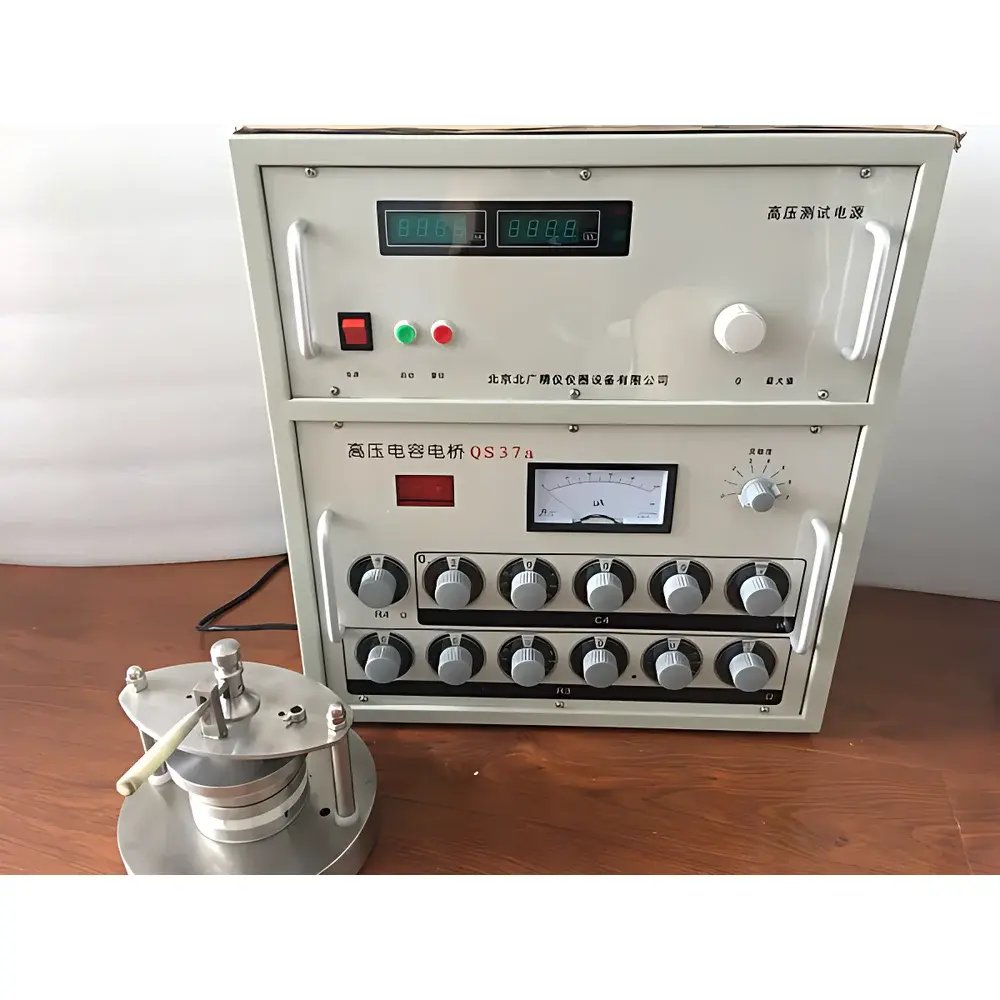
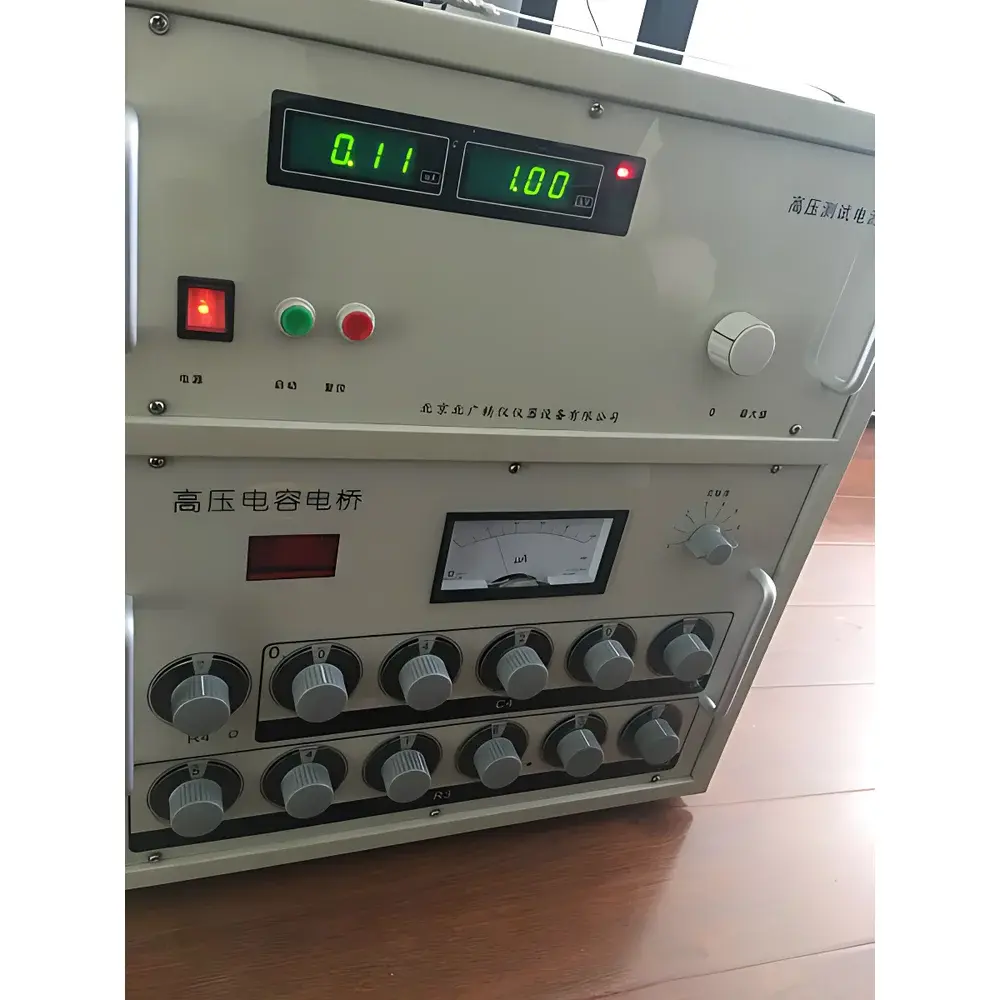
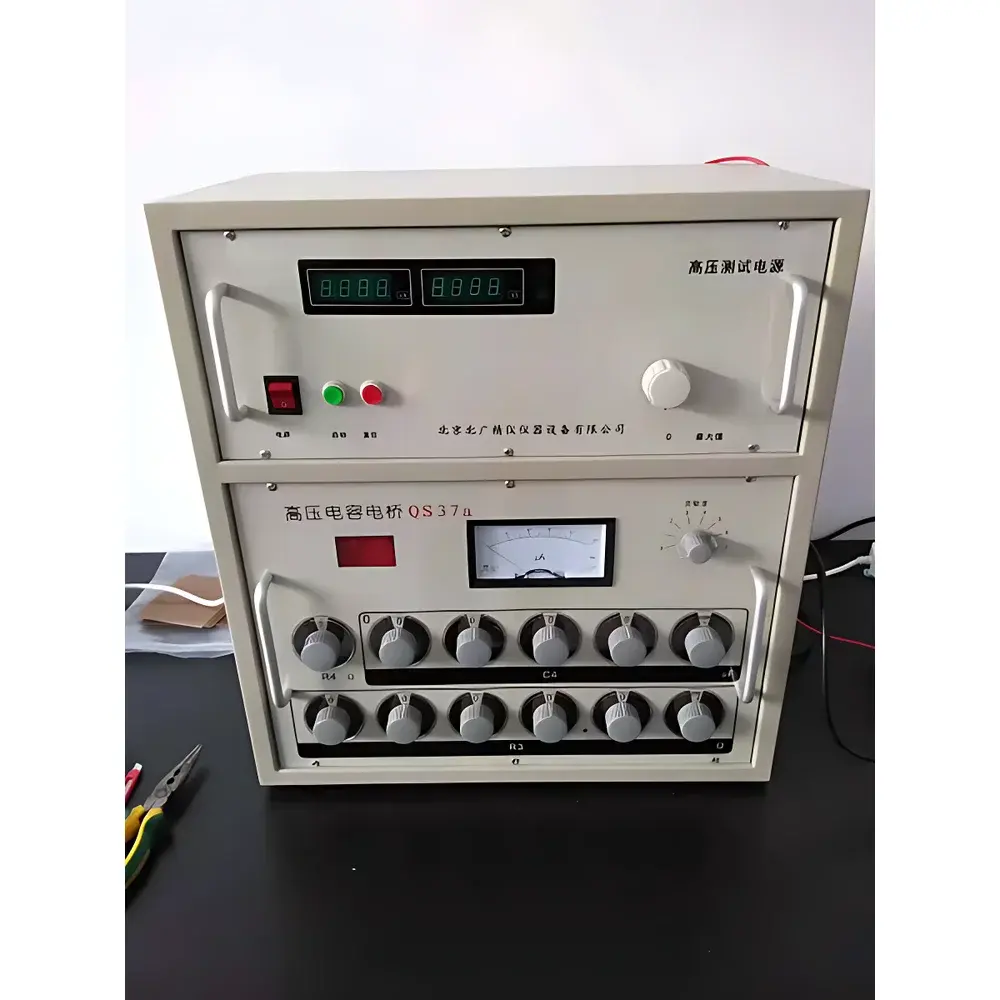
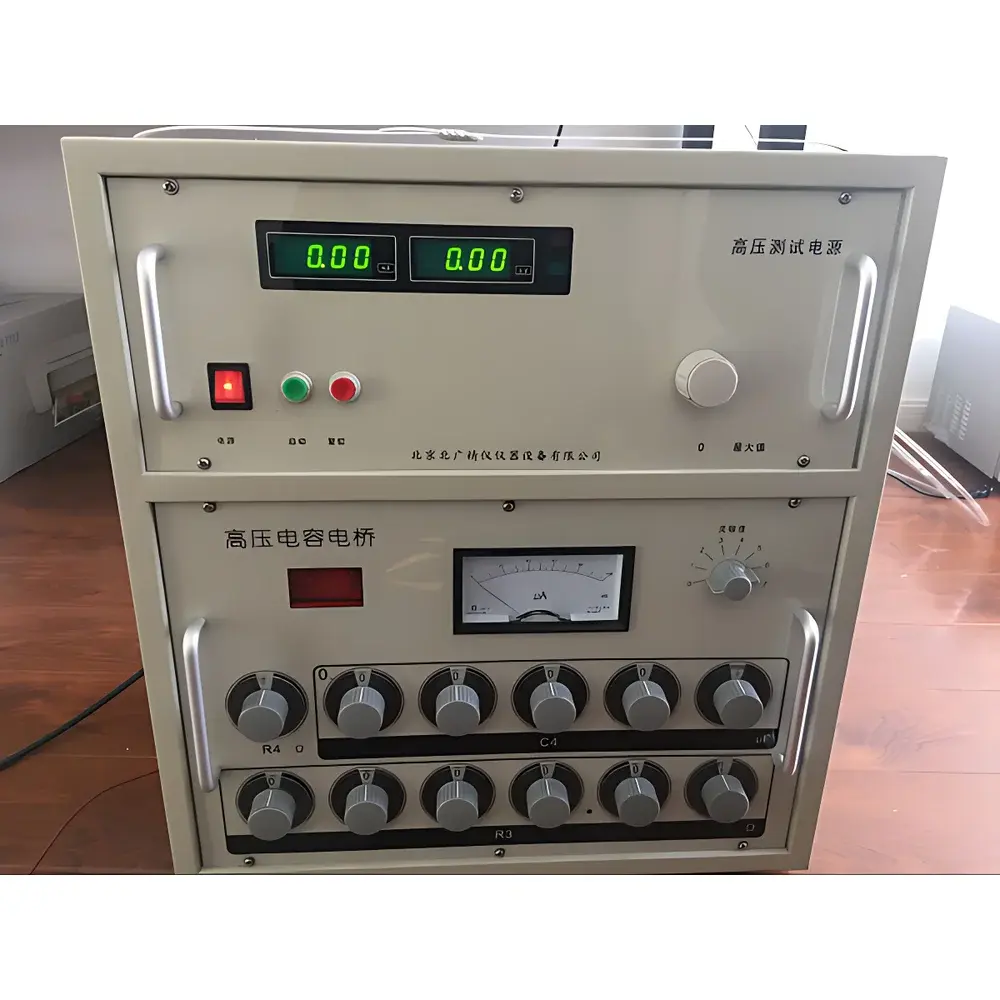
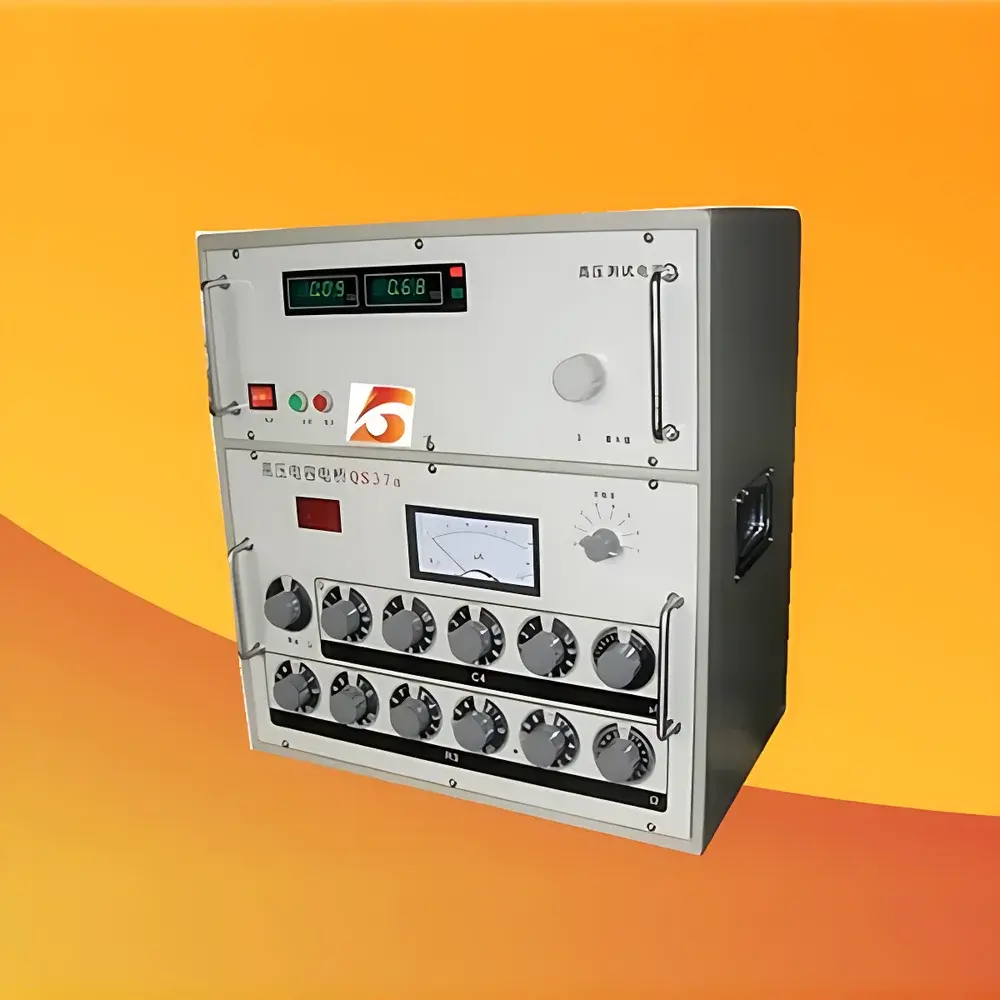
Beiguang Jingyi BQS-37a High-Voltage Schering Bridge for Dielectric Constant and Dissipation Factor Measurement of Thin-Film Insulating Materials
| Brand | Beiguang Jingyi / All Precision Instrument |
|---|---|
| Origin | Beijing, China |
| Manufacturer Type | Direct Manufacturer |
| Country of Origin | China |
| Model | BQS-37a |
| Price | USD 4,950 (FOB Beijing) |
Overview
The Beiguang Jingyi BQS-37a is a precision high-voltage Schering bridge engineered for accurate, traceable measurement of dielectric constant (εr) and dissipation factor (tan δ) in thin-film insulating materials. Based on the classical Schering bridge topology—optimized for AC impedance balance at 50 Hz—it operates under controlled laboratory conditions (20 ± 5 °C, 30–80 % RH) to deliver metrologically sound results compliant with international standards including ASTM D150-1998(2004), GB/T 1693, GB 1409, and GB 5654. The instrument employs a dual-shielded, low-noise architecture with an integrated 0–5 kV digitally displayed high-voltage source and a factory-calibrated 100 pF reference capacitor (tan δ < 5 × 10⁻⁵). Its design prioritizes long-term stability through thermally aged passive components, mechanical robustness via extended-life decade switches, and active potential tracking to suppress parasitic capacitance and ground-loop interference—critical for reliable characterization of sub-micron polymer films, ceramic coatings, and laminated dielectrics used in capacitors, printed circuit boards, and high-frequency packaging substrates.
Key Features
- Classical Schering bridge configuration with automatic auxiliary balance via electronic potential tracker, eliminating manual nulling of stray capacitance between bridge nodes (A, B, S)
- Dual electrostatic shielding (outer guard + inner driven shield) to attenuate external electromagnetic coupling and improve signal-to-noise ratio
- Integrated high-voltage source (0–5 kV, ±3 % accuracy) with real-time digital display and current-limited output per IEC 61010-1 safety requirements
- Reference capacitor: 100 pF, nominal value; loss angle ≤ 5 × 10⁻⁵, temperature-stabilized ceramic construction
- Decade resistance arm (10 × [1 kΩ + 100 Ω + 10 Ω + 1 Ω + 0.1 Ω]) and capacitance arm (10 × [0.1 µF + 0.01 µF + 0.001 µF + 0.0001 µF] + 100 pF variable) for fine resolution
- Analog galvanometer-based null detector with voltage sensitivity ≥ 1 × 10⁻⁶ V/div and current sensitivity ≥ 2 × 10⁻⁹ A/div at 50 Hz
- Harmonic rejection: ≥25 dB at 100 Hz (2nd harmonic), ≥50 dB at 150 Hz (3rd harmonic)
- Compliance with electrical safety limits: max 11 V RMS between terminals A/B and ground (V); max permissible currents per decade resistor stage specified per IEC 60065
Sample Compatibility & Compliance
The BQS-37a accommodates rigid and flexible thin-film specimens (thickness range: 10 µm – 500 µm) mounted between standardized parallel-plate electrodes (included). It supports measurements on polyimide, PET, PP, PTFE, alumina, barium titanate, and epoxy-glass laminates—provided surface contamination is minimized and electrode contact is uniform. All test procedures adhere to ASTM D150’s requirement for electrode geometry, guard ring implementation, and environmental conditioning. The system meets essential requirements of ISO/IEC 17025 for calibration traceability when used with NIST-traceable reference capacitors and certified high-voltage meters. While not inherently 21 CFR Part 11 compliant, audit-ready documentation—including raw balance readings, operator ID, date/time stamps, and ambient condition logs—can be maintained manually or via external lab information management systems (LIMS) for GLP/GMP environments.
Software & Data Management
The BQS-37a is a benchtop analog instrument with no embedded microprocessor or native digital interface. Data acquisition relies on manual recording of R3 and C4 dial positions, applied voltage, and null detector deflection. Calculations for Cx and tan δ follow standardized equations:
Cx = (R4 × Cn) / R3; tan δ = ω·R4·C4.
Frequency correction is supported per ASTM D150: tan δactual = (f′ / f) × tan δmeasured. For laboratories requiring automated reporting, third-party DAQ systems (e.g., National Instruments USB-6211 with custom LabVIEW VI) may digitize galvanometer output and voltage signals—enabling CSV export, statistical process control (SPC) charting, and integration into enterprise quality databases. Calibration certificates for the internal standard capacitor and HV source are supplied with each unit and valid for 12 months under recommended storage conditions.
Applications
- Quality control of dielectric films in capacitor manufacturing (e.g., metallized polypropylene, ceramic multilayer capacitors)
- R&D evaluation of novel polymer electrolytes for solid-state batteries
- Comparative aging studies of insulation systems under thermal/electrical stress per IEC 60270
- Validation of thin-film deposition uniformity in semiconductor packaging substrates
- Material qualification for aerospace-grade conformal coatings (MIL-STD-883, Method 3014)
- Academic research on ferroelectric hysteresis and frequency dispersion in relaxor ceramics
FAQ
What is the minimum measurable capacitance and associated uncertainty?
At R4 = 3183.2 Ω and Cn = 100 pF, the lower limit is 40 pF with combined uncertainty of ±0.5 % Cx ± 2 pF (k = 2). At R4 = 318.3 Ω, the range extends down to 4 pF (±0.5 % Cx ± 3 pF).
Can the instrument measure samples with conductive backing layers?
Yes—when used with guarded three-terminal electrodes per ASTM D150 Annex A1. Unshielded two-terminal configurations require fully insulating substrates.
Is external standard capacitance support available?
Yes—the rear panel includes dedicated terminals for external Cn units up to 1 nF, enabling extension to higher Cx ranges and improved uncertainty at elevated frequencies.
How often does the internal reference capacitor require recalibration?
Annually under continuous lab use; every 24 months if stored at 23 ± 2 °C, 50 ± 5 % RH in sealed desiccant cabinet.
Does the BQS-37a comply with CE or UKCA marking requirements?
It conforms to IEC 61010-1:2010 for measurement category CAT II 600 V and pollution degree 2. CE marking is not applied as it is sold exclusively for industrial laboratory use outside EU consumer directives.



