
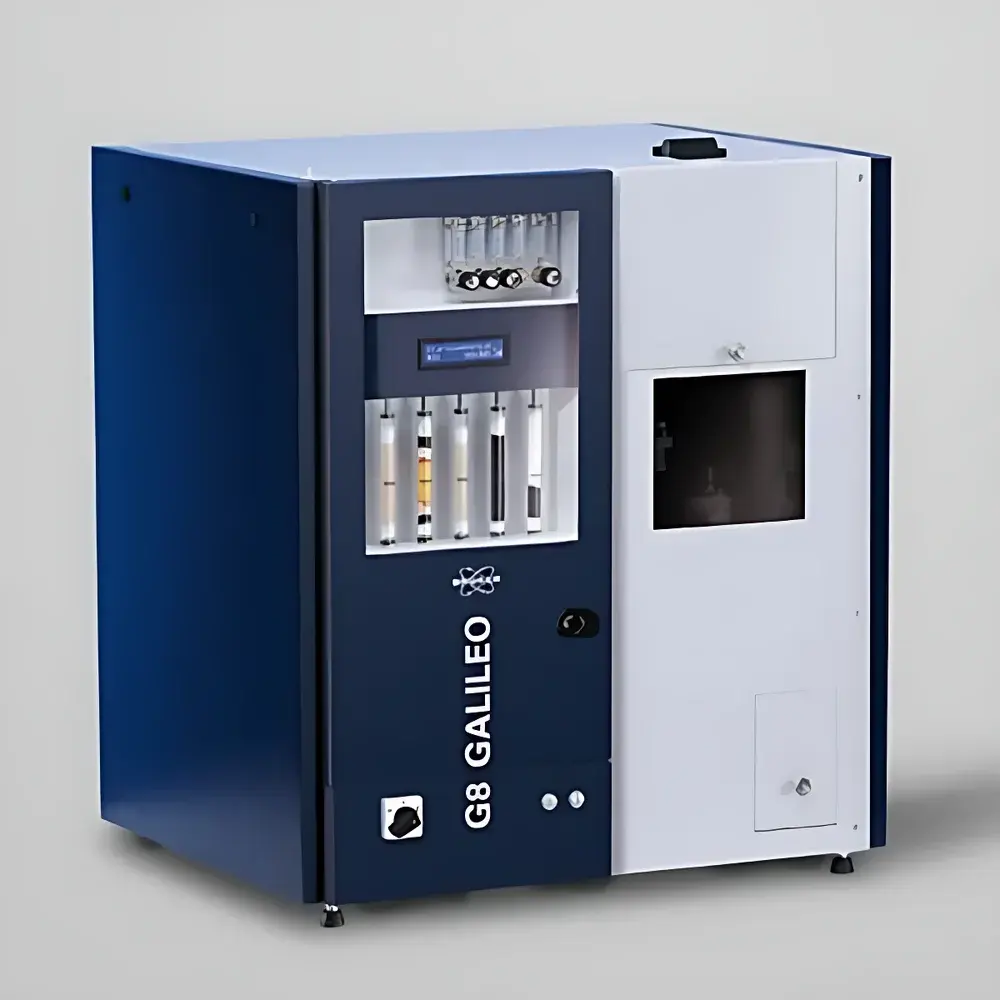
Bruker G8 GALILEO Oxygen-Nitrogen-Hydrogen Analyzer
| Brand | Bruker |
|---|---|
| Origin | Germany |
| Model | G8 GALILEO |
| Detection Principle | Inert Gas Fusion (IGF) coupled with Thermal Conductivity Detection (TCD) and Mass Spectrometry (MS) |
| Mass Range | 0–100 amu/mz |
| Detection Limits | <1 ppb (ng/g) for H, O, N (1 g sample) |
| Measurement Method | Direct gas-phase analysis via Smart Molecule Sequence™ |
| Furnace Options | Water-cooled graphite electrode furnace with FusionControl™ real-time non-contact temperature monitoring |
| Optional External IR Furnace | For diffusion hydrogen analysis per ISO 360 and AWS A4.3 |
| Compliance | Designed for GLP/GMP environments |
| Automation | Fully automated sample/crucible handling, electrode cleaning, and 10-step gas dosing calibration |
| MS Configuration | Industrial-grade quadrupole mass spectrometer optimized for H₂, N₂, O₂, Ar, and H₂O detection with reference channel stabilization |
| Particle Filtration | Integrated high-capacity dust collector + inline particulate filter |
Overview
The Bruker G8 GALILEO is a fully integrated, high-precision inert gas fusion (IGF) analyzer engineered for the quantitative determination of oxygen (O), nitrogen (N), and hydrogen (H) in metallic and ceramic materials. It operates on the principle of thermal decomposition under high-purity helium or argon atmosphere, followed by selective detection of evolved gases using dual-path detection architecture: a high-stability thermal conductivity detector (TCD) for routine O/N/H quantification and an industrial-grade quadrupole mass spectrometer (MS) for isotope-resolved, multi-gas analysis—including trace argon inclusion and hydrogen speciation (diffusible vs. residual). Unlike conventional systems relying on stoichiometric conversion or empirical correction algorithms, the G8 GALILEO implements Smart Molecule Sequence™—a proprietary direct gas measurement protocol that captures raw, unaltered emission profiles of all analyte molecules (H₂, N₂, O₂, CO, CO₂, H₂O, Ar) in real time, enabling absolute quantification without chemical derivatization or unpublished calibration models.
Key Features
- Multi-detector architecture: Simultaneous TCD and MS detection paths ensure redundancy, cross-validation, and extended dynamic range—from sub-ppb to 100 wt%—within a single analytical run.
- FusionControl™ technology: Non-contact infrared pyrometry enables continuous, closed-loop temperature monitoring of the graphite electrode furnace, preventing overheating-induced side reactions (e.g., carbide formation, oxide reduction) and ensuring reproducible melt conditions across >10,000 analyses.
- Water-cooled electrode furnace and crucible holder: Maintains thermal stability during high-power fusion (up to 3,000 °C), minimizes thermal drift, and extends component lifetime—critical for high-throughput QC labs.
- Integrated high-efficiency particulate filtration: Comprises a large-volume dust collector and inline sintered metal filter, eliminating carryover between samples and protecting downstream detectors from abrasive metal oxides and refractory residues.
- Automated operational sequence: Includes robotic sample/crucible loading, programmable electrode cleaning cycles, and fully automated 10-point gas dosing calibration—reducing operator dependency and improving inter-laboratory reproducibility.
- Optional external infrared furnace: Enables compliant diffusion hydrogen analysis per ISO 360 (weld metal) and AWS A4.3 (hydrogen collection efficiency validation), supporting failure analysis and hydrogen embrittlement mitigation in structural alloys.
Sample Compatibility & Compliance
The G8 GALILEO accommodates solid metallic samples (steels, titanium alloys, nickel superalloys, aluminum, zirconium, copper), powders (including AM feedstock), weld deposits, and ceramics—with sample mass ranging from 0.1 g to 1.5 g. Its inert gas fusion method complies with ASTM E1019, ISO 14284, DIN 51017, and JIS G 1211 standards for total O/N/H determination. When configured with the MS module, it meets ISO/IEC 17025 requirements for trace argon inclusion analysis in atomized metal powders. The system architecture supports audit-ready data management: all instrument parameters, calibration records, raw chromatograms, and detector signals are timestamped, user-logged, and stored in encrypted, immutable format—fully aligned with FDA 21 CFR Part 11 and EU Annex 11 expectations for regulated laboratories.
Software & Data Management
Control and data acquisition are managed via Bruker’s unified G8 Control Suite, a Windows-based platform featuring role-based access control, electronic signatures, and full audit trail functionality. Raw MS spectra and TCD chromatograms are stored in vendor-neutral HDF5 format, ensuring long-term readability and third-party compatibility. Quantitative results are generated using peak integration algorithms validated per ICH Q2(R2) guidelines, with uncertainty propagation calculated per ISO/IEC 17025:2017 Annex A. Optional LIMS integration (via ASTM E1578-compliant API) enables seamless transfer of certified results—including method metadata, calibration history, and QC flagging—to enterprise quality systems.
Applications
- Quality assurance of high-strength steels and aerospace alloys where hydrogen-induced cracking dictates service life.
- Trace argon quantification in additively manufactured Ti-6Al-4V and Inconel 718 powders—critical for porosity prediction and fatigue performance modeling.
- Diffusible hydrogen testing of pipeline welds per ISO 360, supporting integrity management programs in oil & gas infrastructure.
- Residual hydrogen mapping in biomedical-grade cobalt-chromium implants, where sub-ppm H levels influence corrosion resistance and biocompatibility.
- Process validation of vacuum-melted specialty steels, where oxygen content governs inclusion morphology and machinability.
- Research into hydrogen storage materials (e.g., MgH₂, complex hydrides), requiring simultaneous O/N/H speciation under controlled thermal desorption protocols (TDMS mode).
FAQ
What detection limits does the G8 GALILEO achieve for hydrogen in steel?
With a 1 g sample and MS detection, the system achieves a practical detection limit of ≤0.05 ppm (50 ng/g) for hydrogen—verified using NIST SRM 669 and certified reference materials per ISO 17034 guidelines.
Can the G8 GALILEO distinguish between diffusible and trapped hydrogen?
Yes—when paired with the optional external infrared furnace and programmed thermal desorption ramp, it delivers time-resolved H₂ evolution profiles enabling kinetic deconvolution of hydrogen binding states per ASTM F3049 Annex A.
Is the system compliant with pharmaceutical or medical device regulatory requirements?
The hardware and software architecture support 21 CFR Part 11 compliance when deployed with validated IQ/OQ/PQ documentation packages and configured with appropriate network security controls.
How is calibration traceability maintained across multiple instruments?
All gas calibrations use NIST-traceable standard mixtures; the 10-step automated dosing sequence ensures consistent pressure, flow, and residence time—minimizing inter-instrument bias in multi-site manufacturing networks.
Does the MS module require liquid nitrogen or other cryogenic cooling?
No—the quadrupole mass spectrometer employs a conduction-cooled detector and sealed ion source, eliminating consumables and enabling 24/7 operation in ambient laboratory environments.




