
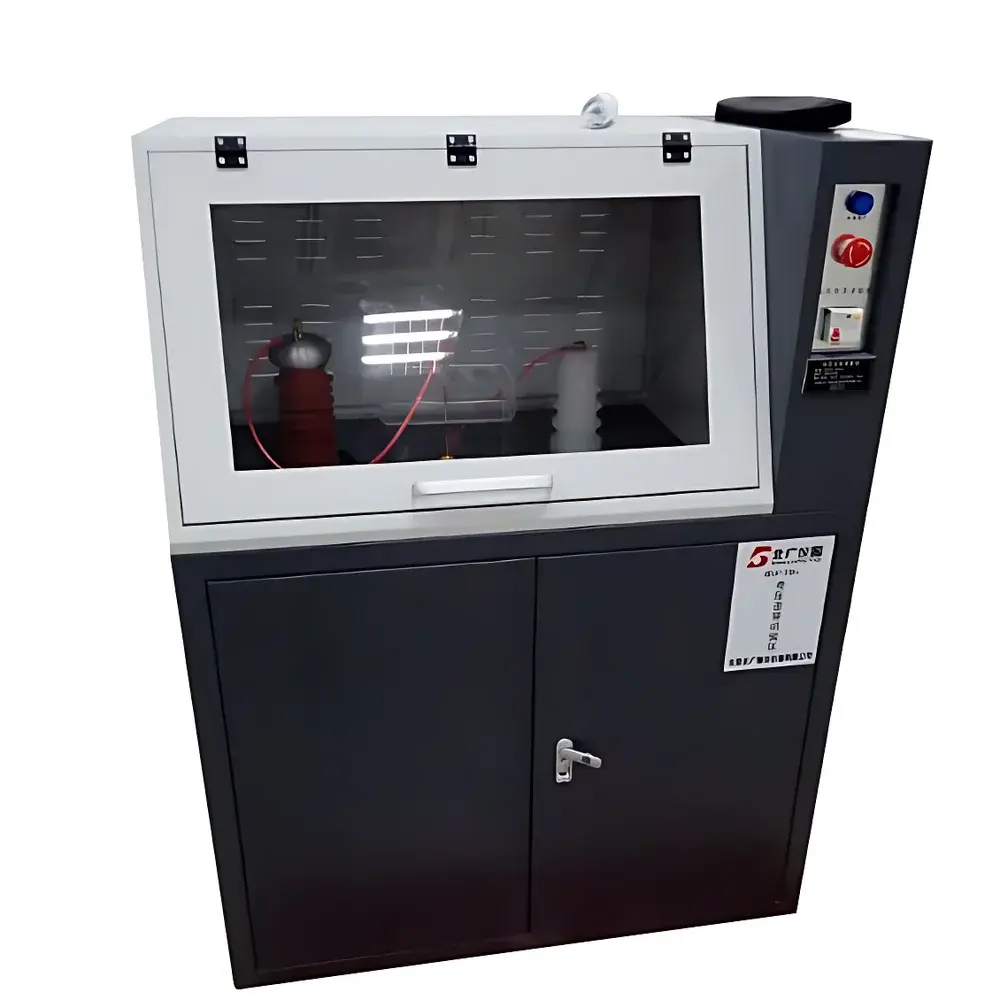
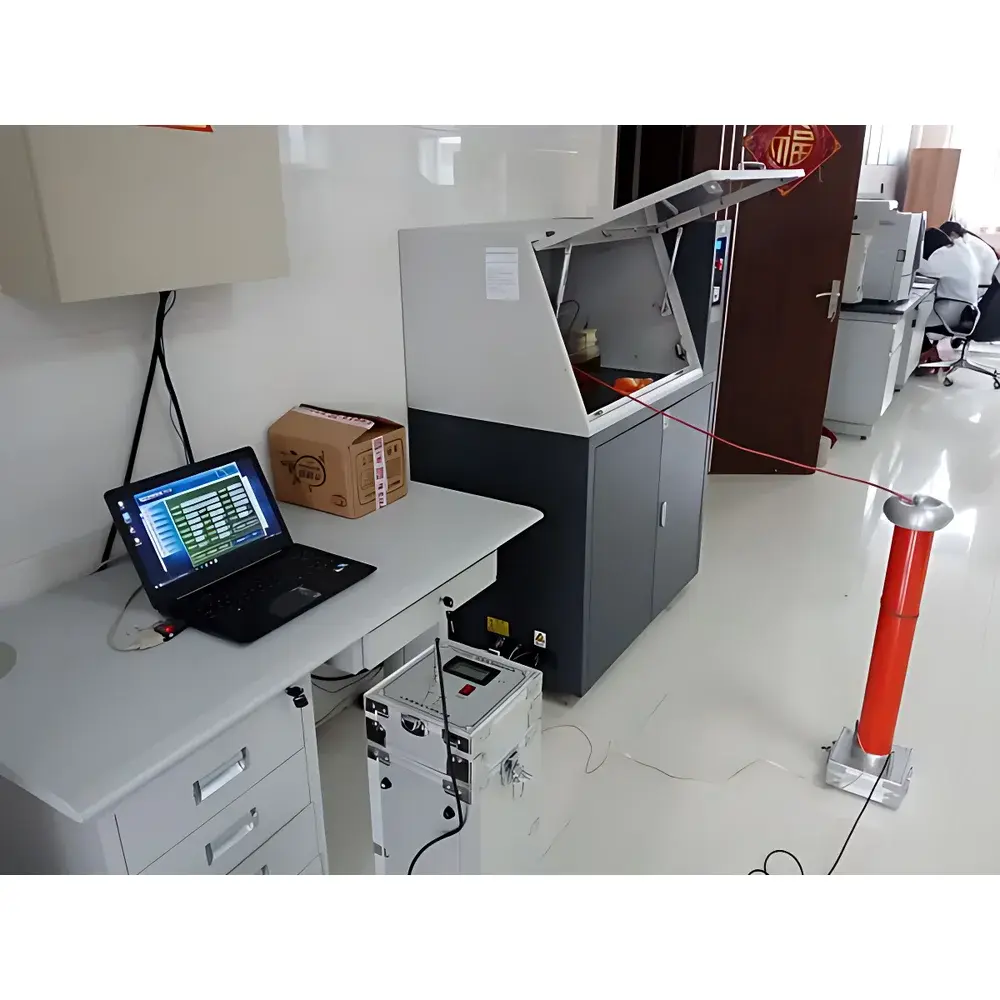
Beiguang BDJC-50KV Fluoropolymer Dielectric Breakdown Voltage Tester
| Brand | Beiguang Precision Instrument |
|---|---|
| Origin | Beijing, China |
| Manufacturer Type | OEM Manufacturer |
| Model | BDJC-50KV |
| Maximum Test Voltage | 50 kV |
| Compliance Standards | GB/T 1408.1, ASTM D149, IEC 60243-1, GB/T 1695, HG/T 3330, GB 12656 |
| Voltage Accuracy | ±1%–±5% |
| Ramp Rate Range | 0.01–3 kV/s (continuously adjustable) |
| Test Modes | AC/DC, Short-Time Breakdown, Stepwise Withstand, Gradient Ramp |
| Electrode Options | 25 mm & 75 mm brass disk electrodes (standard), optional wire & tubular electrodes |
| Transformer Capacity | 3–10 kVA |
| Safety Protection | 9-level interlock system including door interlock, zero-voltage startup, overvoltage cutoff, mechanical high-voltage limit, overcurrent trip, real-time arc detection, and exhaust ventilation |
| Dimensions (L×W×H) | 1000×600×1400 mm or 1700×600×1400 mm |
| Weight | 100–200 kg |
| Warranty | 3 years full coverage, lifetime technical support |
Overview
The Beiguang BDJC-50KV Fluoropolymer Dielectric Breakdown Voltage Tester is a precision-engineered high-voltage testing system designed for determining the dielectric strength and electrical breakdown characteristics of fluorinated polymers—including PTFE, FEP, PFA, ETFE—and other insulating materials such as elastomers, thermoplastics, ceramics, glass, varnishes, laminates, and insulating oils. Operating on the principle of controlled voltage ramping under standardized electrostatic stress conditions, the instrument applies either AC or DC voltage across a defined electrode geometry until electrical failure (i.e., dielectric breakdown) occurs. The resulting breakdown voltage—measured in kilovolts (kV)—and derived dielectric strength (kV/mm) serve as critical quality control metrics for material qualification, R&D validation, and compliance with international insulation performance specifications. Engineered for laboratory-grade reproducibility and long-term stability, the BDJC-50KV adheres strictly to test methodologies outlined in GB/T 1408.1–2006, ASTM D149–2022, and IEC 60243-1, ensuring data traceability and regulatory acceptability in ISO/IEC 17025-accredited environments.
Key Features
- High-fidelity voltage acquisition using Japan-made Matsusada high-voltage sensors (±1% accuracy) and current sensing via dual-channel Matsusada transducers for synchronized breakdown detection.
- Siemens S7-1200 PLC-based control architecture with 1 ms sampling rate and 1 ms real-time breakdown response latency—ensuring precise event capture during transient arcing.
- Optically isolated USB/RS232 interface between host PC and high-voltage controller, eliminating ground-loop interference and guaranteeing electromagnetic compatibility (EMC) in shared lab infrastructure.
- Continuously variable ramp rate (0.01–3 kV/s) with no fixed-step limitations—enabling strict adherence to standard-specified stress rates (e.g., 0.5 kV/s per ASTM D149).
- Dual termination logic: programmable voltage-triggered stop and current-threshold-triggered stop—critical for detecting partial discharge onset and pre-breakdown leakage anomalies.
- Nine-layer integrated safety architecture including interlocked access door, automatic zero-voltage reset after power interruption, software-configurable upper voltage limit, mechanical HV hard-stop, overcurrent tripping, status-indicating HV LED, thermal management via transformer ventilation ducts, and active fume extraction.
Sample Compatibility & Compliance
The BDJC-50KV accommodates solid sheet, film, rod, and molded specimens per GB/T 1408.1 requirements. Standard brass electrodes (25 mm and 75 mm diameter disks) comply with electrode geometry stipulations for flat specimens; optional wire and tubular electrodes extend applicability to coated conductors and hollow insulators. Test media include ambient air and dielectric oil (e.g., transformer oil per IEC 60296), selectable via software configuration. All operational parameters—including ramp rate, hold time, voltage polarity, and termination criteria—are configurable to satisfy method-specific protocols from ASTM D149 (short-time test), IEC 60243-1 (stepwise withstand), and GB/T 1695 (rubber vulcanizates). Full documentation supports audit readiness for GLP, GMP, and FDA 21 CFR Part 11-compliant workflows when paired with optional electronic signature and audit trail modules.
Software & Data Management
The proprietary Windows-based test software features role-based user authentication (multi-user password protection), parameter versioning, and encrypted local database storage. It enables full test method definition: AC/DC selection, breakdown vs. withstand mode, gradient step magnitude and dwell time, leakage current threshold, and voltage ramp profile. Real-time voltage–time and current–time curves are displayed and archived in CSV/PDF formats. Post-test analysis includes automatic dielectric strength calculation (kV/mm), statistical reporting across multiple samples, overlay comparison of up to five test curves, and customizable report templates compliant with ISO/IEC 17025 reporting clauses. Data export supports LIMS integration, and all raw acquisition logs retain timestamped metadata for full forensic traceability.
Applications
This system is routinely deployed in polymer R&D labs evaluating fluoropolymer formulations for aerospace wiring insulation, semiconductor process chamber linings, medical device encapsulation, and high-frequency PCB substrates. Quality assurance teams use it for incoming inspection of PTFE tapes, FEP tubing, and ETFE films per IPC-4101 or MIL-I-46146. Regulatory submission packages for UL recognition, CE marking, or FDA 510(k) clearance rely on BDJC-50KV-generated data to substantiate dielectric integrity claims. Universities and national metrology institutes—including China Academy of Metrology Sciences (CAM), China Institute of Electronics Standardization (CESI), and Southwest Institute of Physics—utilize its calibrated output for inter-laboratory round-robin studies and reference material certification.
FAQ
What standards does the BDJC-50KV fully support?
It is validated against GB/T 1408.1–2006, ASTM D149–2022, IEC 60243-1, GB/T 1695–2005, HG/T 3330, and GB 12656—with documented uncertainty budgets available upon request.
Can the system perform both AC and DC breakdown tests?
Yes—dual-mode high-voltage transformer output supports sinusoidal 50/60 Hz AC and ripple-free DC, with independent calibration certificates for each polarity.
Is third-party calibration traceable to national standards?
All units ship with factory calibration verified by China Academy of Metrology Sciences (CAM) or China National Institute of Metrology (NIM); optional on-site verification by CNAS-accredited providers (e.g., No. 514 Institute, No. 304 Institute) is available.
How is operator safety ensured during high-voltage operation?
Nine independent hardware and firmware safety layers—including door interlock, zero-voltage initialization, overvoltage cutoff, mechanical hard-stop, arc detection, and ventilated enclosure—meet IEC 61010-1 CAT III safety requirements.
What electrode configurations are included by default?
Standard delivery includes two 25 mm and one 75 mm brass disk electrodes conforming to GB/T 1408.1 Annex A; custom geometries (e.g., needle-plane, spherical) can be supplied upon specification.



