
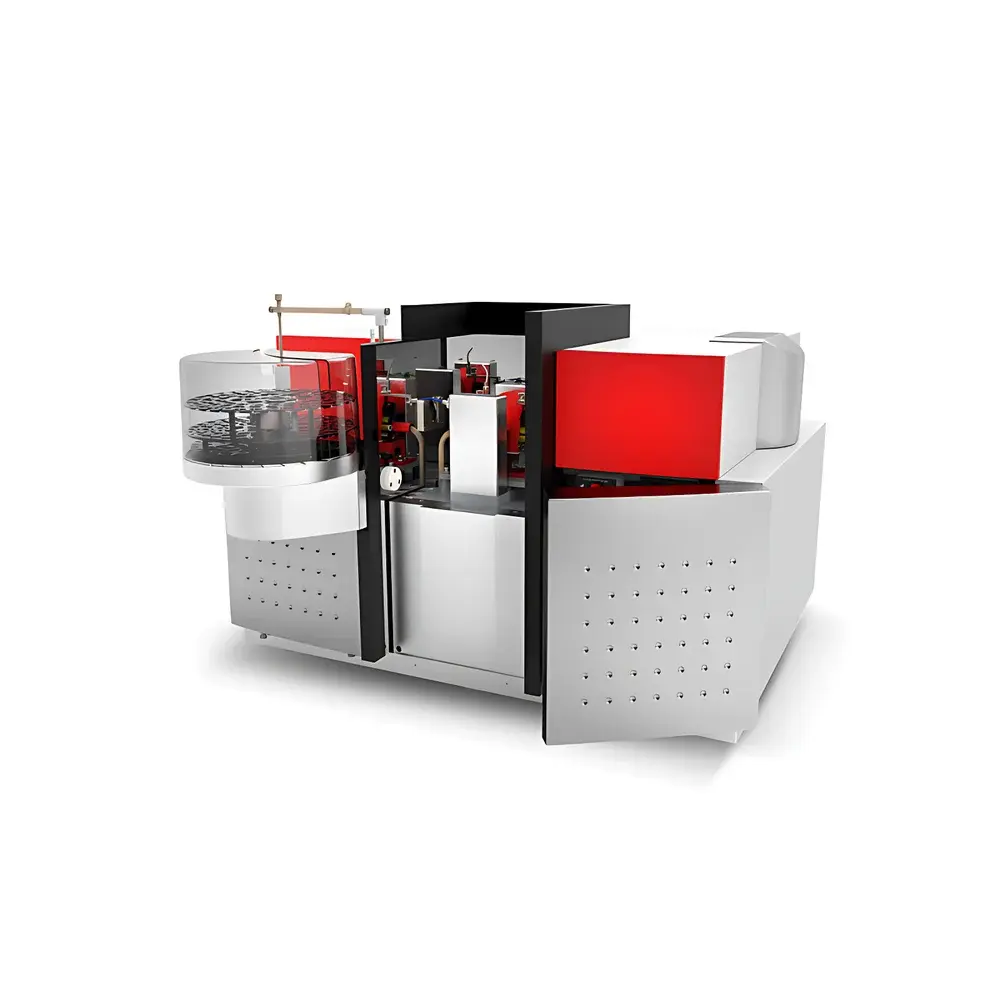
Shanghai Spectrum SP-3887ZAA Zeeman Atomic Absorption Spectrophotometer
| Brand | Shanghai Spectrum |
|---|---|
| Origin | Shanghai, China |
| Model | SP-3887ZAA |
| Instrument Type | Flame–Graphite Furnace Hybrid AAS |
| Optical System | Single-beam |
| Monochromator | Not specified (conventional grating-based) |
| Detector | Photomultiplier Tube (PMT) |
| Background Correction | D₂ Lamp + Self-Absorption + Transverse AC Magnetic Field Zeeman Correction |
| Graphite Furnace Configuration | Integrated Horizontal DC-heated Furnace with Automatic Resistance Compensation |
| Background Correction Modes | Three-mode selectable (D₂, Self-Absorption, Zeeman) |
| Safety | Multi-level hardware interlocks, STPF-compliant temperature control platform, Full PC automation with real-time monitoring |
| Lamp System | Motorized 8-lamp turret with auto-alignment |
| Viewing System | Integrated furnace viewing camera (real-time graphite tube status monitoring) |
Overview
The Shanghai Spectrum SP-3887ZAA is a high-performance, integrated flame–graphite furnace atomic absorption spectrophotometer engineered for trace elemental analysis in complex matrices. It operates on the fundamental principle of atomic absorption spectroscopy (AAS), where ground-state atoms in a gaseous state absorb characteristic radiation emitted by a hollow cathode lamp (HCL) or electrodeless discharge lamp (EDL). The SP-3887ZAA distinguishes itself through its dual-mode atomization capability—supporting both flame nebulization and electrothermal graphite furnace atomization—and its advanced background correction architecture based on transverse alternating-current magnetic field Zeeman splitting. This Zeeman configuration enables high-fidelity separation of analyte absorption from broadband molecular or scattering background, particularly critical when analyzing high-salt, biological, or environmental samples where spectral interference is prevalent. Unlike conventional single-beam instruments relying solely on deuterium arc or self-absorption correction, the SP-3887ZAA implements a three-tiered background correction strategy—D₂, self-absorption, and Zeeman—allowing method-specific optimization for maximum signal-to-background ratio and measurement robustness.
Key Features
- Integrated horizontal graphite furnace with direct-current (DC) power supply, enabling uniform thermal distribution and reduced longitudinal temperature gradients across the graphite tube.
- Real-time automatic resistance compensation during furnace heating cycles, maintaining precise thermal profiles even as graphite resistance changes with temperature and aging—critical for method reproducibility under STPF (Stabilized Temperature Platform Furnace) conditions.
- Transverse AC magnetic field Zeeman background correction system, generating quantifiable Zeeman-split π and σ⁺/σ⁻ components to isolate atomic absorption from non-specific background absorption without requiring separate reference beam paths.
- Motorized 8-position lamp turret with automatic lamp alignment and intensity optimization, supporting sequential multi-element analysis without manual intervention.
- Dedicated furnace viewing camera system providing real-time optical monitoring of sample drying, pyrolysis, atomization, and residue stages—enabling visual validation of thermal program execution and detection of splattering or incomplete volatilization.
- Comprehensive hardware interlock network covering gas flow, cooling water pressure, furnace door position, and power sequencing—ensuring operational safety and preventing unintended furnace activation or thermal runaway.
Sample Compatibility & Compliance
The SP-3887ZAA accommodates liquid samples (aqueous and organic), digested solids, and slurries compatible with graphite furnace introduction. Its optimized Zeeman correction and STPF-compatible temperature programming support accurate quantification of refractory elements—including V, Mo, W, and rare earths—at sub-pg levels. The instrument architecture aligns with internationally recognized analytical frameworks: background correction modes comply with ISO 11170 and ASTM D5196 for trace metal determination; furnace thermal programs adhere to STPF principles defined in the work of Welz and Sperling; and data acquisition protocols support audit-ready output for GLP environments. While not pre-certified for FDA 21 CFR Part 11, the system’s full PC-based control, electronic logbook, and immutable method storage provide a foundational infrastructure for laboratory compliance upgrades.
Software & Data Management
Control and data processing are managed via dedicated Windows-based software featuring intuitive workflow-driven method setup, real-time spectral visualization, and automated calibration curve generation (linear, quadratic, or weighted least-squares). All instrument parameters—including lamp current, slit width, furnace temperature ramp rates, hold times, and background correction mode—are stored with timestamped metadata. Raw absorbance vs. time traces, peak area/height integration, and background-subtracted signals are exportable in CSV and XML formats. The software supports user-defined reporting templates compliant with internal QA/QC requirements and includes built-in QC checks such as drift monitoring, replicate precision alerts (RSD thresholding), and calibration verification standards tracking.
Applications
The SP-3887ZAA is routinely deployed in environmental testing laboratories for Pb, Cd, As, and Hg in wastewater and soil extracts; in clinical research for ultra-trace Cu, Zn, and Se in serum and whole blood; in geochemical analysis for REE profiling in acid-digested rock samples; and in food safety labs for Ni and Cr migration testing from packaging materials. Its ability to resolve low-intensity atomic lines against intense polychromatic backgrounds makes it especially suitable for high-matrix applications where conventional D₂ correction fails—such as direct analysis of seawater, brine, or pharmaceutical excipients containing chloride or phosphate.
FAQ
Does the SP-3887ZAA support simultaneous multi-element analysis?
No—it performs sequential analysis via the 8-lamp turret. True simultaneous detection requires ICP-OES or ICP-MS instrumentation.
Is the Zeeman correction system field-tunable?
Yes—the magnetic field strength and AC frequency are software-adjustable to optimize splitting magnitude for specific analytes and line widths.
Can the furnace viewing camera be used for quantitative image analysis?
No—it provides qualitative real-time observation only; no pixel-intensity calibration or automated feature recognition is implemented.
What level of operator training is required to maintain STPF compliance?
Operators must complete documented training on thermal program development, background correction mode selection, and furnace tube conditioning protocols per manufacturer-recommended SOPs.
Is third-party software integration (e.g., LIMS) supported?
Yes—via ODBC-compliant database export and ASCII/CSV file triggers; API-level integration requires custom middleware development.
Related Products





