
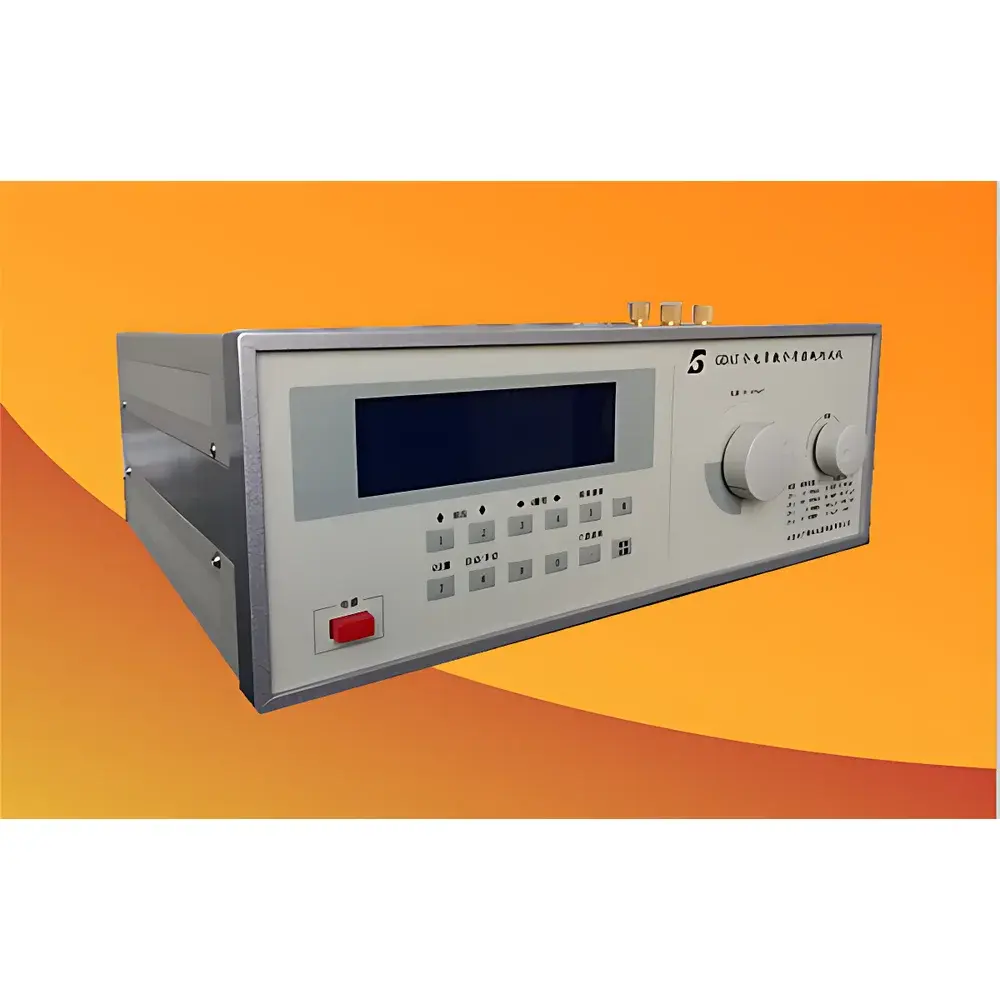
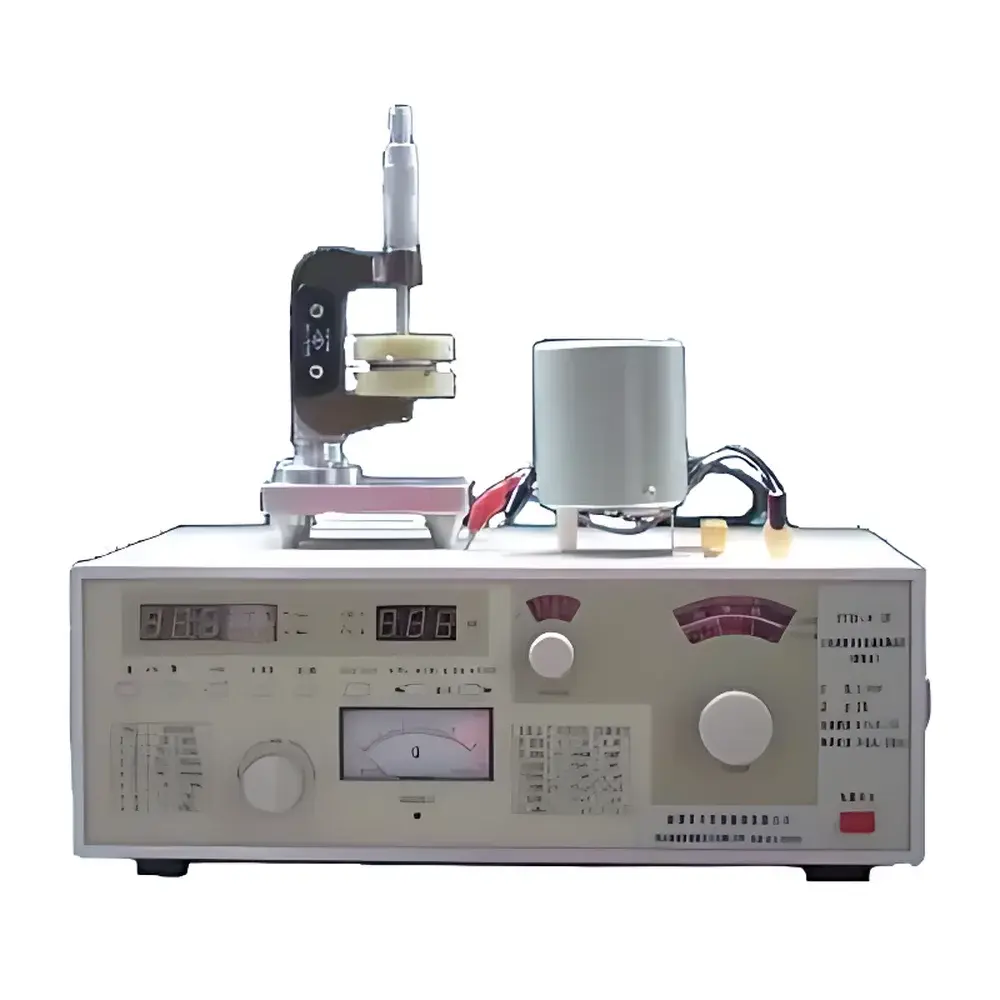
Beijing North Guang Precision Instruments GDAT-A High-Frequency Dielectric Constant and Loss Tangent Analyzer
| Brand | Beijing North Guang Precision Instruments |
|---|---|
| Origin | Beijing, China |
| Manufacturer Type | OEM Manufacturer |
| Product Origin | Domestic (China) |
| Model | GDAT-A |
| Price | USD 2,800 (FOB Beijing) |
Overview
The Beijing North Guang Precision Instruments GDAT-A High-Frequency Dielectric Constant and Loss Tangent Analyzer is a precision impedance measurement system engineered for the quantitative characterization of dielectric properties in insulating materials under high-frequency excitation. It operates on the principle of series-resonant Q-meter methodology—per ASTM D150, IEC 60250, and GB/T 1409–2006—where the test specimen serves as the dielectric medium within a calibrated parallel-plate capacitor (BH916 fixture), forming a resonant circuit with a high-Q inductor (LKI-1 series). The system measures the quality factor (Q) of this resonant loop, from which the complex permittivity (ε* = ε′ − jε″) is derived: the real part (ε′) corresponds to the relative dielectric constant, while the imaginary part yields the loss tangent (tan δ = ε″/ε′). This method ensures high sensitivity and physical fidelity, particularly for low-loss materials such as printed circuit board laminates (e.g., FR-4), polymer films, ceramic substrates, and epoxy composites—where conventional bridge-based techniques suffer from limited resolution and edge-effect artifacts.
Key Features
- Integrated high-stability series-resonant architecture combining BH916 precision parallel-plate fixture, GDAT-A digital Q-meter, and LKI-1 multi-range inductor set (9 units, 0.125 μH to 25 mH)
- Dual-frequency operation modes: 10 kHz–60 MHz (standard) and 200 kHz–160 MHz (optional extended band), with frequency accuracy ±3×10⁻⁵ ±1 digit
- LCD-digital micrometer with 1 μm resolution for precise sample thickness measurement (0–15 mm adjustable gap)
- Automated tan δ and ε calculation via embedded microprocessor-controlled data acquisition module—eliminating manual interpolation and calibration table dependency
- Digitally synthesized RF source with automatic resonance tracking, Q-range auto-switching (2–1023), and harmonic-free output
- Low-residual-inductance tuning circuitry minimizing stray reactance; <4×10⁻⁴ intrinsic tan δ at 1 MHz (fixture-only baseline)
- VFD display with full Chinese/English bilingual UI, real-time parameter visualization (Q, C, L, f, resonance trend arrow), and error diagnostics
Sample Compatibility & Compliance
The GDAT-A accommodates rigid and flexible sheet specimens up to Φ50 mm diameter (Φ38 mm optional), with thicknesses from 0.02 mm to 15 mm. It is validated for non-destructive evaluation of low-dielectric-loss materials including copper-clad laminates (CCL), polyimide films, PTFE substrates, alumina ceramics, and fiber-reinforced composites. Its design conforms to international standards governing dielectric characterization: GB/T 1409–2006 (China), ASTM D150–18 (Standard Test Methods for Dielectric Constant and Dissipation Factor of Electrical Insulating Materials), and IEC 60250 (Measurement of the Dielectric Properties of Solid Electrical Insulating Materials at Power, Audio and Radio Frequencies Including Millimetre Lengths). For regulated environments, the instrument supports GLP-compliant audit trails when paired with optional RS232-linked PC software (data timestamping, operator ID logging, and report export in CSV/PDF).
Software & Data Management
The GDAT-A embeds firmware-level data processing logic for direct computation of ε′ and tan δ without external conversion. Optional Windows-compatible communication software enables remote control, batch measurement sequencing, statistical analysis (mean, SD, CV%), and compliance reporting aligned with ISO/IEC 17025 documentation requirements. All measurements include metadata stamping: date/time, operator ID, fixture ID, temperature/humidity (via optional sensor input), and calibration certificate traceability. Export formats include Unicode-text CSV for LIMS integration and print-ready PDF reports with embedded instrument serial number and calibration status. The system meets foundational requirements for electronic record integrity per FDA 21 CFR Part 11 when configured with user authentication and electronic signature modules.
Applications
This analyzer is routinely deployed in R&D laboratories and QC departments for material qualification across multiple sectors:
- PCB manufacturing: Quantifying resin content variation, moisture absorption, and curing uniformity in FR-4 and high-speed laminates (e.g., Megtron, Isola)
- Aerospace composites: Screening dielectric homogeneity in carbon-fiber/epoxy prepregs and radome materials
- Capacitor dielectrics: Benchmarking ε′ stability and tan δ drift vs. frequency/temperature in Class I and II ceramic formulations
- Biomedical polymers: Assessing hydration-dependent permittivity shifts in hydrogel-based sensors and implant coatings
- Academic research: Supporting structure–property studies of ferroelectric thin films, MOFs, and metamaterial substrates
FAQ
What is the minimum measurable tan δ value for thin polymer films?
The system achieves a base resolution of 1×10⁻⁴ tan δ under optimized conditions (e.g., 1 MHz, 1 mm-thick PET film, LKI-1 coil #5); actual limit depends on sample geometry and fixture parasitics.
Can the GDAT-A measure materials with ε′ > 100?
Yes—within the constraints of electrode geometry and frequency range; however, high-permittivity samples require careful capacitance compensation and may necessitate lower test frequencies to maintain resonance stability.
Is calibration traceable to national standards?
Factory calibration uses NIST-traceable LCR standards; users receive a certificate indicating uncertainty budgets per ASTM E2554 and ISO/IEC 17025 Annex A.
Does the system support automated temperature-controlled testing?
Not natively—but the BH916 fixture accepts custom thermal stages (e.g., Linkam LTS420) with external temperature feedback integration via analog input port.
How often must the LKI-1 inductors be recalibrated?
Annually under normal lab use; each coil includes individual Q-factor vs. frequency characterization data per IEC 60250 Annex B.



