
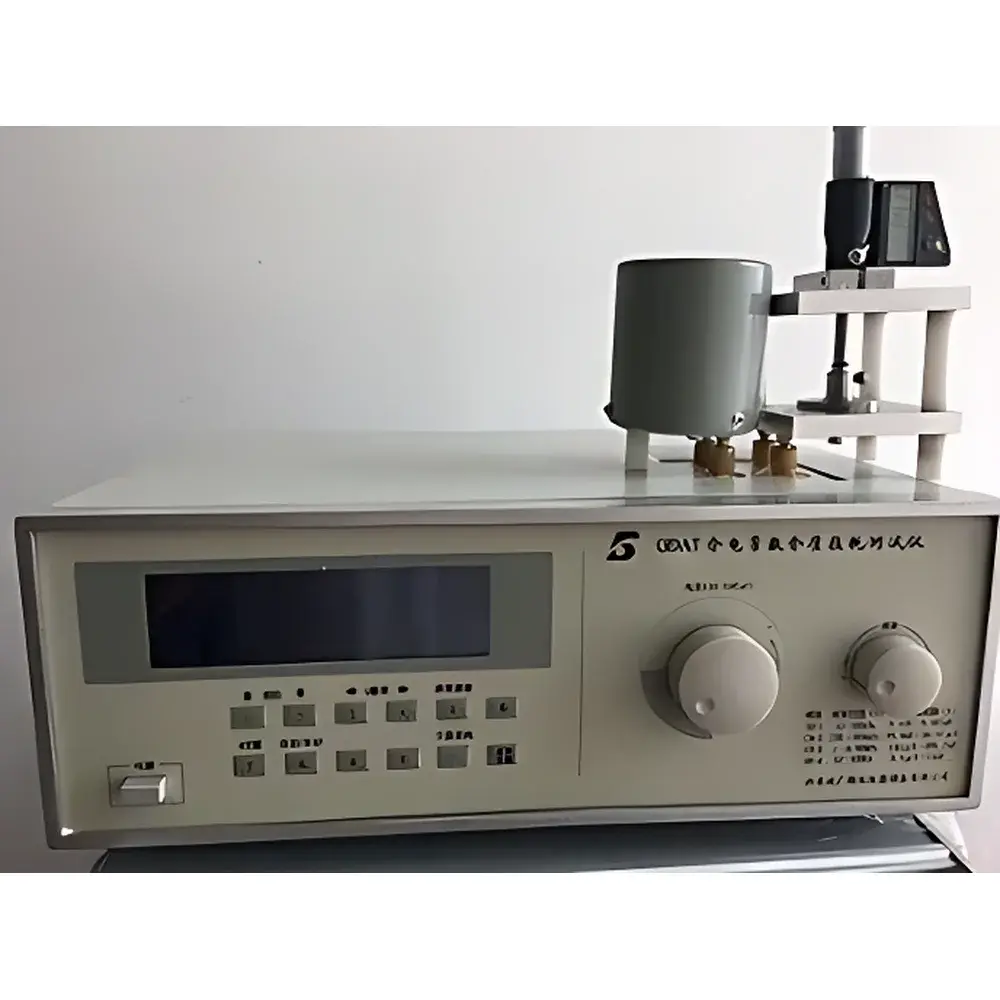
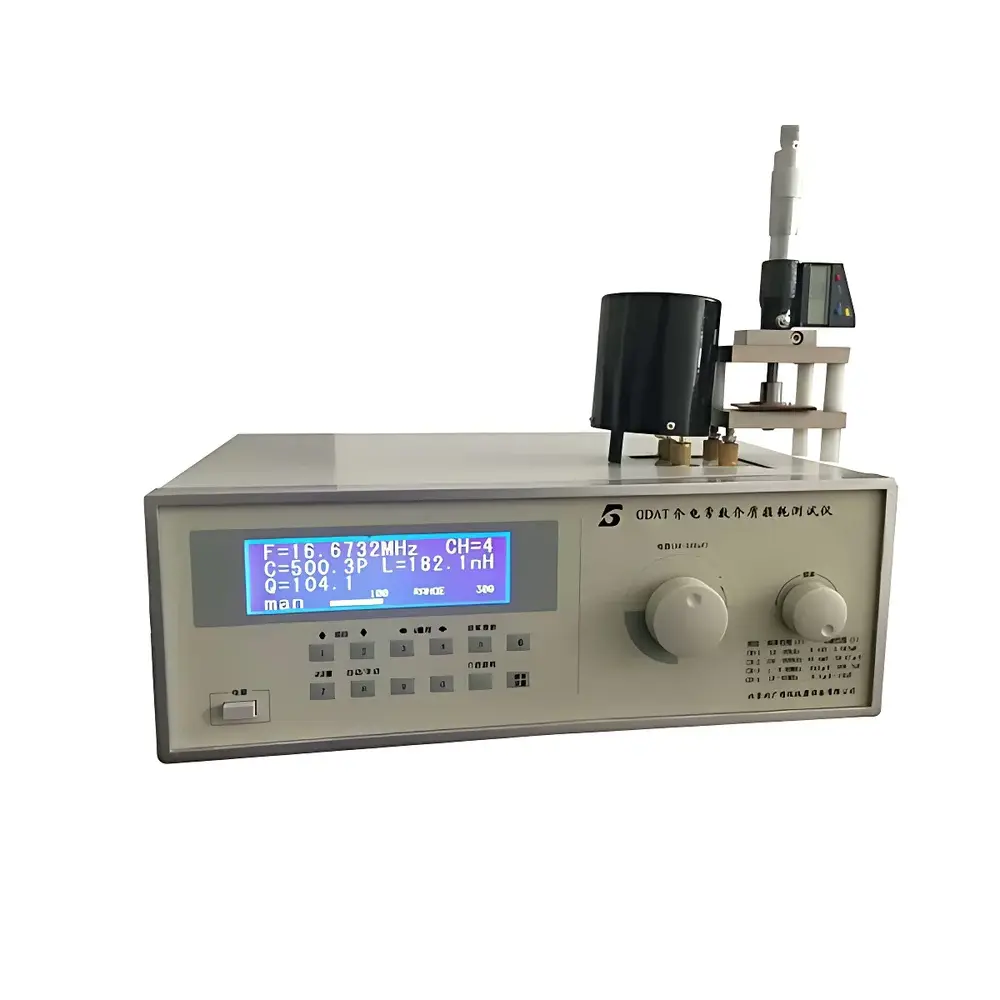
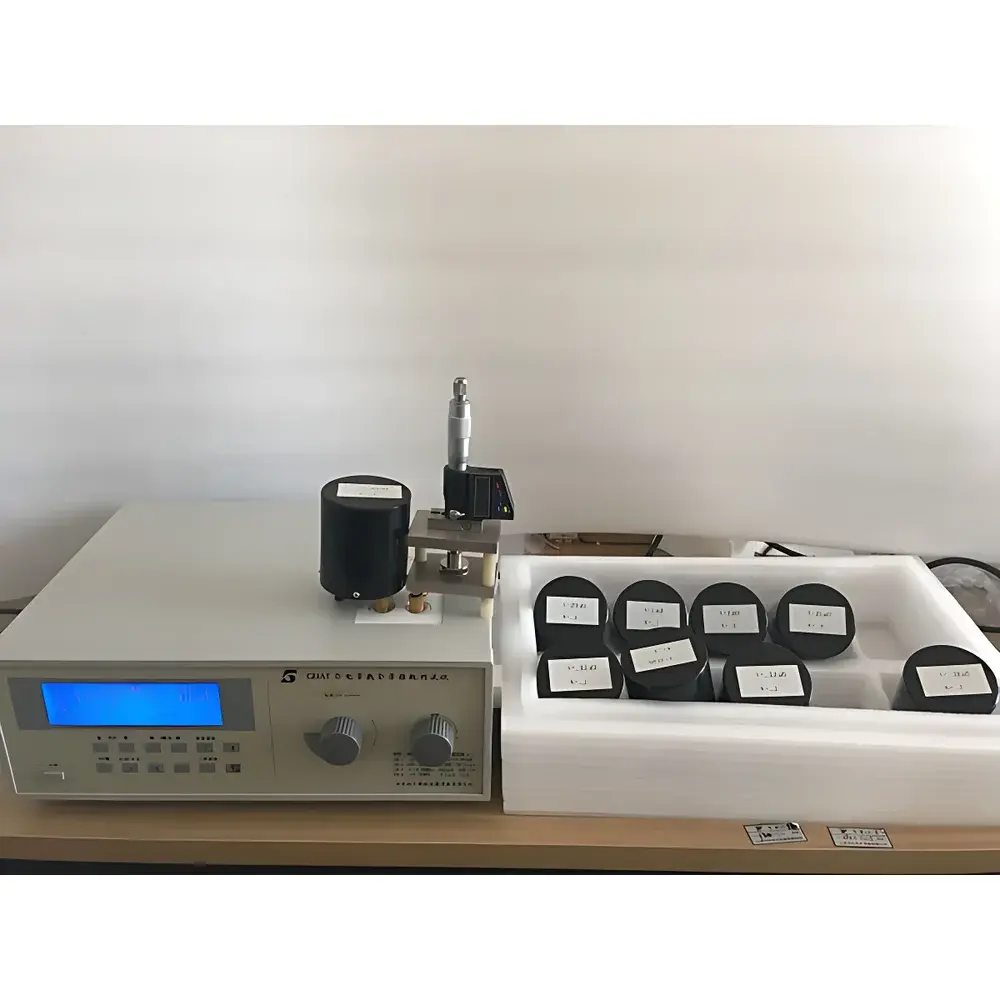
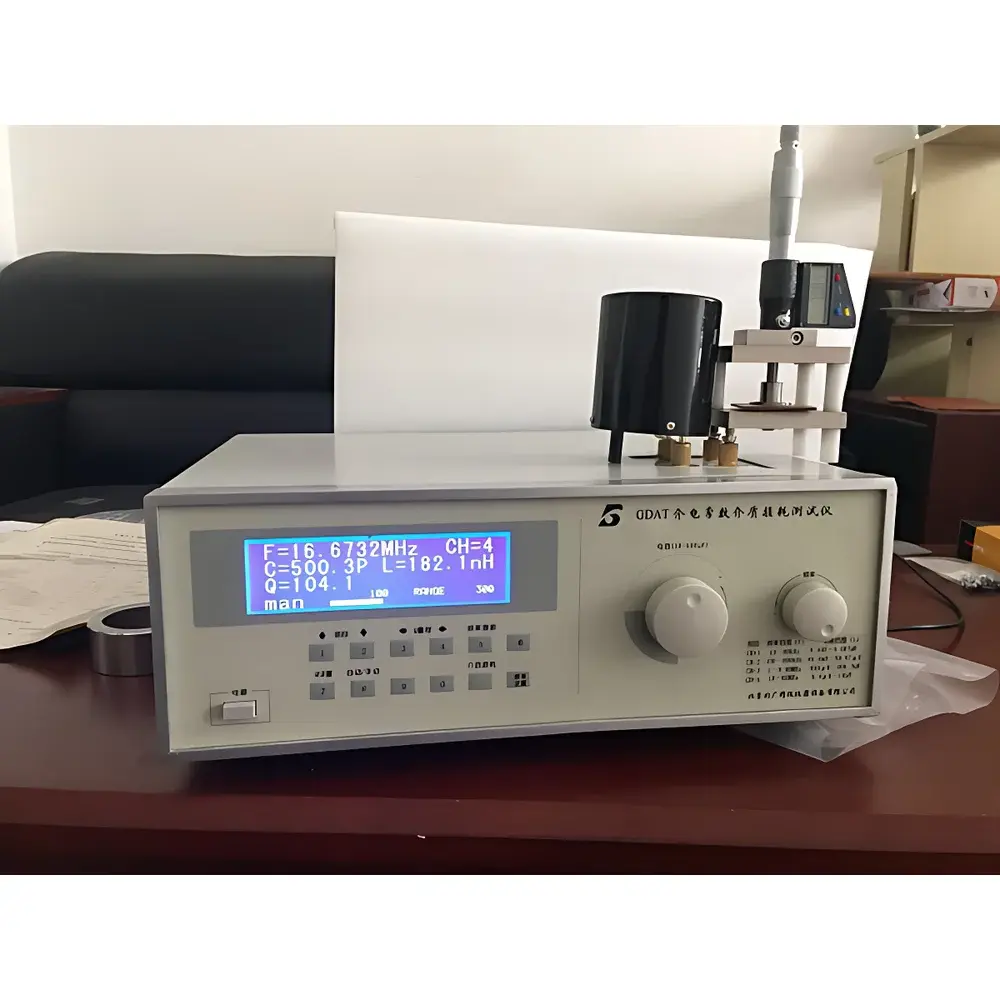
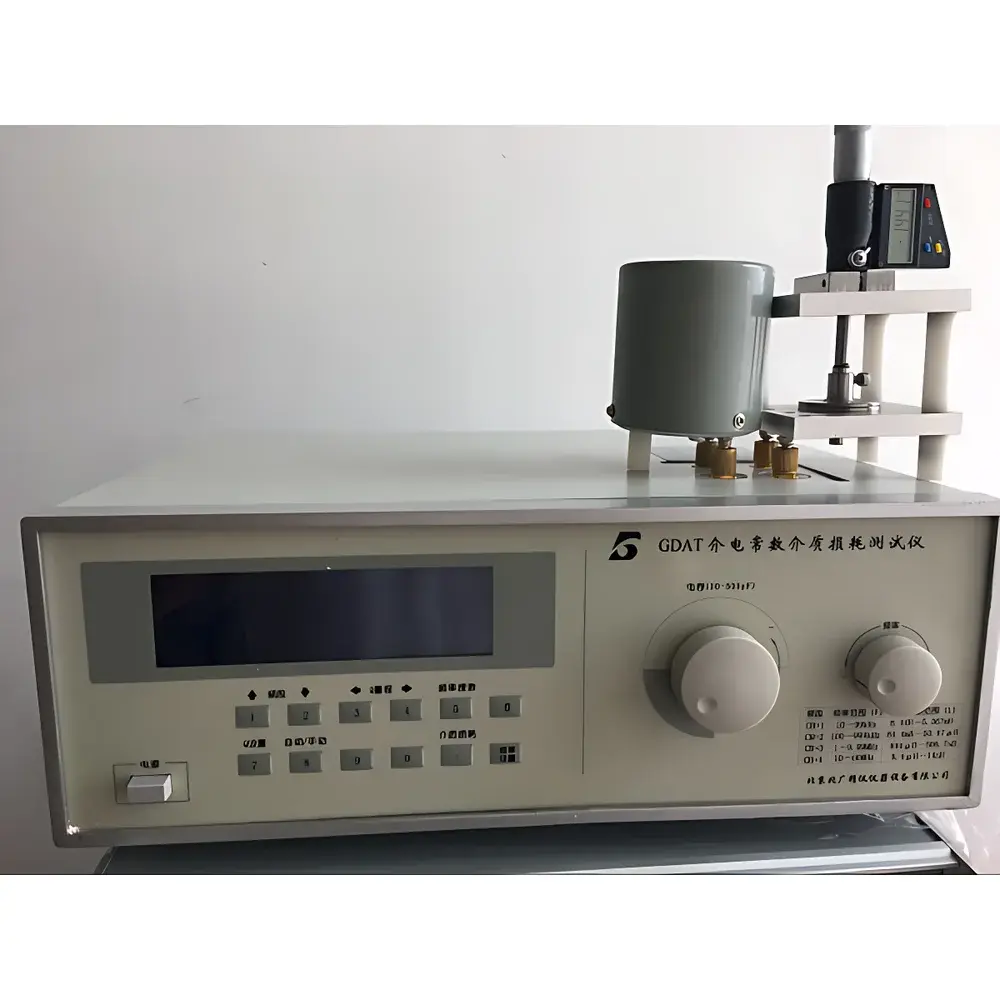
Beijing North Guang Precision Instruments GDAT-A High-Frequency Dielectric Constant and Loss Tangent Analyzer for Vulcanized Rubber
| Brand | Beijing North Guang Precision Instruments |
|---|---|
| Origin | Beijing, China |
| Manufacturer Type | Direct Manufacturer |
| Product Category | Domestic |
| Model | GDAT-A |
| Q Factor Range | 1–1023 |
| Q Range Steps | 30, 100, 300, 1000, auto/manual switching |
| Inductance Measurement Range | 1 nH–140 mH |
| Capacitance Direct Measurement Range | 1 pF–25 nF |
| Main Capacitor Tuning Range | 17 pF–240 pF |
| Capacitance Accuracy | ±1 pF (≤150 pF), ±1% (>150 pF) |
| Frequency Coverage | 100 kHz–160 MHz |
| Tanδ Resolution | ≤4×10⁻⁴ at 1 MHz |
| Electrode Options | Φ38 mm or Φ50 mm parallel-plate fixtures with micrometer adjustment (resolution ≤0.001 mm) |
| Liquid Cell | Ø48 mm × 7 mm depth, compatible with S916 lower electrode |
| Power Supply | 220 V ±22 V, 50 Hz ±2.5 Hz |
| Power Consumption | ~25 W |
| Operating Temperature | 0–40 °C |
| Interface | RS232 serial port, built-in thermal printer (Chinese-language output) |
| Display | Large-format VFD dot-matrix display with full Chinese menu navigation |
Overview
The Beijing North Guang Precision Instruments GDAT-A High-Frequency Dielectric Constant and Loss Tangent Analyzer is a precision impedance measurement system engineered for the quantitative characterization of dielectric properties in vulcanized rubber and other insulating polymeric materials. It operates on the principle of high-frequency resonance, utilizing a digitally stabilized RF oscillator and automatic Q-factor tracking to determine complex permittivity (ε* = ε′ − jε″) across a broad frequency spectrum from 100 kHz to 160 MHz. The instrument implements the standard high-frequency Q-meter method—defined in GB/T 1409–2006 (equivalent to IEC 60250)—to measure relative permittivity (εr) and loss tangent (tan δ), critical parameters for evaluating insulation integrity, polarization mechanisms, and energy dissipation behavior under alternating electric fields. Its architecture integrates a microprocessor-controlled tuning loop, frequency digital locking, automatic resonance point search, and multi-range Q scaling—minimizing residual inductance and improving repeatability in high-Q measurements. Designed for laboratory-based QC/QA and R&D applications, the GDAT-A supports both solid-sheet and liquid-sample configurations via interchangeable electrode fixtures, enabling compliance-driven testing in accordance with ASTM D150, IEC 60250, and ISO 257.
Key Features
- High-resolution VFD dot-matrix display with intuitive Chinese-language menu interface—operable without reference manuals, even under extreme ambient temperatures (0–40 °C).
- Integrated thermal printer for direct hardcopy output of εr, tan δ, Q, C, L, and test conditions—all labeled in Chinese for traceable reporting.
- RS232 serial interface compliant with standard UART protocols, supporting bidirectional communication with Windows-based data acquisition software (optional application suite available).
- Dual-mode electrode configuration: selectable Φ38 mm or Φ50 mm parallel-plate fixtures with calibrated micrometer adjustment (≤0.001 mm resolution) and verified tan δ ≤ 4×10⁻⁴ at 1 MHz.
- LKI-1 inductor set included (10 units: 0.05 µH to 10 mH), enabling calibration verification and extended impedance range coverage for resonant circuit analysis.
- Liquid cell (Ø48 mm × 7 mm) compatible with S916 lower electrode assemblies—facilitating comparative measurements of filled elastomers or solvent-swollen specimens.
- Automatic Q-range switching and frequency-point presetting eliminate manual recalibration during multi-frequency sweeps.
Sample Compatibility & Compliance
The GDAT-A accommodates standardized solid dielectric specimens per GB/T 1409–2006 and ASTM D150: flat sheets of vulcanized rubber (thickness measured to ±(0.2% + 0.005 mm)), ceramics, polymer composites, and insulating films. Electrode systems support both guarded and unguarded configurations; for high-frequency accuracy (>1 MHz), coaxial cabling and shielded fixtures are recommended to suppress stray inductance and fringing effects. Liquid samples may be evaluated using the dedicated cell, provided their conductivity remains below 10⁻⁶ S/m to avoid conduction-loss interference. The instrument meets electromagnetic compatibility (EMC) requirements for Class B industrial environments and conforms to safety standards for low-voltage equipment (IEC 61010-1). While not FDA 21 CFR Part 11–certified out-of-the-box, audit-ready operation is supported through timestamped printouts, manual logbooks, and RS232 data export for integration into GLP/GMP-aligned LIMS platforms.
Software & Data Management
The GDAT-A does not embed proprietary firmware-based data storage; instead, it relies on external PC-based applications for statistical processing, trend analysis, and long-term archiving. The RS232 interface delivers ASCII-formatted measurement packets—including frequency, Q, C, L, εr, tan δ, and system status flags—at up to 115.2 kbps. Optional companion software provides automated sweep sequencing, pass/fail thresholding (user-definable tan δ limits: 5–1000), CSV export, and graphical εr/tan δ vs. frequency plots. All printed reports include instrument ID, date/time stamp, operator entry field, and environmental condition prompts—supporting basic traceability requirements for internal quality audits.
Applications
- Quality control of sulfur-cured EPDM, NBR, and silicone rubber compounds for automotive sealing systems and high-voltage cable jackets.
- Development of low-loss dielectric elastomers for capacitive soft sensors and electroactive polymer actuators.
- Correlation of tan δ peaks with glass transition temperature (Tg) shifts induced by plasticizer migration or thermal aging.
- Characterization of ceramic-filled rubber composites to quantify interfacial polarization (Maxwell–Wagner effect) at MHz frequencies.
- Validation of coating uniformity and moisture ingress in laminated insulating tapes via localized εr mapping (using fixture aperture masking).
- Supporting failure analysis of HV bushings and transformer insulation where dielectric loss escalation precedes breakdown.
FAQ
Does the GDAT-A comply with international standards such as ASTM D150 or IEC 60250?
Yes—the instrument implements the high-frequency resonance method specified in GB/T 1409–2006, which is technically aligned with IEC 60250 and functionally equivalent to ASTM D150 Section 8 (Q-meter method). Calibration verification using the supplied LKI-1 inductor set ensures metrological consistency.
Can the GDAT-A measure samples thicker than 5 mm?
Yes—electrode spacing is adjustable up to ≥15 mm. However, for accurate εr calculation, specimen thickness must be measured independently to ±0.005 mm and entered manually; the instrument does not integrate thickness sensing.
Is the thermal printer capable of exporting data in English?
No—the built-in printer outputs exclusively in Chinese. English-language reporting requires RS232 data capture and post-processing via external software.
What is the minimum measurable tan δ value at 1 MHz?
The fixture’s intrinsic loss is ≤4×10⁻⁴ at 1 MHz. Therefore, reliable measurement of material tan δ requires values ≥1×10⁻³ to maintain signal-to-noise ratio >10:1.
Does the instrument support automated frequency sweeps?
Not natively—the GDAT-A performs single-frequency point measurements. Multi-frequency profiling requires manual frequency stepping or external PC control via RS232 scripting.
Related Products



