
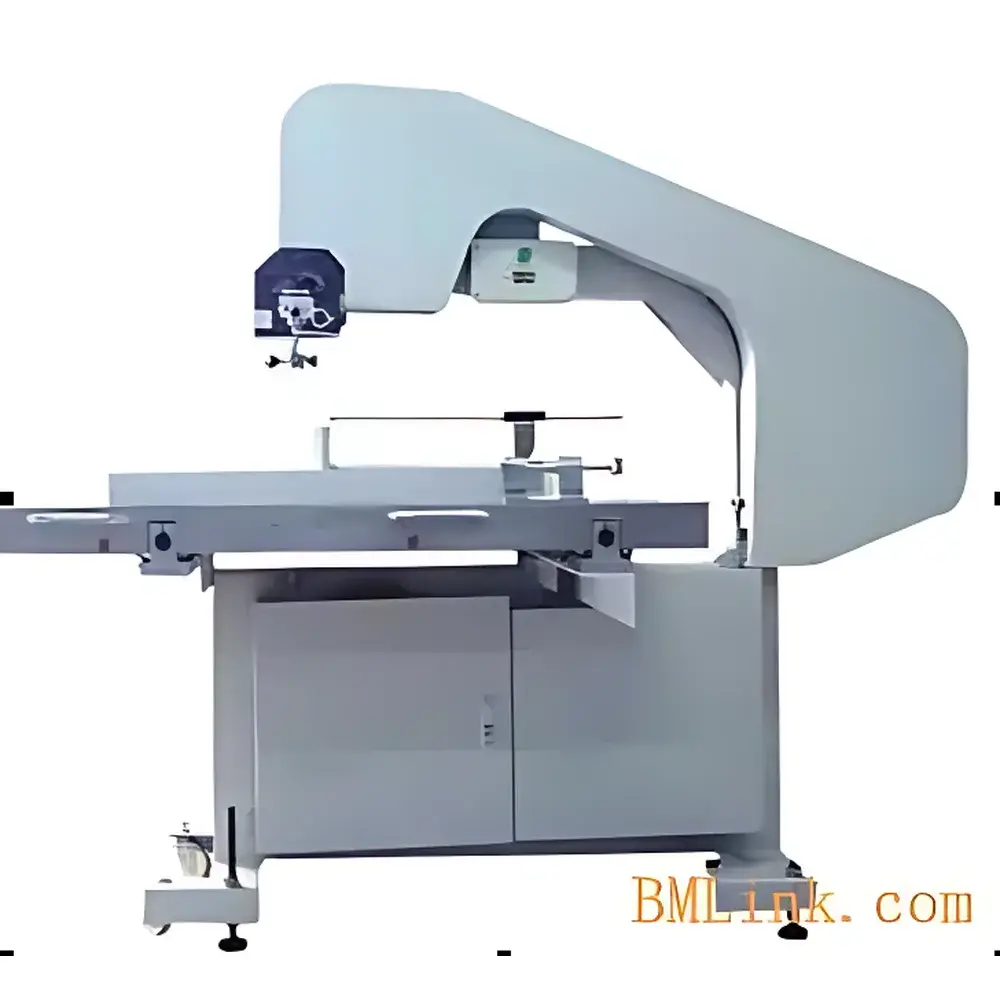
North Guang Precision Instrument HMQG-100 Foam Cutting Machine with Ball Rebound Measurement Capability
| Brand | North Guang Precision Instrument / All Precision Instrument |
|---|---|
| Origin | Beijing, China |
| Manufacturer Type | OEM Manufacturer |
| Country of Origin | China |
| Model | HMQG-100 |
| Cutting Display Resolution | 0.01 mm |
| Dimensional Accuracy | ±1 mm |
| Worktable Dimensions | 1000 × 700 mm (customizable) |
| Effective Travel of Movable Worktable | 500 mm |
| Adjustable Cutting Thickness Range | 10–160 mm |
| Maximum Sample Thickness | 80 mm |
| Power Supply | 220 V AC |
| Rated Power | 1.1 kW |
Overview
The North Guang Precision Instrument HMQG-100 Foam Cutting Machine is an industrial-grade, precision-engineered system designed for the reproducible and dimensionally controlled cutting of flexible and rigid polymeric foam materials—including polyurethane (PU), polystyrene (PS), ethylene-vinyl acetate (EVA), and cross-linked polyethylene (XLPE). While primarily a high-accuracy cutting platform, the HMQG-100 integrates mechanical interface provisions compatible with standardized ball rebound testing per ISO 8307 and ASTM D3574 Annex A5, enabling seamless sample preparation for resilience evaluation. The machine operates on a servo-controlled linear motion architecture, utilizing a fixed tungsten-carbide-tipped hot-wire or cold-blade cutting mechanism (user-selectable configuration), coupled with a vacuum-assisted movable worktable to ensure zero-slippage fixation during traversal. Its design prioritizes dimensional fidelity in specimen generation—critical for downstream mechanical testing where geometry directly influences compressive modulus, tensile strength, and dynamic rebound behavior.
Key Features
- Digital micrometer-scale positioning system with 0.01 mm display resolution, ensuring traceable and repeatable cut placement across batch production.
- Vacuum-based negative-pressure worktable (adjustable suction zones) for uniform immobilization of low-density, compressible foam substrates without surface deformation.
- Movable worktable with 500 mm effective linear travel, guided by hardened linear rails and preloaded ball screws for minimal backlash and long-term geometric stability.
- Integrated dual-mode control: fully automated programmable cycle mode and manual jog mode with emergency stop redundancy.
- Redundant safety architecture including illuminated red mushroom-head emergency brake, fail-safe electromagnetic brake release interlocked with start signal, and automatic power cutoff upon sensor fault detection.
- Modular cutting head mount supports interchangeable tooling—hot-wire (for smooth-edge thermal slicing), oscillating blade (for high-density or laminated foams), and optional rebound test fixture adapter plate.
Sample Compatibility & Compliance
The HMQG-100 accommodates a broad spectrum of cellular polymer materials, from soft open-cell PU foams (density range: 10–40 kg/m³) to semi-rigid closed-cell EVA and PVC-based syntactic foams (up to 200 kg/m³). It accepts specimens up to 80 mm in thickness and cuts within a nominal dimensional envelope of 10–160 mm (height/depth), with custom toolpath programming supporting non-rectilinear geometries (e.g., cylindrical cores for ISO 1856 compression tests). All mechanical tolerances and operational parameters comply with ISO 17025 calibration traceability requirements when used with certified metrology equipment. The system’s dimensional output supports direct input into GLP-compliant test workflows per ISO 17123-7 (foam resilience) and ASTM D3574 (flexible cellular materials), facilitating audit-ready documentation for quality assurance departments in automotive seating, medical cushioning, and packaging R&D labs.
Software & Data Management
The HMQG-100 operates via embedded real-time controller firmware—not PC-dependent software—ensuring deterministic response timing and immunity to OS-level interruptions. Cut parameters (position coordinates, feed rate, dwell time) are stored in non-volatile memory with timestamped logging (ISO/IEC 17025-aligned audit trail). Optional RS-485 or Ethernet Modbus TCP interface enables integration into MES or LIMS platforms for automated job dispatch and QC record linkage. No proprietary drivers or cloud dependencies are required; all configuration and diagnostics are accessible via front-panel keypad and 4.3″ TFT LCD with multilingual UI (English default). Firmware updates follow IEC 62443-3-3 secure update protocols, with digital signature verification prior to installation.
Applications
- Preparation of standardized test specimens for ISO 8307 (ball rebound resilience), ASTM D3574 (compression set, tensile strength), and ISO 1856 (tensile properties of flexible foams).
- High-volume prototyping of acoustic insulation panels requiring precise edge definition and thickness consistency.
- Manufacturing support for orthopedic cushioning components where layer stacking accuracy impacts pressure distribution profiles.
- R&D laboratories evaluating density-gradient foam structures, where sequential z-axis sectioning enables layer-by-layer property mapping.
- Quality control environments performing first-article inspection (FAI) per AS9102 or PPAP requirements, leveraging the machine’s repeatable positional accuracy for statistical process control (SPC) charting.
FAQ
Can the HMQG-100 cut materials other than foam?
Yes—when equipped with the oscillating blade module, it processes thin rubber sheets, gasket materials, and composite laminates up to 80 mm thick, provided hardness does not exceed Shore A 90.
Is the ball rebound measurement function built-in or accessory-based?
The machine itself does not perform rebound measurement; however, its precision-cutting capability ensures specimens meet ISO 8307 dimensional tolerances (±0.5 mm in diameter, ±0.2 mm in thickness), and the worktable includes mounting interfaces for third-party rebound testers (e.g., Erichsen 320 or equivalent).
Does the system support G-code import for custom contour cutting?
No—the HMQG-100 uses proprietary coordinate-based programming via its onboard interface; however, CSV-formatted position tables can be uploaded via USB for batch parameter loading.
What maintenance intervals are recommended for vacuum pump and drive train?
Vacuum pump oil replacement every 500 operating hours; linear rail lubrication and belt tension verification every 1,000 hours; annual calibration of digital position encoder against NIST-traceable gauge blocks.
Is FDA 21 CFR Part 11 compliance available?
The base unit does not include electronic signature or audit trail features required for Part 11; however, optional firmware upgrade (HMQG-100-GLP) adds role-based user authentication, electronic log archiving, and tamper-evident record hashing for regulated environments.



