
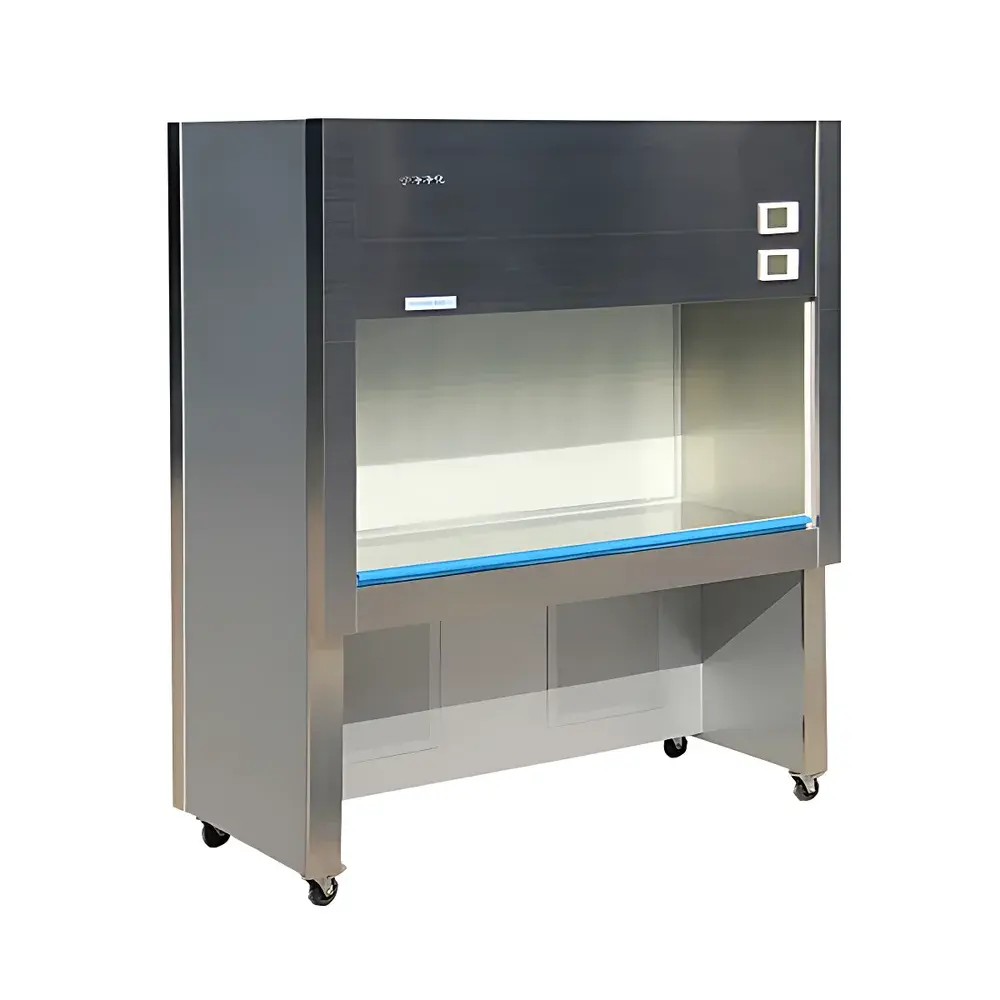
HJ SW-CJ-2FB Vertical Flow Clean Bench
| Brand | HJ Purification |
|---|---|
| Origin | Shanghai, China |
| Manufacturer Type | Direct Manufacturer |
| Product Category | Domestic |
| Model | SW-CJ-2FB |
| Instrument Type | Vertical Flow Clean Bench |
| Cleanliness Class | ISO Class 5 (100 @ ≥0.5 µm, Fed. Std. 209E) |
| Noise Level | ≤62 dB(A) |
| User Capacity | Dual-Operator, Single-Face Configuration |
| Airflow Pattern | Vertical Downflow |
| Average Air Velocity | 0.25–0.45 m/s (Dual-Speed Control) |
| Vibration | ≤5 µm Half-Peak (X/Y/Z axes) |
| Illuminance | ≥450 lx |
| Power Supply | AC 220 V, 50 Hz |
| Max. Power Consumption | 800 W |
| Net Weight | 200 kg |
| Work Area Dimensions | 1320 × 510 × 600 mm (W×D×H) |
| Overall Dimensions | 1475 × 745 × 1815 mm (W×D×H) |
| HEPA Filter Specifications | 1320 × 600 × 38 mm × 1 pc + 1320 × 484 × 38 mm × 1 pc |
| Lighting | 30 W Fluorescent Lamp × 1 + 30 W UV Lamp × 1 |
Overview
The HJ SW-CJ-2FB Vertical Flow Clean Bench is an ISO Class 5-certified laminar flow workstation engineered for personnel-protected, particle-controlled environments in microbiological, pharmaceutical, and cell culture laboratories. It operates on the principle of vertical unidirectional airflow: ambient air is drawn through a pre-filter, conditioned by a variable-speed centrifugal blower, and then passed through dual high-efficiency particulate air (HEPA) filters—each rated at ≥99.995% efficiency for particles ≥0.3 µm—before being delivered as laminar downflow across the work surface at a controlled velocity of 0.25–0.45 m/s. This airflow architecture minimizes turbulence and cross-contamination, ensuring consistent protection of both samples and operators during non-hazardous procedures. Unlike biosafety cabinets, the SW-CJ-2FB does not recirculate air nor provide containment for hazardous agents; it is strictly intended for applications requiring product protection only, in compliance with ISO 14644-1 and aligned with US Federal Standard 209E (Class 100).
Key Features
- Dual-HEPA filtration system with independently specified filter modules: one 1320 × 600 × 38 mm filter for the main work zone and one 1320 × 484 × 38 mm filter for the rear exhaust plenum—ensuring uniform velocity distribution and extended filter service life.
- Digitally controlled, multi-stage centrifugal blower with real-time speed adjustment via LCD interface—enabling precise maintenance of target face velocity under varying filter loading conditions.
- Single-face, dual-operator configuration with ergonomic work area dimensions (1320 × 510 × 600 mm), optimized for collaborative bench-scale manipulations without compromising laminarity.
- Integrated dual-lighting system: a 30 W fluorescent lamp (≥450 lx at work surface) for routine operation and a 30 W UV-C germicidal lamp (253.7 nm) for pre-use decontamination—both independently switchable and interlocked to prevent simultaneous UV exposure during operation.
- Structural rigidity achieved via reinforced steel frame and anti-vibration mounting—measured vibration amplitude maintained at ≤5 µm half-peak across all three orthogonal axes per ISO 22067-1.
- Compliance-ready electrical design: grounded AC 220 V / 50 Hz input with thermal overload protection, CE-marked components, and internal wiring conforming to IEC 61000-6-3 EMC emission standards.
Sample Compatibility & Compliance
The SW-CJ-2FB supports open-vessel handling of sterile media, tissue cultures, microbial inocula, and precision weighing of non-volatile pharmaceutical intermediates. It is validated for use in environments governed by ISO/IEC 17025, cGMP Annex 1 (non-sterile manufacturing support), and CLSI M29-A4 guidelines for aseptic technique. While not certified for biological hazard containment (i.e., lacks NSF/ANSI 49 classification), its performance metrics—including ≤0.5 colony-forming units per 90-mm petri dish per hour (per ISO 14698-1 bioaerosol challenge testing)—meet acceptance criteria for Grade A environments in EU GMP Annex 1 supporting operations. All materials in contact with airflow (stainless steel 304 work surface, anodized aluminum side panels) are non-shedding and compatible with 70% ethanol, hydrogen peroxide vapor (HPV), and quaternary ammonium disinfectants.
Software & Data Management
This clean bench operates as a standalone mechanical system with no embedded firmware or network connectivity. All operational parameters—including blower speed selection, lighting mode, and UV exposure timer—are managed locally via a sealed, IP54-rated LCD control panel. No data logging or electronic audit trail is provided, consistent with its classification as Class I laboratory infrastructure equipment. For regulated environments requiring traceability, users may integrate external environmental monitoring systems (e.g., Vaisala viewLinc or DeltaTrak) via analog 4–20 mA outputs (optional accessory). The unit complies with FDA 21 CFR Part 11 requirements only when paired with validated third-party data acquisition hardware and SOP-defined procedural controls—not as an out-of-the-box digital system.
Applications
- Aseptic preparation of agar plates, broth cultures, and suspension media in academic and clinical microbiology labs.
- Handling of primary mammalian cells and stem lines prior to transfer into CO₂ incubators or bioreactors.
- Weighing and dispensing of active pharmaceutical ingredients (APIs) in non-sterile formulation development workflows.
- Assembly and testing of microfluidic devices and MEMS sensors where electrostatic discharge (ESD)-safe laminar flow is required.
- Supporting ISO 11137 radiation sterilization validation studies by providing particle-free staging zones for dosimetry sample placement.
FAQ
Is the SW-CJ-2FB suitable for handling pathogenic organisms?
No. It provides product protection only and offers no personnel or environmental protection against biohazards. Use only for non-infectious, non-toxic materials.
What is the recommended HEPA filter replacement interval?
Filter life depends on ambient air quality and usage frequency; typical service intervals range from 12–24 months. Replace when static pressure differential exceeds 250 Pa or face velocity falls below 0.25 m/s after calibration.
Can this unit be installed in a room with positive pressure?
Yes—vertical flow clean benches are compatible with positively pressurized cleanrooms (ISO Class 7 or better), but must be located away from HVAC supply diffusers to avoid airflow disruption.
Does the unit include validation documentation?
Factory-installed units ship with a Certificate of Conformance and initial airflow uniformity test report. IQ/OQ protocols and site-specific PQ are user-responsible per ISO 14644-3.
Is UV lamp intensity monitored or calibrated?
No built-in radiometric sensor is included. Users must perform periodic UV intensity verification using a NIST-traceable UV-C meter (e.g., Sper Scientific 850003) per ISO 15858.



