
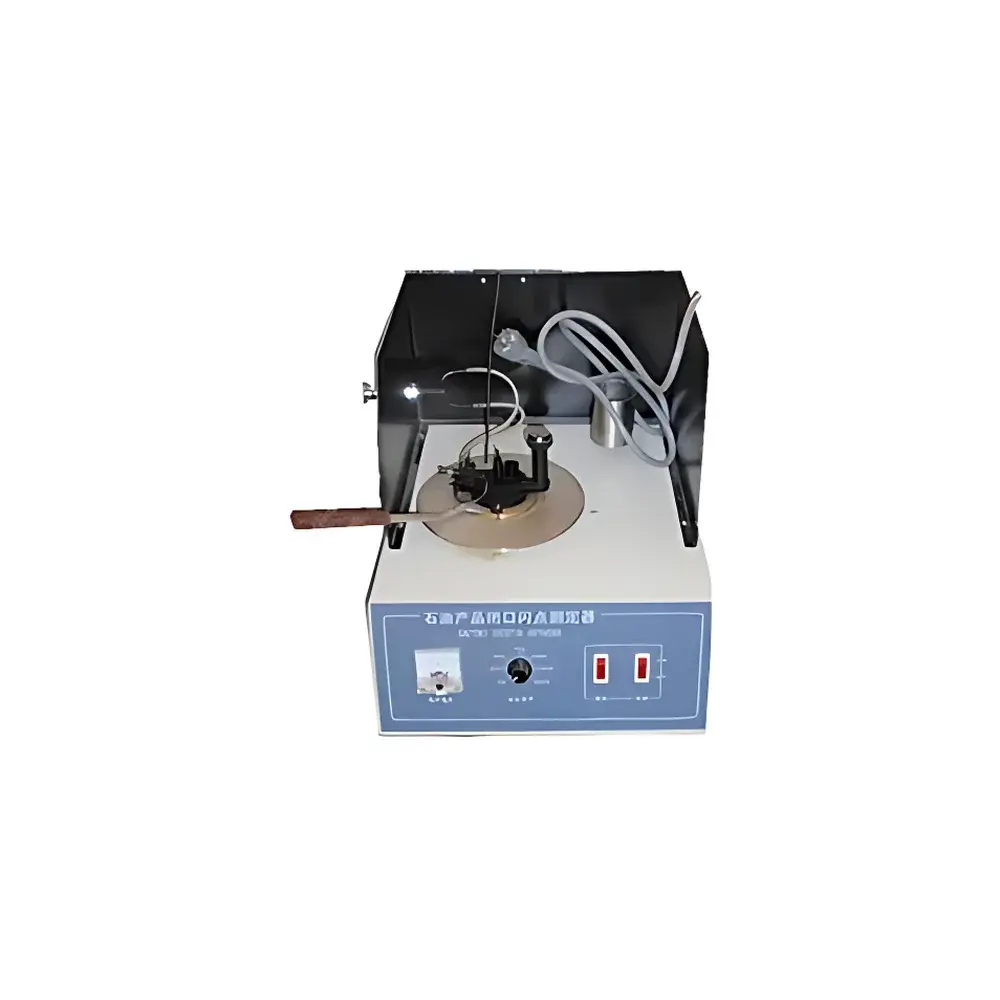
KA-102 Karrie Closed-Cup Flash Point Tester (Pensky-Martens Method)
| Brand | Karrie |
|---|---|
| Origin | Shenzhen, China |
| Model | KA-102 |
| Heating Power | 400 W |
| Stirring Speed | 250 rpm (high), 100 rpm (low) |
| Power Supply | AC 220 V ±10%, 50 Hz |
| Compliance | GB/T 261–2008, ASTM D93 |
Overview
The KA-102 Karrie Closed-Cup Flash Point Tester is a precision-engineered instrument designed for the determination of flash point according to the standardized Pensky-Martens closed-cup method. It operates in strict accordance with GB/T 261–2008 *Determination of Flash Point — Pensky-Martens Closed Cup Method* and fully satisfies the procedural requirements of ASTM D93 *Standard Test Method for Flash Point by Pensky-Martens Closed Cup Tester*. This instrument measures the lowest temperature at which vapors above a liquid sample ignite momentarily when exposed to an ignition source under controlled, sealed conditions. The test principle relies on precise thermal ramping, regulated stirring, and reproducible flame application—critical parameters defined by international petroleum testing standards. Its design targets routine quality control and regulatory compliance testing in refining laboratories, lubricant formulation facilities, fuel distribution centers, and third-party certification labs where traceability, repeatability, and adherence to GLP-aligned workflows are mandatory.
Key Features
- Digitally referenced solid-state voltage regulator enables continuous 0–220 V AC adjustment, ensuring exact compliance with prescribed heating rate profiles (e.g., 5–6 °C/min during initial heating, reduced to 1–1.5 °C/min near expected flash point).
- Dual-speed stirrer motor (100 rpm for viscous or film-forming samples; 250 rpm for low-viscosity fuels) maintains homogeneous sample temperature distribution and vapor equilibrium—essential for accurate flash point detection per ASTM D93 Annex A1.
- Integrated band-type heating element delivers uniform thermal transfer across the test cup base, minimizing thermal gradients and extending service life compared to coiled resistive heaters.
- Standardized brass ignition ball (diameter 3.2–4.8 mm) mounted on the lid meets dimensional tolerances specified in Clause 7.2 of ASTM D93 and Clause 5.3 of GB/T 261–2008, ensuring consistent flame geometry and ignition energy delivery.
- Bundled LPG-compatible gas cylinder adapter kit—including pressure-regulated hose, quick-connect fittings, and flashback arrestor—eliminates integration delays and supports immediate deployment without external gas infrastructure modification.
Sample Compatibility & Compliance
The KA-102 is validated for use with a broad range of petroleum-derived liquids, including but not limited to diesel fuel, jet fuel (Jet A-1, JP-8), residual fuel oils, base oils, hydraulic fluids, transformer oils, and solvent-cut lubricants. It accommodates samples exhibiting surface film formation (e.g., oxidized or additive-rich formulations) and suspended particulates, provided they remain pumpable and do not obstruct stirrer rotation or cup thermocouple contact. Instrument operation conforms to ISO/IEC 17025:2017 clause 7.2.2 (method validation), supports audit-ready documentation for FDA 21 CFR Part 11–aligned environments when paired with compliant lab information management systems (LIMS), and facilitates traceable calibration via NIST-traceable reference standards (e.g., n-decane, iso-octane, cyclohexane). Routine verification follows ASTM D6134 *Standard Practice for Verification of Flash Point Testers*.
Software & Data Management
While the KA-102 operates as a stand-alone benchtop unit with analog voltage indication and manual ignition timing, its operational sequence is fully compatible with digital data capture workflows. Voltage setpoint, observed flash temperature, ambient barometric pressure (manually entered), and operator ID can be logged into structured CSV or Excel templates aligned with internal QA/QC protocols. For laboratories implementing electronic records, the instrument’s deterministic behavior—repeatable ramp rates, fixed stir speeds, and standardized flame dwell time—enables seamless integration into validated LIMS or ELN platforms. Audit trails, user access logs, and electronic signature support are managed at the system level, satisfying GLP and GMP documentation requirements without embedded firmware.
Applications
- Refinery process control: Monitoring flash point drift in distillate cuts to detect contamination or fractionation anomalies.
- Lubricant manufacturing: Verifying flash point specifications for industrial gear oils, turbine oils, and greases post-blending.
- Fuel certification: Supporting ASTM D975 (diesel), D1655 (jet fuel), and EN 590 compliance reporting.
- Regulatory submission: Generating test data accepted by CNPC, Sinopec, local MEE (Ministry of Ecology and Environment) inspection units, and international trading partners requiring GB/T or ASTM conformance.
- Research & development: Screening novel bio-based fuel blends, synthetic esters, or nano-additive suspensions for volatility safety thresholds.
FAQ
Does the KA-102 comply with both Chinese and U.S. flash point testing standards?
Yes—the instrument implements the exact mechanical configuration, heating protocol, stir speed switching logic, and ignition timing sequence required by GB/T 261–2008 and ASTM D93.
Is calibration traceable to national metrology institutes?
The unit itself does not include built-in calibration; however, it accepts external NIST- or NIM-traceable reference materials (e.g., certified flash point standards), and all critical dimensions (cup depth, ball diameter, flame height) conform to standard specifications.
Can the KA-102 test samples with high viscosity or suspended solids?
Yes—provided the sample remains fluid enough for the stirrer to rotate freely at 100 rpm and does not coat the thermometer well or obstruct cup sealing. Preheating or filtration may be required for highly viscous residuals.
What maintenance is required for long-term reliability?
Routine cleaning of the test cup, lid aperture, and ignition ball with analytical-grade acetone; periodic verification of stir motor torque and voltage regulator linearity using a calibrated multimeter and load bank.
Is the included gas supply compatible with laboratory safety regulations?
The LPG adapter kit includes a pressure regulator (0–0.1 MPa output), non-return valve, and integrated flashback arrestor—meeting general industrial gas handling requirements per GB/T 34677 and OSHA 1910.101.





