
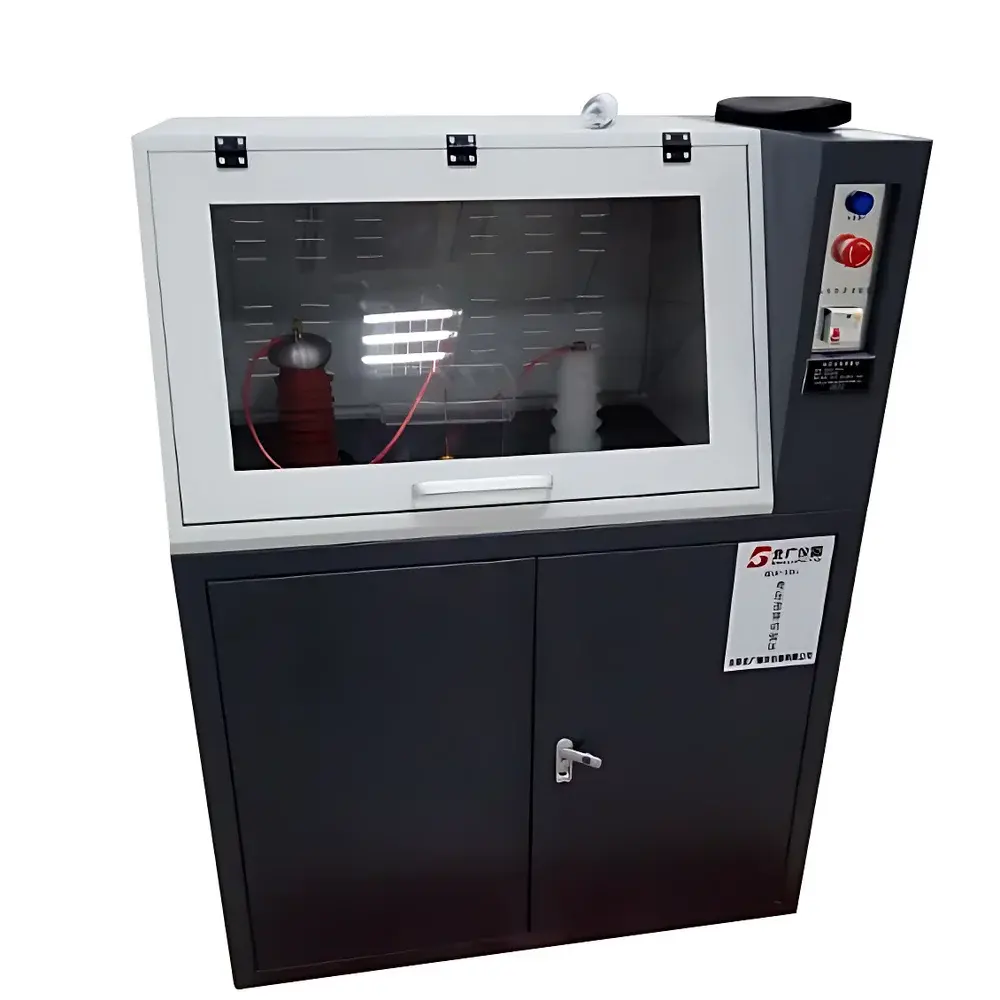
Beijing North Guang Precision Instruments BDJC-20KV AC/DC Dielectric Breakdown Tester for Capacitor Paper and Cable Paper
| Brand | Beijing North Guang Precision Instruments |
|---|---|
| Origin | Beijing, China |
| Manufacturer Type | OEM Manufacturer |
| Product Category | Domestic |
| Model | BDJC-20KV |
| Rated Breakdown Voltage | 20 kV AC/DC |
| Input Voltage | 220 V AC |
| Power Rating | 5 kVA |
| Voltage Range | 0–50 kV (adjustable) |
| Rise Rate | 0.1–3 kV/s (continuously variable) |
| Voltage Measurement Accuracy | ≤ ±1% |
| Test Duration Range | 0–6 hours (software-settable) |
| Dimensions (L×W×H) | 1200 × 800 × 1500 mm |
| Weight | ~100 kg |
| Compliance | GB 1408.1–2006, GB/T 1695–2005, GB/T 3333–1999, GB/T 12656–1990, ASTM D149, ASTM D3755, HG/T 3330 |
Overview
The Beijing North Guang Precision Instruments BDJC-20KV AC/DC Dielectric Breakdown Tester is a precision-engineered high-voltage testing system designed for determining the dielectric strength and withstand voltage performance of solid insulating materials under power-frequency (48–62 Hz) or direct-current conditions. Based on the principle of controlled voltage ramping—either continuous uniform rise or stepwise increment—the instrument applies calibrated AC or DC voltage across a standardized test specimen until electrical breakdown occurs, enabling accurate measurement of breakdown voltage and subsequent calculation of dielectric strength (kV/mm). The system fully complies with international and national standards including GB 1408.1–2006 (Part 1: Tests at power frequency), GB/T 1695–2005 (vulcanized rubber), GB/T 3333–1999 (cable paper), GB/T 12656–1990 (capacitor paper), ASTM D149 (standard test method for dielectric breakdown voltage of solid electrical insulating materials), and ASTM D3755 (dielectric strength of insulating varnishes). Its architecture integrates electro-mechanical precision, optical isolation for signal integrity, and real-time waveform capture to ensure traceable, repeatable, and auditable test outcomes in R&D, QC, and certification laboratories.
Key Features
- Continuously adjustable voltage ramp rate from 0.1 kV/s to 3 kV/s, supporting both ultra-slow and rapid-rise test protocols per updated standard requirements.
- Dual-mode operation: AC (0–50 kV) and DC (0–50 kV) output, with independent calibration and error compensation.
- Optically isolated data acquisition system eliminates electromagnetic interference during high-voltage transients, ensuring stable current leakage monitoring (<1 mA resolution) and precise breakdown detection.
- Automatic arc-quenching response: Upon breakdown detection, output voltage drops to zero within <100 ms, minimizing specimen damage and enhancing operator safety.
- Vertical cabinet design with integrated castor wheels reduces laboratory footprint and enables flexible repositioning—eliminating the need for fixed mounting platforms required by horizontal alternatives.
- Nine-layer hardware and software interlock system: includes overvoltage protection, overcurrent cutoff (<0.1 s response), short-circuit containment, safety door interlock, zero-voltage reset, post-test automatic discharge, dedicated grounding, electromagnetic discharge circuitry, and software-based operational authorization.
- Motor-driven servo-controlled voltage regulation ensures mechanical stability and long-term repeatability without contact wear or drift.
Sample Compatibility & Compliance
The BDJC-20KV accommodates a broad spectrum of solid dielectric specimens—including capacitor paper, cable paper, polymer films (e.g., PET, PE, PVC), vulcanized rubber, ceramic tiles, glass plates, mica sheets, epoxy laminates, silicone elastomers, insulating varnish films, fiber-reinforced composites, and rigid insulation boards. Testing may be conducted in ambient air or immersed in insulating oil (e.g., transformer oil), per Clause 6 of GB 1408.1–2006. Electrode configurations conform to standardized geometries (e.g., spherical, cylindrical, or parallel-plate per IEC 60243-1), and sample thickness is automatically factored into dielectric strength calculations. All test sequences are fully compliant with GLP and GMP documentation requirements; audit trails, user access logs, parameter change history, and electronic signatures align with FDA 21 CFR Part 11 readiness when deployed with validated software configurations.
Software & Data Management
The proprietary Windows-based control software provides full IEC 61508-aligned human-machine interface with intuitive workflow navigation. Real-time voltage–time and leakage current–time curves are rendered in color-coded overlays, enabling immediate visual assessment of pre-breakdown conduction behavior and breakdown consistency across replicate samples. Each test session auto-generates timestamped metadata (operator ID, environmental temperature/humidity if externally logged, electrode type, immersion medium, ramp profile), stored in encrypted binary format with optional CSV export. Post-test analysis tools support curve superposition, statistical deviation reporting (mean, SD, CV%), pass/fail flagging per user-defined thresholds, and customizable report templates compatible with Word and Excel. Role-based access control (with password-protected admin mode) enforces procedural integrity, while all parameter modifications are time-stamped and non-erasable in the local audit log.
Applications
This tester serves as a primary qualification tool across electrical insulation material development and quality assurance workflows. Key application domains include: evaluation of capacitor-grade kraft paper and polypropylene film dielectric integrity for energy storage systems; validation of cable jacket and bedding compound resistance to partial discharge initiation; screening of aerospace-grade laminates (e.g., G10/FR4) for high-altitude corona resistance; verification of medical device insulation barriers per IEC 60601-1; certification of EV battery module separators under thermal–electrical stress coupling; and routine lot-release testing of industrial insulating varnishes, potting compounds, and encapsulants used in motor windings and transformers. It is routinely deployed in third-party testing labs accredited to ISO/IEC 17025 for electrical safety certification (e.g., UL, TÜV, CCC).
FAQ
What standards does the BDJC-20KV explicitly support?
It is engineered to meet GB 1408.1–2006, GB/T 1695–2005, GB/T 3333–1999, GB/T 12656–1990, ASTM D149, ASTM D3755, and HG/T 3330—with documented traceability to NIM (National Institute of Metrology, China) voltage calibration protocols.
Can the system perform both AC and DC breakdown tests?
Yes—dual high-voltage modules deliver independently regulated AC (48–62 Hz) and DC outputs up to 50 kV, each with dedicated feedback control and accuracy verification.
Is software validation available for regulated environments?
Upon request, IQ/OQ documentation packages and 21 CFR Part 11 compliance add-ons—including electronic signature modules and secure audit trail archiving—are available for pharmaceutical, medical, and aerospace QA departments.
How is electrical noise suppressed during measurement?
All analog signal paths utilize galvanic optical isolation; voltage and current sensors employ shielded twisted-pair cabling with ferrite suppression, achieving >80 dB common-mode rejection at 50/60 Hz and harmonics.
What safety certifications does the instrument hold?
It conforms to GB/T 21711.1–2008 (safety requirements for electrical equipment) and carries CE marking for EMC (EN 61326-1) and low-voltage directive (2014/35/EU) compliance.



