
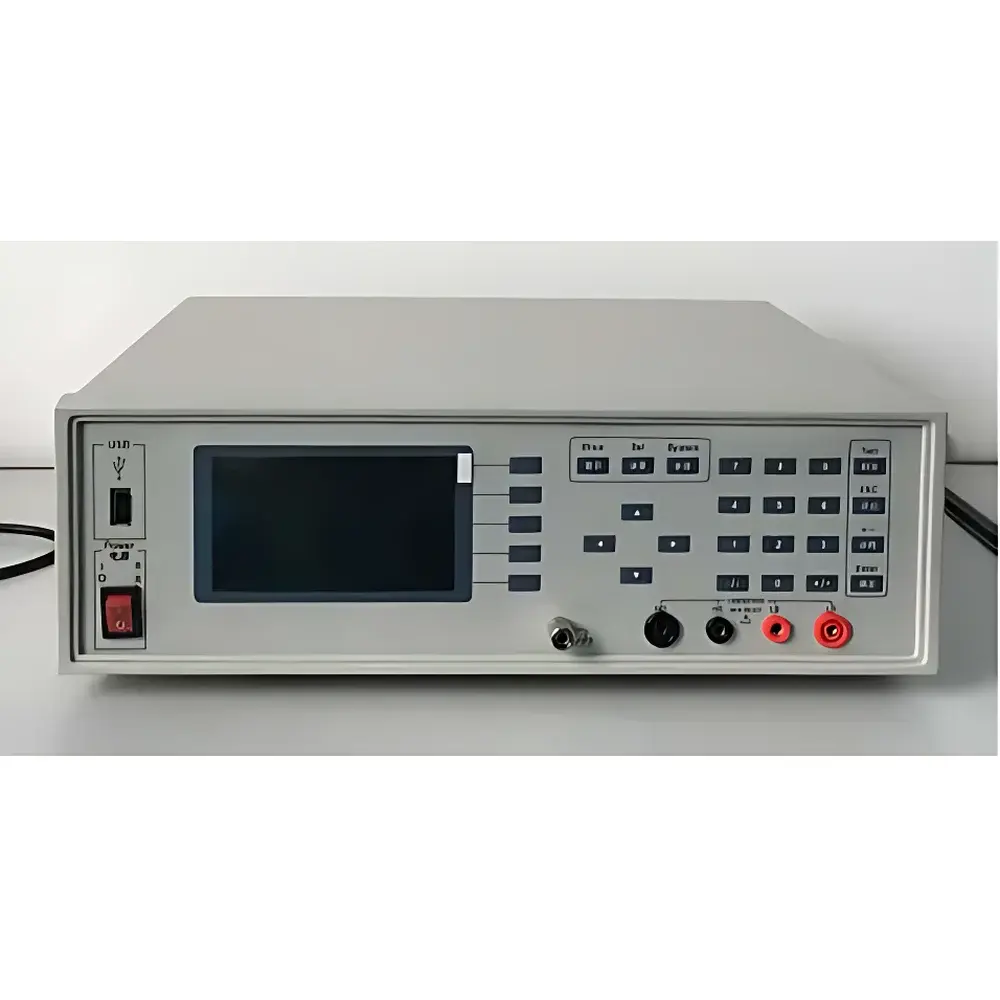
Beijing North Guang Precision Instrument BEST-10 Carbon Resistivity Tester
| Brand | Beijing North Guang Precision Instrument |
|---|---|
| Model | BEST-10 |
| Measurement Principle | Four-Terminal (Kelvin) DC Resistivity Method |
| Sample Forms | Solid rods, blocks, and powders (with optional fixtures) |
| Voltage Ranges | 2 mV / 20 mV / 200 mV / 2 V (resolution down to 0.1 µV) |
| Current Output | 100 µA to 10 A (accuracy: ±0.1% for ≤100 mA |
| Resistivity Range | 2×10⁻⁸ Ω·cm to 20 kΩ·cm |
| Resistance Resolution | 0.01 µΩ |
| Display | 4.3-inch LCD showing real-time resistivity, conductivity, resistance, voltage, current, and temperature |
| Compliance Standards | GB/T 6717, GB/T 24525–2009, YS/T 63.2–2005, YS/T 64–1993, ISO 11713:2000 |
| Power Supply | AC 220 V ±10%, 50/60 Hz |
| Software Option | PC-based data acquisition with charting and report generation (optional) |
Overview
The Beijing North Guang Precision Instrument BEST-10 Carbon Resistivity Tester is an engineered solution for precise, traceable DC resistivity measurement of carbonaceous materials under ambient conditions. It operates on the four-terminal (Kelvin) method—eliminating lead and contact resistance errors—to deliver high-fidelity characterization of bulk electrical properties in industrial-grade carbon products. Designed specifically for the metallurgical and electrode manufacturing sectors, the instrument meets the metrological rigor required for quality control of cathode blocks, prebaked anodes, anode pastes, and graphite electrodes. Its architecture supports stable, low-noise current sourcing and microvolt-level voltage sensing across six decades of resistance (0.01 µΩ to 20 kΩ), enabling reproducible evaluation of material homogeneity, sintering density, and graphitization degree—all critical parameters influencing electrochemical efficiency in aluminum smelting cells.
Key Features
- Four-terminal DC measurement topology with automatic current range selection (100 µA to 10 A), minimizing thermal EMF and contact potential interference.
- High-resolution voltage sensing: selectable ranges (2 mV–2 V) with digitized resolution down to 0.1 µV on the lowest range; accuracy specified as ±0.1% of reading + 6 digits (2 mV range) or ±0.1% + 2 digits (higher ranges).
- Dual-channel real-time display on a 4.3-inch industrial-grade LCD: simultaneous readout of resistivity (Ω·cm), conductivity (S/cm), resistance (Ω), applied current (A), measured voltage (V), and ambient temperature (°C).
- Modular fixture compatibility: configurable test jigs for cylindrical rods (diameter 100–600 mm, length 1.6–2 m), cuboidal blocks, and compacted powder specimens—ensuring geometric consistency per ASTM D4496 and ISO 11713 protocols.
- Embedded calibration traceability: internal reference standards support field verification against NIST-traceable shunts; full calibration log stored in non-volatile memory.
Sample Compatibility & Compliance
The BEST-10 is validated for use with carbon and graphite materials conforming to industry-standard geometries and processing histories. It accommodates solid-state forms including extruded rods, molded blocks, and cold-isostatically pressed (CIP) compacts—as well as granular or pelletized powders when paired with standardized die-press fixtures. All measurements comply with internationally recognized methods: GB/T 6717 (China), GB/T 24525–2009 (aluminum industry cathode specifications), YS/T 63.2–2005 (carbon material resistivity testing), and ISO 11713:2000 (determination of electrical resistivity of carbonaceous materials). The system supports audit-ready documentation aligned with GLP and GMP frameworks, including timestamped measurement records, operator ID logging, and configurable pass/fail thresholds per batch specification.
Software & Data Management
An optional Windows-compatible software suite enables automated data capture, visualization, and reporting. The application acquires time-stamped readings at user-defined intervals, generates XY plots (e.g., resistivity vs. position along rod axis), exports CSV and PDF reports compliant with internal QA templates, and supports statistical process control (SPC) charting (X-bar/R, Cpk). Data files include embedded metadata: instrument serial number, calibration date, test standard referenced, fixture ID, and environmental conditions. The software adheres to FDA 21 CFR Part 11 requirements for electronic records—featuring role-based access control, audit trails, and digital signature capability for release-critical measurements.
Applications
- Quality assurance of cathode carbon blocks and prebaked anodes in primary aluminum production facilities.
- In-process monitoring of graphitization efficiency during high-temperature heat treatment of electrode blanks.
- R&D evaluation of novel carbon composites, silicon-carbon anodes, and binder-modified graphite powders for battery applications.
- Material certification for nuclear-grade graphite moderators where resistivity correlates with neutron absorption cross-section stability.
- Academic research into structure–property relationships in polycrystalline graphite, carbon fiber-reinforced ceramics, and pyrolytic carbon coatings.
FAQ
What sample dimensions are supported without custom fixturing?
Standard configuration accommodates cylindrical specimens 1.6–2.0 m in length and 100–600 mm in diameter, per GB/T 6717 requirements.
Does the instrument meet ISO/IEC 17025 calibration requirements?
Yes—the BEST-10 includes factory calibration certificates traceable to national metrology institutes; users may perform in-house verification using certified low-resistance shunts.
Can the system measure resistivity of powdered carbon under pressure?
Yes—when used with optional uniaxial powder compaction fixtures (e.g., 13 mm or 25 mm die sets), enabling resistivity evaluation per YS/T 63.2–2005 Annex B.
Is temperature compensation available during measurement?
The unit integrates a calibrated Pt100 sensor for ambient temperature monitoring; resistivity values are automatically corrected to 20 °C using the standard carbon temperature coefficient (α = −0.0005 °C⁻¹) unless disabled by user preference.
What is the minimum measurable resistivity for highly conductive graphite?
With 10 A excitation and 2 mV range, the system resolves resistivities down to 2×10⁻⁸ Ω·cm—sufficient for dense, highly graphitized electrode materials.



