
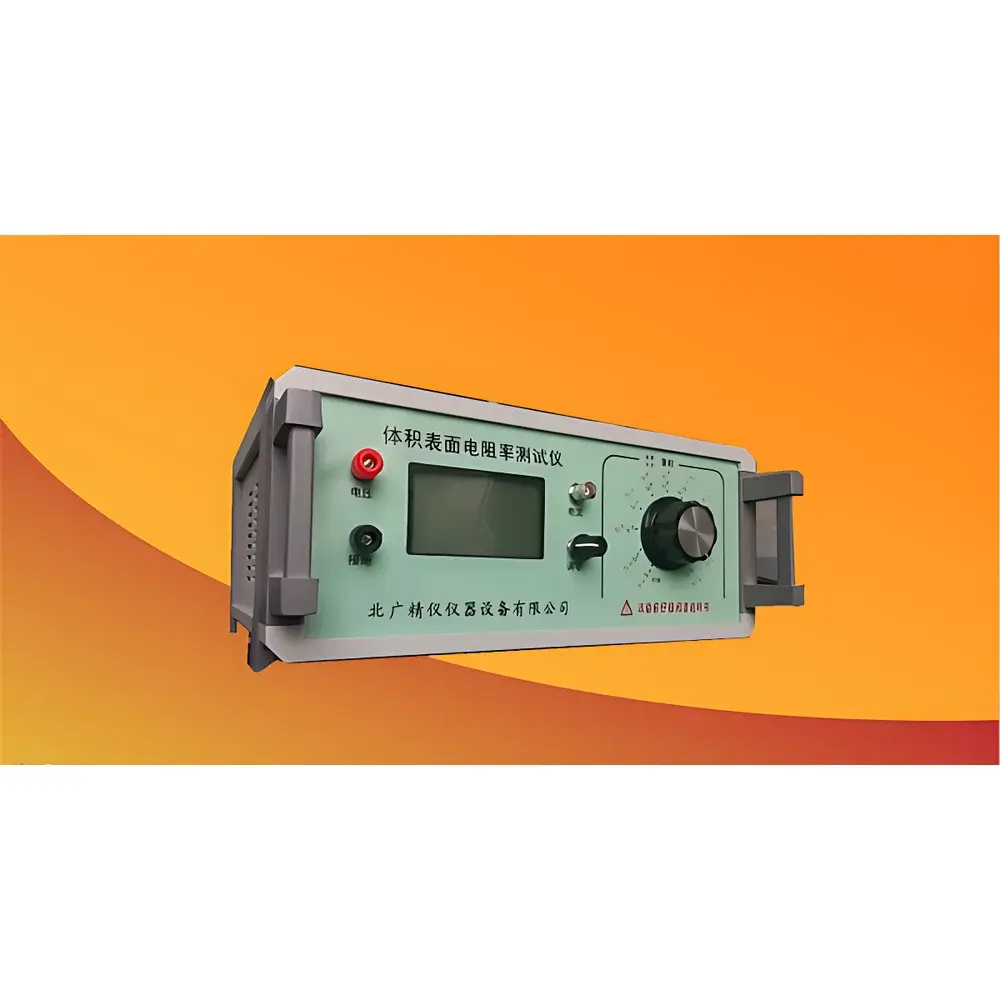
Beijing Guangjing BEST-121 Digital Volume & Surface Resistivity Tester for Rubber and Insulating Materials
| Brand | Beijing Guangjing / All Precision Instrument |
|---|---|
| Origin | Beijing, China |
| Manufacturer Type | Direct Manufacturer |
| Product Origin | Domestic (China) |
| Model | BEST-121 |
| Pricing | Available Upon Request |
Overview
The Beijing Guangjing BEST-121 Digital Volume & Surface Resistivity Tester is a precision electrometric instrument engineered for the quantitative characterization of electrical insulation performance in solid dielectric materials—particularly elastomers, rubber compounds, plastics, anti-static flooring, footwear, and polymer-based electronic packaging. It operates on the principle of direct-current (DC) voltage application and high-impedance current measurement, enabling simultaneous determination of volume resistivity (ρv, in Ω·m) and surface resistivity (ρs, in Ω/sq) in accordance with internationally recognized test methodologies. The instrument implements the three-electrode configuration specified in ASTM D257 and GB/T 1410, minimizing edge effects and guard-ring leakage to ensure metrological integrity during high-resistance measurements. Its core architecture integrates custom large-scale integrated circuits (LSI) derived from legacy Intel design principles, delivering stable operation across an ultra-wide resistance range—from 1 × 10⁴ Ω to 1 × 10¹⁸ Ω—with calibrated accuracy per IEC 62631-3-1 and ISO 3915 traceability requirements.
Key Features
- Triple-range DC test voltage selection: 10 V, 50 V, 100 V, 250 V, 500 V, and 1000 V—user-selectable to match material conductivity class and avoid dielectric polarization artifacts.
- Dual-display digital readout: Simultaneous 3½-digit indication of resistance value (Ω) and leakage current (A), eliminating manual calculation and reducing operator error.
- Eight-decade resistance measurement capability with selectable multiplier ranges (×10² to ×10⁹), each validated to ±10% up to 1 × 10¹³ Ω and ±20% beyond, in compliance with GJB 5104-2004 for electrostatic control coatings.
- Current measurement range: 2 × 10⁻⁴ A to 1 × 10⁻¹⁶ A—enabling direct microcurrent quantification where Ohm’s Law derivation is impractical.
- Integrated three-electrode test fixture: Consisting of guarded main electrode, guard ring, and back electrode—designed to isolate bulk conduction from surface conduction pathways per ASTM D257 Annex A3.
- Thermal and humidity-stabilized analog front-end: Mitigates thermoelectric offset and electrolytic potential drift during extended dwell-time measurements.
Sample Compatibility & Compliance
The BEST-121 supports standardized testing of heterogeneous insulating specimens including vulcanized rubber soles, ESD-safe polymer sheets, conductive elastomer gaskets, computer room raised-floor tiles (per GB/T 6650), and molded plastic housings. It accommodates flat, rigid, or semi-flexible samples ≥1 mm thick and ≥100 mm × 100 mm in planar dimension. Compliance extends to multiple regulatory frameworks: ASTM D257 (Standard Test Methods for DC Resistance or Conductance of Insulating Materials), GB/T 1410 (Chinese national standard for volume/surface resistivity), USP (for pharmaceutical packaging qualification), and ISO 3915 (Electrical resistance of conductive plastics). For GLP/GMP environments, the instrument supports audit-ready documentation when paired with external data loggers compliant with FDA 21 CFR Part 11 requirements for electronic records.
Software & Data Management
While the BEST-121 operates as a standalone benchtop instrument, its analog output interface (0–5 V DC proportional to log₁₀(R)) enables integration with third-party SCADA systems or PC-based acquisition platforms (e.g., LabVIEW, MATLAB). Raw resistance and current values are displayed in real time; no proprietary software is required for basic operation. For traceable reporting, users may manually record readings alongside environmental metadata (temperature: 10–40 °C; relative humidity: 40–70 % RH per GB/T 10580 pre-conditioning protocol). Calibration certificates—including uncertainty budgets referenced to NIM (National Institute of Metrology, China) standards—are provided with each unit shipment.
Applications
- Quality assurance of anti-static footwear: Verification of sole resistance within 5 × 10⁴ Ω to 1 × 10⁸ Ω (GB 4386-84) and conductive footwear ≤1.5 × 10⁵ Ω.
- Volume resistivity screening of rubber formulations: Detection of ionic impurities or carbon-black dispersion anomalies affecting dielectric homogeneity.
- Surface resistivity mapping of ESD work surfaces: Validation of system resistance <1 × 10⁹ Ω per ANSI/ESD S20.20.
- Insulation integrity assessment of cable jacketing and transformer bushings: Quantification of aging-induced resistivity degradation.
- Research-grade characterization of novel dielectric nanocomposites: Correlation of filler loading (e.g., graphene, CNTs) with percolation threshold behavior.
FAQ
What is the recommended preconditioning protocol for rubber samples prior to testing?
Per GB/T 10580, specimens must be conditioned at 23 ± 2 °C and 50 ± 5 % RH for ≥48 h after vulcanization. Surface cleaning with isopropyl alcohol and lint-free wiping is mandatory before electrode placement.
Why does surface resistivity vary more than volume resistivity under ambient humidity changes?
Surface conduction is dominated by adsorbed moisture layers and ionic contaminants; volume conduction depends on bulk lattice defects and dopant concentration—making ρs inherently more sensitive to environmental fluctuations.
Can the BEST-121 measure resistivity of porous elastomers like sponge rubber?
Yes—provided the sample thickness exceeds electrode gap depth and surface contact is uniform. Use 100 V test voltage and 60 s electrification time to minimize capillary current artifacts.
Is three-electrode measurement mandatory for volume resistivity?
Yes—ASTM D257 mandates guard-ring configuration to exclude surface leakage paths. Two-electrode mode is only valid for qualitative screening of homogeneous, non-hygroscopic solids.
How often should calibration verification be performed?
Annual calibration against certified reference resistors (e.g., IET Labs SR104) is recommended. In-process verification using 1 × 10⁹ Ω and 1 × 10¹² Ω standards should occur before each test session.



