
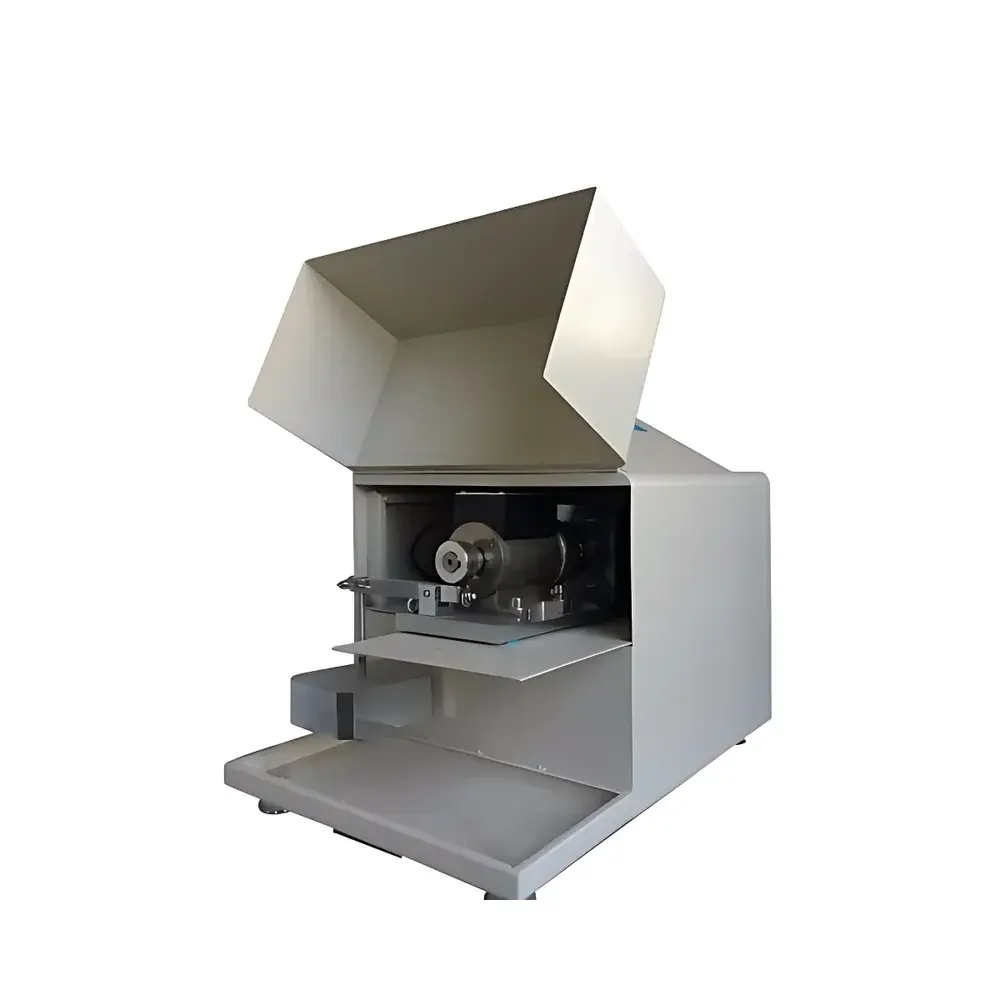
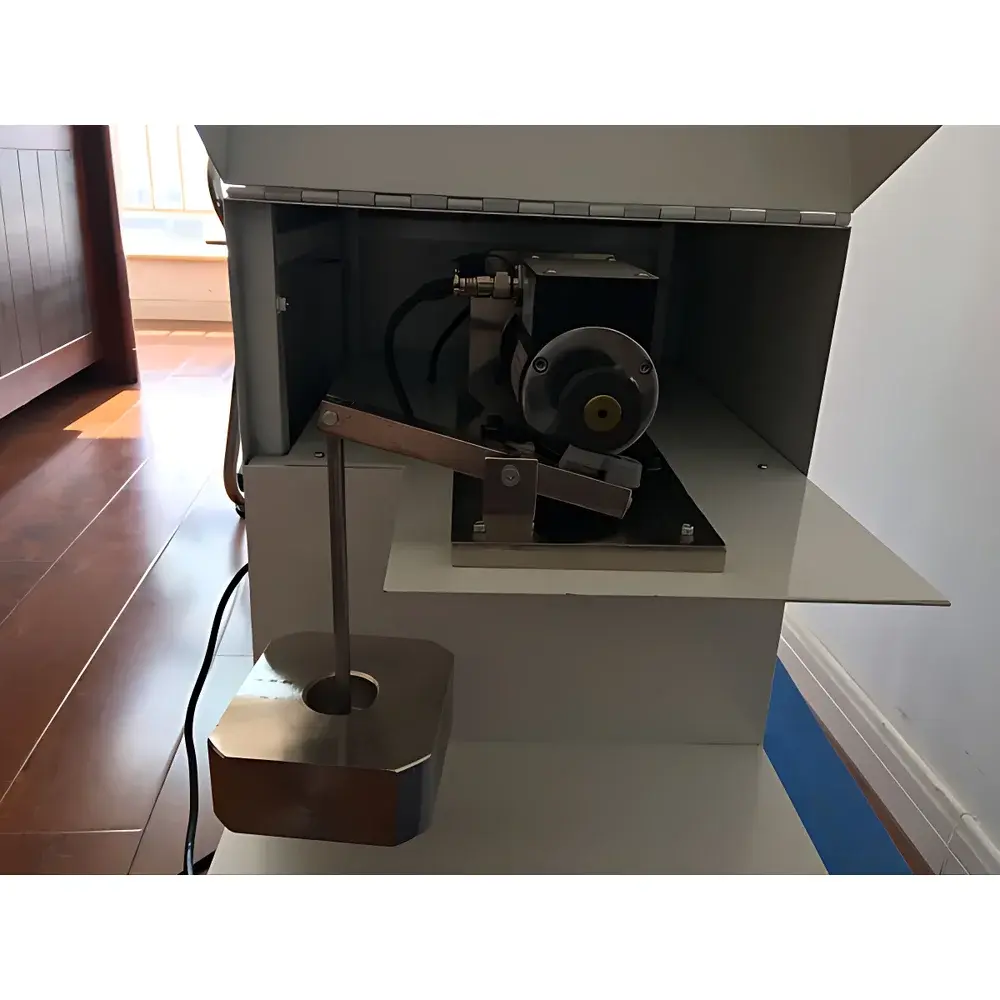
North Guangjingyi M-201 Plastic Sliding Friction and Wear Tester
| Brand | North Guangjingyi / All Precision Instrument |
|---|---|
| Origin | Beijing, China |
| Manufacturer Type | Direct Manufacturer |
| Product Category | Domestic |
| Model | M-201 |
| Instrument Type | Coefficient of Friction Tester |
| Maximum Friction Force | 196 N (extendable to 392 N) |
| Friction Force Resolution | 1% FS |
| Torque Range | 0–4 N·m |
| Rotational Speed | 0–500 rpm (adjustable) |
| Test Temperature Range | Ambient (23 ± 5 °C per ASTM D3702) |
| Specimen Dimensions | 30 mm × 7 mm × 6 mm |
| Counter Accuracy | ±1 s |
| Load Accuracy | ±0.5% |
| Speed Accuracy | ±1% |
| Torque Measurement Accuracy | ±1% FS |
| Friction Ring | Ø40 × 10 mm, 45# steel, hardened to HRC 40–45, surface roughness Ra ≤ 3.2 µm (▽8), concentricity deviation < 0.01 mm |
Overview
The North Guangjingyi M-201 Plastic Sliding Friction and Wear Tester is a precision-engineered tribological testing system designed for quantitative evaluation of sliding friction behavior and wear resistance in polymeric materials under controlled normal load and rotational motion. It operates on the principle of pin-on-disk (or block-on-ring) configuration per ASTM D3702 and ISO 8295, where a rectangular plastic specimen is pressed against a rotating hardened steel ring under constant normal force. The system measures real-time dynamic torque output, enabling direct calculation of coefficient of friction (µ = T / (r × Fn)), while wear volume or wear track width is determined post-test via gravimetric or profilometric analysis. Engineered for repeatability and traceability, the M-201 supports standardized qualification of engineering thermoplastics—including POM, PA6/66, PTFE, UHMWPE, and filled composites—under laboratory-controlled environmental conditions (23 ± 5 °C, 50 ± 5% RH unless otherwise specified).
Key Features
- High-stability electromechanical drive system with closed-loop speed control (0–500 rpm, ±1% accuracy) and low radial runout (<0.01 mm at ring mounting shaft)
- Dual-range calibrated load application: standard 196 N (20 kgf) ±0.1%, extendable to 392 N (40 kgf) via modular weight stack (1×4 kg + 4×1 kg certified masses)
- High-resolution torque transducer (0–4 N·m, ±1% full-scale accuracy) with digital signal conditioning and noise-immune analog-to-digital conversion
- Integrated real-time data acquisition: simultaneous plotting of coefficient of friction vs. time and torque vs. time curves on host PC interface
- User-level access control with role-based permissions (administrator, operator, reviewer) supporting GLP-compliant audit trails
- Compact benchtop architecture with rigid cast-iron base, vibration-damped isolation, and ergonomic specimen loading mechanism
- Comprehensive calibration documentation including torque sensor certificate, load cell verification report, and rotational encoder traceability to national standards
Sample Compatibility & Compliance
The M-201 accommodates standard ASTM D3702 and GB/T 3960 specimens (30 mm × 7 mm × 6 mm), with optional custom fixtures available for alternative geometries. Friction counterfaces comply strictly with material, hardness (HRC 40–45), dimensional tolerance (Ø40.00 ±0.02 mm × 10 mm), and surface finish (Ra ≤ 3.2 µm) requirements. All mechanical and electrical subsystems conform to IEC 61000-6-2 (EMC immunity) and IEC 61010-1 (safety). Test methodology aligns with ASTM D3702 (Plastic Materials—Coefficient of Friction), ISO 8295 (Plastics—Determination of Coefficient of Friction), and GB/T 3960 (Plastic—Determination of Coefficient of Friction). Data integrity meets FDA 21 CFR Part 11 requirements for electronic records and signatures when used with validated software configurations.
Software & Data Management
The included Windows-based control and analysis suite provides ISO/IEC 17025-aligned data handling: automatic timestamping, raw torque/load/time logging at ≥10 Hz sampling rate, and embedded calculation modules for µ, wear volume (V = π × w² × d / 4, per ASTM D3702 Annex A1), and specific wear rate (mm³/N·m). Reports are exportable in PDF and XLSX formats, include configurable headers (lab ID, operator, calibration dates), editable footnotes, and digital signature fields. Audit logs record all parameter changes, user logins, and report generation events. Software supports CSV import/export for third-party statistical analysis (e.g., JMP, Minitab) and integrates with LIMS via ODBC drivers.
Applications
- Quality control of injection-molded polymer components for automotive interior trim, gears, and bearing cages
- R&D screening of lubricant additives, solid lubricants (MoS₂, graphite), and filler effects (glass fiber, carbon nanotubes) on tribological performance
- Comparative wear ranking of biocompatible polymers (PEEK, UHMWPE) for orthopedic implant qualification
- Accelerated aging studies correlating friction evolution with thermal-oxidative degradation under sustained load
- Validation of surface treatments (plasma etching, fluorination) for reducing static/dynamic µ in packaging films
- Supporting regulatory submissions requiring documented friction/wear data per ISO 10993-6 (biological evaluation of medical devices)
FAQ
What standards does the M-201 support out-of-the-box?
ASTM D3702, ISO 8295, GB/T 3960, and ASTM D1894 (for coefficient of friction only). Custom test protocols can be programmed via API access.
Can the system operate at elevated temperatures?
No—the M-201 is configured for ambient-condition testing per ASTM D3702 (23 ± 5 °C). High-temperature variants require auxiliary environmental chambers and modified load train components.
Is the friction ring reusable?
Yes—each ring is rated for ≥50 test cycles if resurfaced to original Ø40 mm and Ra ≤ 3.2 µm after each use; rings below Ø36 mm must be retired per ASTM D3702 Section 7.3.
How is wear volume calculated from gravimetric data?
Using density-corrected mass loss: V = (M₁ − M₂) / ρ, where ρ is the certified bulk density (g/cm³) of the test polymer, reported with uncertainty per ISO 1183.
Does the system include calibration certificates?
Yes—factory-issued certificates for torque sensor (NIST-traceable), load weights (class M1), and rotational encoder are supplied with each unit.
Related Products



