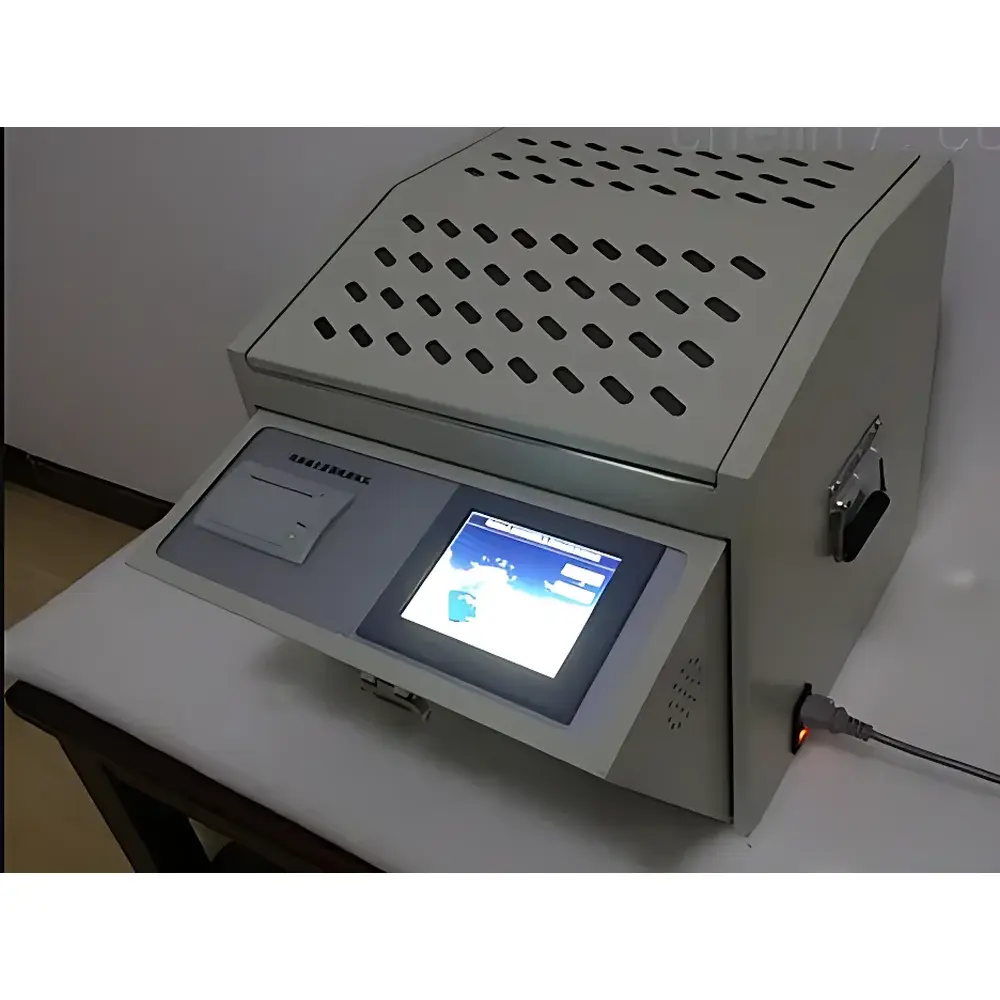
Beiguang GDAT-C1 Insulating Oil Dielectric Loss & Volume Resistivity Tester
| Brand | Beiguang Precision Instrument |
|---|---|
| Origin | Beijing, China |
| Manufacturer Type | OEM Manufacturer |
| Country of Origin | China |
| Model | GDAT-C1 |
| Price | USD 3,500 (FOB Beijing) |
| Compliance | GB/T 5654–2007, IEC 60247 (referenced), ASTM D924 (functional equivalence) |
| Measurement Principle | High-voltage AC/DC bridge method with guarded three-electrode cell |
| Temperature Control | PID-regulated mid-frequency induction heating |
| Display | 7-inch color TFT touchscreen with full Chinese GUI |
| Data Storage | 100 test records with timestamp (RTC integrated) |
| Power Supply | AC 220 V ±10%, 50 Hz, <200 W |
| Dimensions | 420 × 380 × 385 mm |
| Weight | 21 kg |
Overview
The Beiguang GDAT-C1 Insulating Oil Dielectric Loss & Volume Resistivity Tester is a fully integrated, microprocessor-controlled laboratory instrument engineered for precise, standardized evaluation of dielectric performance in transformer oils and other liquid insulating materials. It operates on the principle of high-voltage AC bridge measurement (for dielectric dissipation factor tan δ and relative permittivity εr) and guarded DC resistance measurement (for volume resistivity ρv), in strict accordance with GB/T 5654–2007 — the Chinese national standard technically aligned with IEC 60247 and functionally equivalent to ASTM D924. The system incorporates a precision three-electrode oil cup (electrode gap: 2 mm), digitally stabilized 50 Hz AC test voltage (0–2000 V), adjustable DC test voltage (0–500 V), and closed-loop temperature control (0–125 °C, ±0.5 °C accuracy) via non-contact mid-frequency induction heating. All signal conditioning, data acquisition, and real-time computation are executed using a dedicated DSP core with FFT-based noise suppression, ensuring stable, low-drift measurements under variable ambient conditions.
Key Features
- Automated dual-mode testing: Simultaneous or sequential measurement of dielectric loss factor (tan δ), relative permittivity (εr), and volume resistivity (ρv) within a single thermal cycle.
- Three-electrode oil cup compliant with GB/T 5654–2007: Eliminates stray capacitance and surface leakage effects through guarded electrode geometry; nominal empty-cell capacitance: 60 ±5 pF; empty-cell tan δ < 5×10⁻⁵.
- PID-controlled induction heating system: Enables rapid, uniform oil temperature stabilization without physical contact between heater and cup — reducing thermal gradient error and improving repeatability.
- Digital measurement architecture: Full 24-bit ADC resolution, auto-ranging, and real-time correction for ambient temperature and humidity drift.
- Integrated SF6-filled reference capacitor: Stable capacitance and negligible tan δ over time and environmental variation, preserving long-term calibration integrity.
- 7-inch capacitive touchscreen with localized Chinese GUI: Context-sensitive prompts, step-by-step workflow guidance, and intuitive parameter entry — no specialized operator training required.
- Safety interlocks: Automatic high-voltage cutoff upon oil cup lid opening; short-circuit detection between high- and low-potential electrodes; mandatory grounding verification prior to test initiation.
Sample Compatibility & Compliance
The GDAT-C1 is validated for use with mineral insulating oils (e.g., naphthenic and paraffinic transformer oils), synthetic esters, and silicone-based dielectric fluids meeting IEC 60296 or ASTM D3487 specifications. Its three-electrode cell design accommodates 40 mL sample volume and supports both routine maintenance testing and diagnostic assessment per DL/T 596 and IEEE C57.106. The instrument satisfies technical requirements for GLP-compliant laboratories: all test parameters (voltage, temperature, duration, date/time stamp) are embedded in each stored record; audit trail functionality is enabled via internal RTC and non-volatile memory. While not FDA 21 CFR Part 11 certified out-of-the-box, raw data export (CSV) and manual record retention support traceability in regulated environments requiring ISO/IEC 17025 documentation.
Software & Data Management
All measurement logic, calibration routines, and user interaction are implemented in embedded firmware — no external PC dependency. Test results include: capacitance (5–200 pF, 0.01 pF resolution), εr (1.000–30.000, ±1% reading), tan δ (1×10⁻⁵–100, ±(1% reading + 0.0001)), and ρv (2.5 MΩ·m to 20 TΩ·m, ±10% reading). Each record stores ambient temperature, oil temperature, applied voltage, measurement duration, and operator ID (manually entered). Up to 100 tests are retained with automatic timestamping; data can be printed via built-in thermal printer or exported via USB interface (CSV format). The “empty cup calibration” function verifies electrode cleanliness and mechanical assembly integrity prior to sample introduction — critical for achieving ≤5% measurement uncertainty in accredited labs.
Applications
- Condition monitoring of power transformer insulation oil in substation maintenance programs.
- Quality assurance during oil reclamation, regeneration, or blending processes.
- Acceptance testing of new insulating oils per manufacturer specifications and grid operator standards (e.g., State Grid Corporation of China Q/GDW 11212).
- Research and development of next-generation biodegradable dielectric fluids.
- Root-cause analysis of insulation degradation: elevated tan δ indicates polar contaminant accumulation; reduced ρv suggests moisture ingress or oxidation byproducts.
FAQ
What standards does the GDAT-C1 comply with?
It is designed and verified per GB/T 5654–2007, with functional alignment to IEC 60247 and ASTM D924 for dielectric loss and resistivity measurements.
Is the oil cup cleaning procedure standardized?
Yes — the manual provides two protocols: full cleaning (per GB/T 5654 Annex B) for acceptance testing, and simplified cleaning for routine diagnostics, including oil-rinsing procedures between consecutive samples.
Can test data be exported for LIMS integration?
Yes — measurement records are exportable as CSV files via USB flash drive; timestamps, operator IDs, and environmental metadata are included.
What safety certifications does the instrument carry?
It meets GB 4793.1 (equivalent to IEC 61010-1) for electrical safety and includes redundant hardware interlocks for high-voltage and thermal protection.
Is temperature calibration traceable to national standards?
The integrated Pt100 sensor is factory-calibrated against NIM-traceable references; users may perform field verification using certified dry-block calibrators (–10 to 150 °C range).