
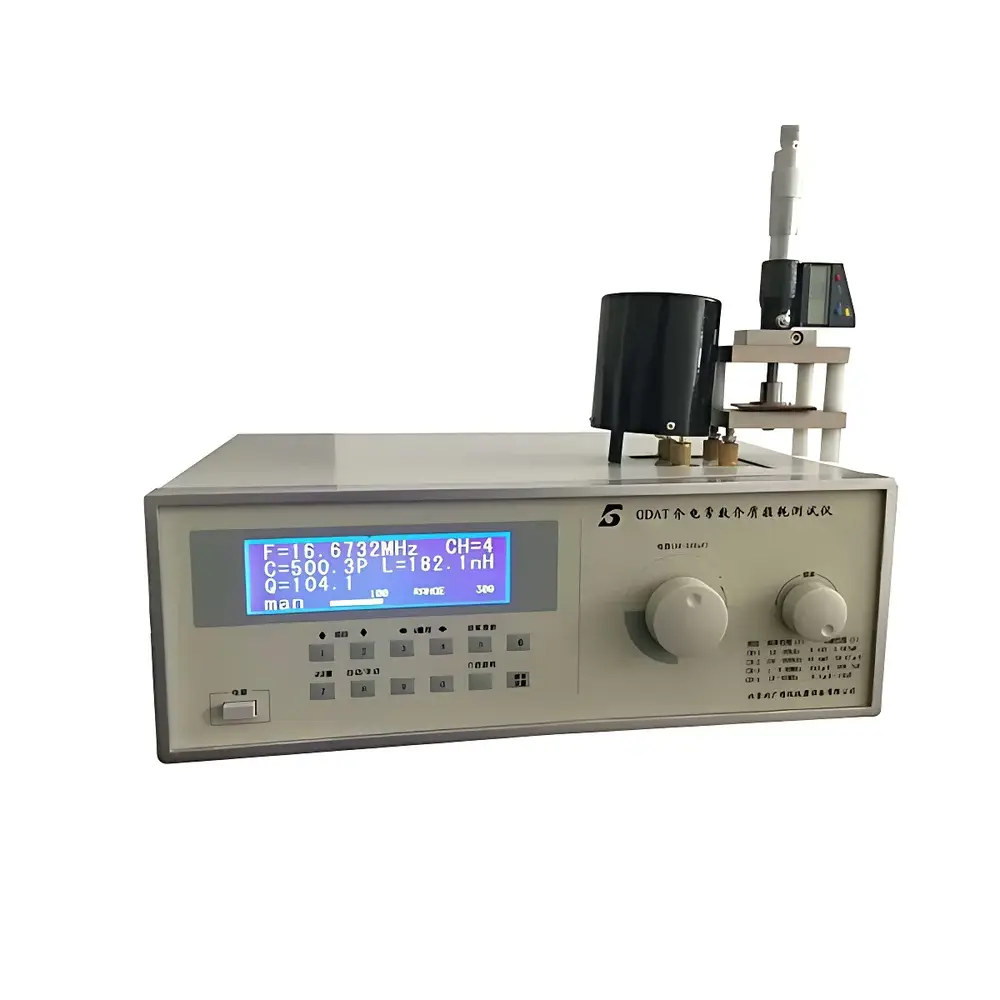
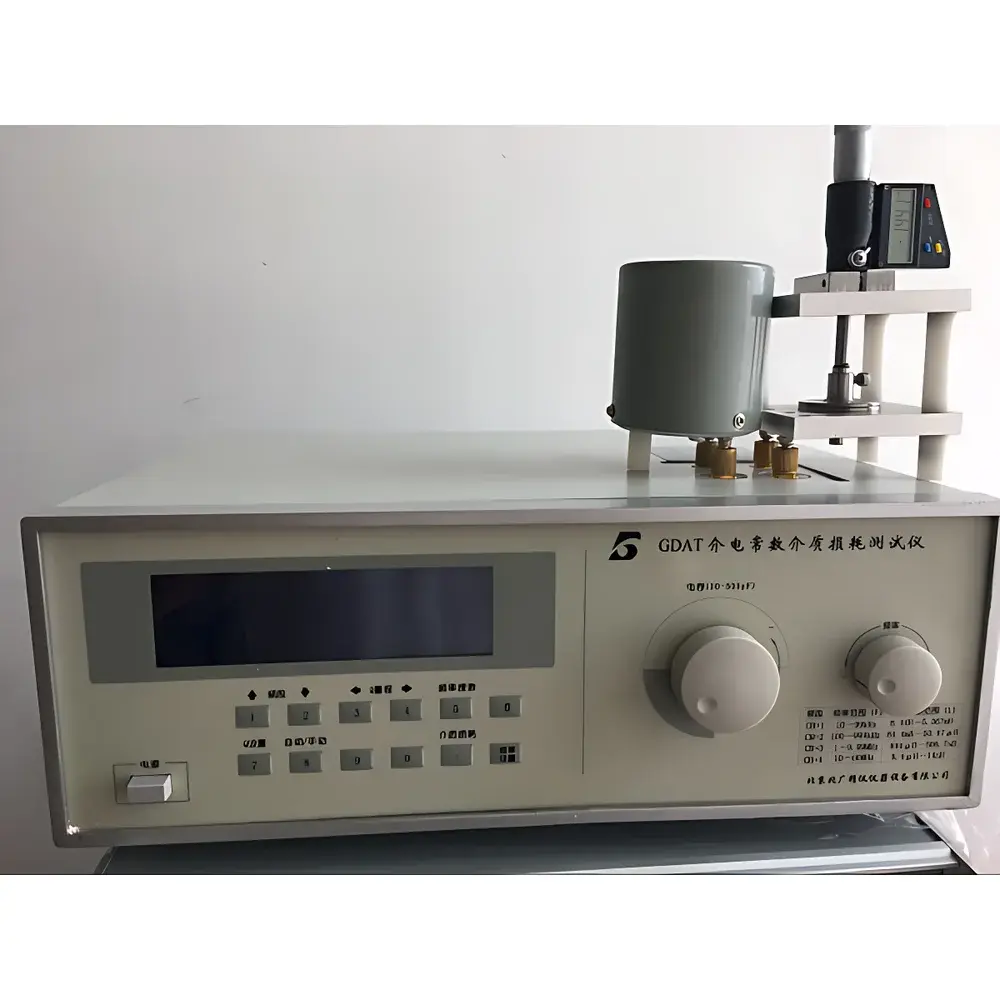
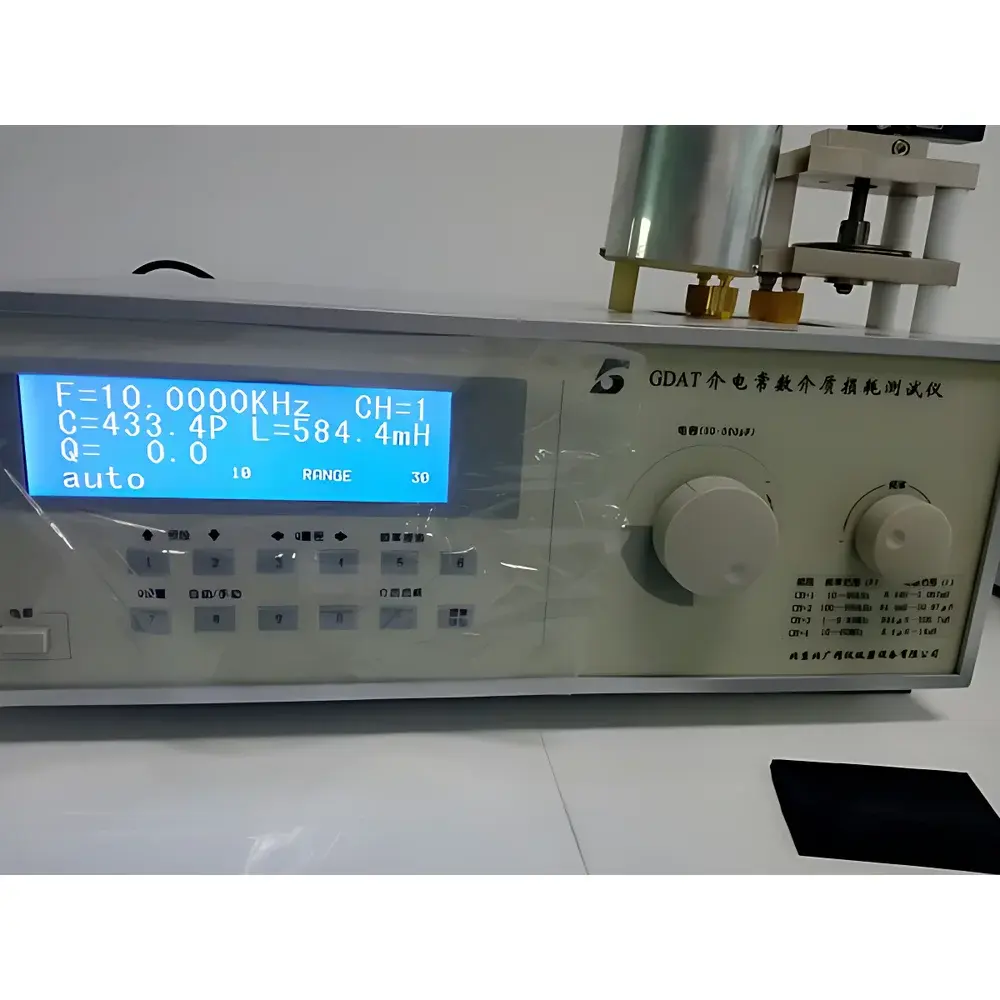
Beiguang Jingyi GDAT-A High-Frequency Dielectric Constant and Loss Tangent Analyzer
| Brand | Beiguang Jingyi / All Precision Instrument |
|---|---|
| Origin | Beijing, China |
| Manufacturer Type | Direct Manufacturer |
| Country of Origin | China |
| Model | GDAT-A |
| Q Factor Range | 1–1023 |
| Q Range Steps | 30, 100, 300, 1000, auto/manual switching |
| Inductance Measurement Range | 1 nH–140 mH |
| Capacitance Direct Measurement Range | 1 pF–25 nF |
| Main Capacitor Tuning Range | 17 pF–240 pF |
| Capacitance Accuracy | ±1 pF (<150 pF), ±1% (>150 pF) |
| Frequency Coverage | 100 kHz–160 MHz |
| Tanδ Measurement Capability | ≤4×10⁻⁴ at 1 MHz |
| Electrode Options | Φ38 mm or Φ50 mm parallel-plate fixtures with micrometer adjustment (resolution ≤0.001 mm) |
| Liquid Cell | 48 mm diameter × 7 mm depth, compatible with S916 lower electrode |
| Power Supply | 220 V ±22 V, 50 Hz ±2.5 Hz |
| Power Consumption | ~25 W |
| Operating Temperature | 0–40 °C |
| Interface | RS232 serial port, built-in thermal printer (Chinese-language output) |
| Display | VFD dot-matrix display with full Chinese menu navigation |
Overview
The Beiguang Jingyi GDAT-A High-Frequency Dielectric Constant and Loss Tangent Analyzer is a precision impedance measurement instrument engineered for the quantitative characterization of dielectric properties in insulating materials—including plastics, ceramics, composites, and polymer-based electrical insulation systems. It operates on the principle of high-frequency resonance, employing a digitally stabilized RF bridge architecture to determine complex permittivity (ε* = ε′ − jε″) and its derived parameters: relative permittivity (ε′) and loss tangent (tan δ = ε″/ε′). Designed in accordance with GB/T 1409–2006—China’s national standard aligned with IEC 60250 and ASTM D150—the GDAT-A supports standardized testing across power frequency (50/60 Hz), audio frequency (1 kHz–20 kHz), and radio frequency bands up to 160 MHz. Its core measurement methodology integrates automatic resonance point detection, frequency digital locking, and adaptive Q-range switching, minimizing residual inductance and enabling high reproducibility in both laboratory and QC environments.
Key Features
- High-stability RF oscillator with digitally locked frequency synthesis across 100 kHz–160 MHz, ensuring traceable and repeatable excitation conditions.
- Dual-mode Q-factor measurement: manual step selection (30/100/300/1000) or fully automatic range switching optimized for dynamic impedance matching.
- Integrated parallel-plate electrode fixtures with precision micrometer adjustment (≤0.001 mm resolution), supporting interchangeable Φ38 mm and Φ50 mm configurations per GB/T 1409 requirements.
- Low-loss fixture design: tan δ ≤ 4×10⁻⁴ at 1 MHz, validated against reference standards to ensure minimal system contribution to measured loss.
- VFD dot-matrix display with intuitive Chinese-language interface—no external documentation required for routine operation; real-time warnings and contextual prompts enhance operational safety and data integrity.
- Built-in thermal printer outputs measurement results—including ε′, tan δ, C, L, Q, and test conditions—in native Chinese, facilitating immediate report generation in domestic QA/QC workflows.
- RS232 serial interface compliant with EIA/TIA-232-E specifications, enabling bidirectional communication with Windows-based host systems for automated data logging, statistical analysis (e.g., Cp/Cpk), and long-term archival in accordance with GLP/GMP record retention policies.
Sample Compatibility & Compliance
The GDAT-A accommodates solid dielectrics (e.g., molded plastic sheets, ceramic substrates, laminated composites) and liquid samples (via optional 48 mm-diameter fluid cell). Solid specimens must be flat, homogeneous, and free of surface contamination or voids; thickness tolerance must meet ±(0.2% + 0.005 mm) per GB/T 1409–2006 Section 6.2. Electrode contact requires uniform pressure and alignment—achieved via calibrated micrometer-driven compression. For low-conductivity materials, uncoated sample insertion into guarded electrode systems is supported. The instrument satisfies essential electromagnetic compatibility (EMC) and electrical safety requirements under GB 4793.1–2019 (IEC 61010-1). While not FDA 21 CFR Part 11–certified out-of-the-box, its RS232 data export capability enables integration into validated LIMS or ELN platforms where electronic signatures, audit trails, and version-controlled protocols are implemented at the enterprise level.
Software & Data Management
No embedded operating system is installed; all control logic resides in firmware executed by an industrial-grade microcontroller. Measurement data—including raw Q, C, L, frequency, and calculated ε′/tan δ values—is timestamped and transmitted via ASCII-formatted RS232 packets. Optional PC software (supplied separately) provides waveform visualization, batch export to CSV/Excel, statistical summary (mean, SD, min/max), and customizable report templates compliant with internal QA documentation standards. All printed or exported records include operator ID, instrument serial number, calibration date, environmental conditions (T/RH), and electrode configuration—supporting ISO/IEC 17025 clause 7.8 on result reporting and traceability.
Applications
This analyzer is routinely deployed in R&D laboratories and production quality control for: evaluating high-frequency insulation performance of polyimide films, PTFE substrates, and epoxy-glass laminates used in PCB manufacturing; quantifying moisture absorption effects on polyamide (PA6/PA66) dielectric stability; screening ceramic capacitor dielectrics (e.g., X7R, C0G) for ε′ consistency and aging-related tan δ drift; validating biocompatible polymer formulations (e.g., silicone elastomers, PEEK) for implantable device encapsulation; and supporting failure analysis of high-voltage bushings and cable terminations where partial discharge inception correlates strongly with localized tan δ anomalies.
FAQ
What standards does the GDAT-A comply with?
It implements GB/T 1409–2006, which is technically equivalent to IEC 60250 and ASTM D150 for dielectric constant and loss tangent measurement.
Can the instrument measure liquid samples?
Yes—using the optional 48 mm-diameter liquid cell, compatible with low-conductivity solvents and polymer solutions per ASTM D924 Annex A3.
Is calibration traceable to national standards?
Factory calibration uses NIST-traceable LCR standards; users receive a certificate of conformance with uncertainty budget per ISO/IEC 17025 requirements.
Does the GDAT-A support automated pass/fail evaluation?
Yes—through programmable tan δ and ε′ upper/lower limits (5–1000 range); visual and audible alerts trigger upon deviation.
What maintenance is required to sustain accuracy?
Annual verification using the supplied LKI-1 inductor set (0.05 µH–10 mH) and reference capacitors is recommended; mechanical cleaning of electrodes with isopropyl alcohol prevents surface contamination-induced drift.



