
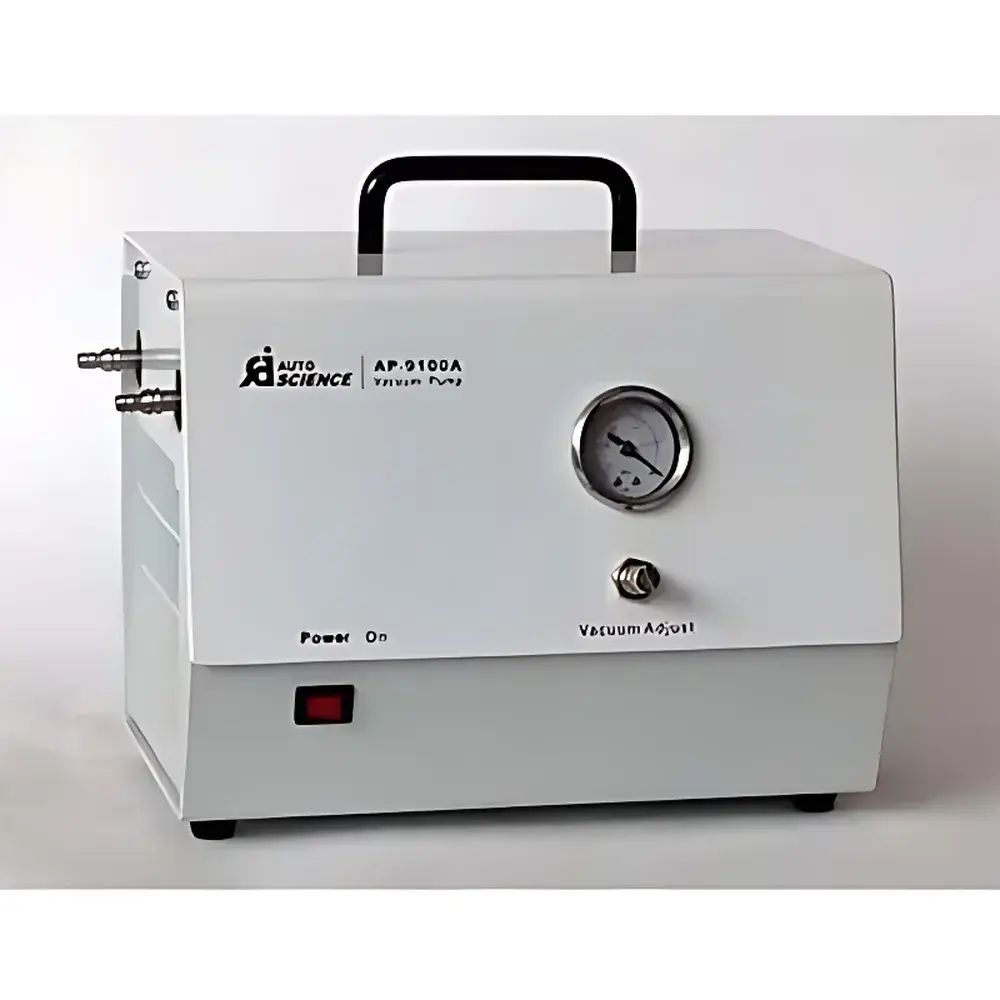
Otisience AP-9100A Diaphragm Vacuum & Pressure Pump
| Brand | Otisience |
|---|---|
| Model | AP-9100A |
| Pump Type | Oil-Free Diaphragm Pump |
| Vacuum Range | 0–95 kPa (gauge), Max Absolute Vacuum >500 kPa (i.e., <50 kPa abs) |
| Pressure Output | Up to 95 kPa (gauge) |
| Flow Rate | 80 L/min |
| Motor Power | 250 W |
| Dimensions (W×H×D) | 270 × 180 × 246 mm |
| Weight | 11.2 kg |
| Power Supply | 220 V / 50 Hz |
| Construction | PPS (Polyphenylene Sulfide) and Anodized Aluminum Housing |
| Compliance | CE-marked, RoHS-compliant, Designed for GLP-Compatible Lab Environments |
Overview
The Otisience AP-9100A is a dual-mode, oil-free diaphragm pump engineered for precision vacuum generation and controlled positive pressure delivery in analytical and preparative laboratory workflows. Unlike rotary vane or piston pumps requiring lubrication, the AP-9100A employs a chemically resistant PPS (polyphenylene sulfide) diaphragm and anodized aluminum pump head—eliminating oil contamination risks and enabling safe operation with aggressive organic solvents such as acetonitrile, methanol, chloroform, and ethyl acetate. Its dual-port architecture supports simultaneous or independent vacuum and pressure applications, making it suitable for both suction-driven processes (e.g., filtration, degassing, solvent removal) and pressure-assisted operations (e.g., sample loading onto SPE cartridges, membrane pressurization, or inert gas purging). The pump operates on a single-phase 220 V / 50 Hz supply and delivers stable performance across ambient temperatures from 5 °C to 40 °C, with thermal protection integrated into the 250 W brushless motor.
Key Features
- Oil-free diaphragm design ensures zero hydrocarbon contamination—critical for HPLC mobile phase preparation, trace analysis, and sterile filtration.
- Dual independent ports: one dedicated vacuum inlet (–95 kPa gauge), one regulated pressure outlet (+95 kPa gauge), each with ISO-KF 16 or NPT 1/4″ compatible fittings (adapters supplied).
- Adjustable pressure/vacuum control via front-panel precision knob—enabling fine-tuned regulation for sensitive applications such as gentle cell lysis or low-pressure lyophilization pre-chamber evacuation.
- Robust construction using injection-molded PPS for diaphragm and valve plates, combined with corrosion-resistant anodized aluminum housing—validated for continuous operation up to 10,000 hours MTBF.
- Low acoustic emission (<52 dB(A) at 1 m), vibration-damped mounting, and compact footprint (270 × 180 × 246 mm) facilitate integration into fume hoods, glove boxes, or modular lab benches.
- Thermal overload cutoff and automatic restart delay prevent motor damage during extended duty cycles or transient overloads.
Sample Compatibility & Compliance
The AP-9100A is routinely deployed in workflows governed by ASTM D854 (vacuum filtration of soils), USP (chromatographic system suitability), and ISO 7207-1 (microbiological membrane filtration). Its solvent-compatible wetted path meets FDA-recommended criteria for Class I and II chemical exposure per ISO 10993-5. When paired with Otisience FB-series filter flasks or PVM/SSM multi-position filter manifolds, the system supports 0.22 µm and 0.45 µm PVDF, nylon, or PTFE membranes without leaching or swelling. All electrical components comply with IEC 61010-1:2010 for laboratory equipment safety, and the unit carries full CE marking under the Low Voltage Directive (2014/35/EU) and EMC Directive (2014/30/EU).
Software & Data Management
While the AP-9100A operates as a standalone analog instrument, its pressure/vacuum output is compatible with third-party digital monitoring systems via optional 0–10 V or 4–20 mA analog output modules (sold separately). For audit-ready environments operating under 21 CFR Part 11 or ISO/IEC 17025, users may integrate the pump into LIMS-controlled workflows using external pressure transducers and programmable logic controllers (PLCs). Built-in mechanical pressure regulation eliminates reliance on software for basic operation—ensuring reliability in GMP manufacturing support labs where firmware validation burdens are minimized.
Applications
- Routine vacuum filtration of aqueous and organic samples using Otisience AMF biological filtration units or SPE columns (e.g., EPA Method 505, 525.3).
- In-line degassing of HPLC mobile phases prior to column equilibration—reducing baseline noise and improving retention time reproducibility.
- Controlled-pressure loading of viscous biological matrices (e.g., plasma, tissue homogenates) onto centrifugal filtration devices or affinity columns.
- Supporting gravimetric analysis per ASTM E180 or ISO 5667-3, where consistent vacuum levels ensure uniform drying kinetics across replicate samples.
- Pre-conditioning of adsorbent tubes and sorbent-packed canisters used in EPA TO-17 air sampling protocols.
- Assisting in cleanroom environmental monitoring setups requiring calibrated negative-pressure differential maintenance.
FAQ
Is the AP-9100A certified for use in explosion-proof environments?
No—it is not intrinsically safe or ATEX-certified. It must be operated outside classified hazardous zones unless housed within an approved ventilated enclosure.
Can this pump be used continuously for 24/7 operation?
Yes, when ambient temperature remains below 35 °C and duty cycle does not exceed 80% (e.g., 48 min ON / 12 min OFF); continuous operation beyond this requires external cooling or duty-cycle monitoring.
What maintenance is required?
No routine oil changes. Annual inspection of diaphragm integrity and valve seating is recommended; replacement kits (diaphragm, valves, gaskets) are available as Otisience part #AP-MK-9100A.
Does it meet ISO 8573-1 Class 0 air purity requirements?
As a vacuum/pressure source—not an air compressor—the AP-9100A is not rated per ISO 8573-1. However, its oil-free architecture ensures Class 0-equivalent cleanliness for vacuum-side applications.
Is remote start/stop capability available?
Not natively—but dry-contact terminals (NO/NC) are provided on the rear panel for integration with building management systems or automated lab platforms.



