
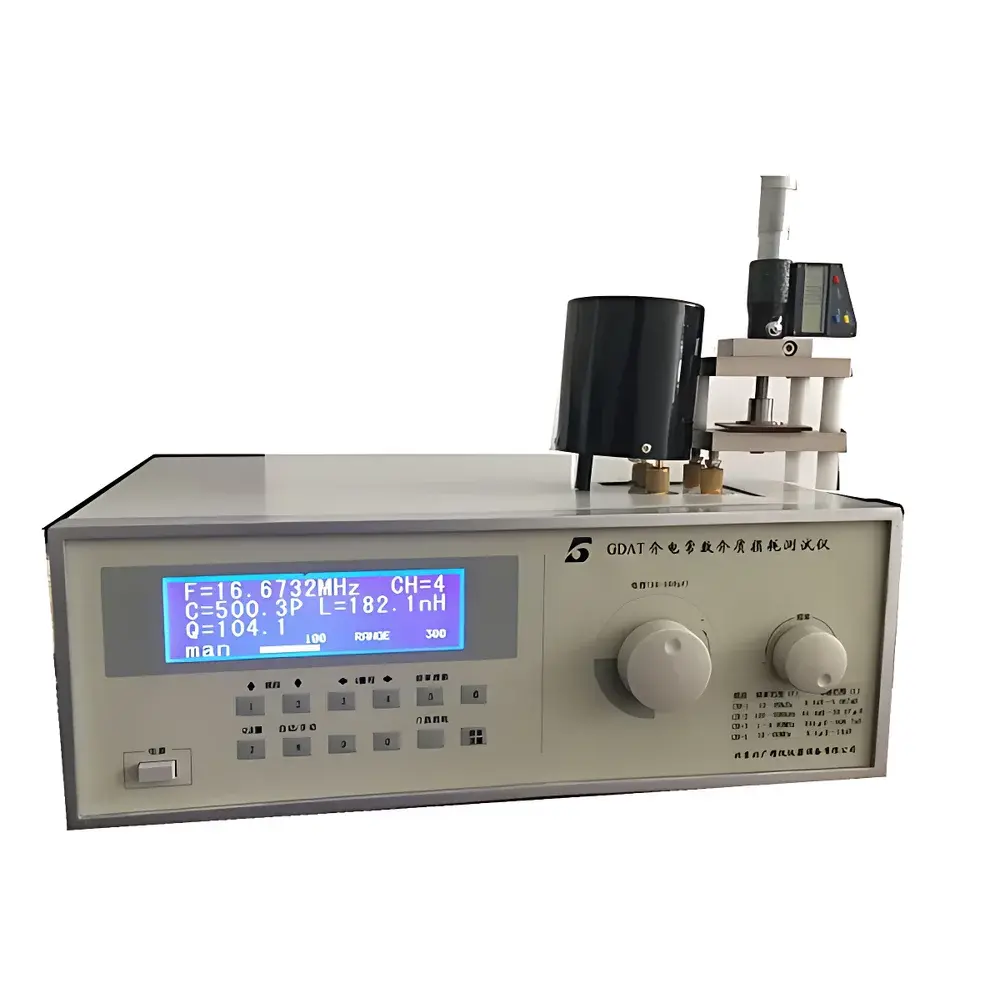
Beijing North Guang GDAT-C High-Frequency Q Meter
| [Brand | Beijing North Guang / All Precision Instrument |
|---|---|
| Origin | Beijing, China |
| Manufacturer Type | Direct Manufacturer |
| Model | GDAT-C |
| Frequency Range | 100 kHz – 160 MHz |
| Q Measurement Range | 1–1023 |
| Q Resolution | 0.1 (full-scale) |
| Capacitance Measurement Range | 1 pF – 25 nF |
| Main Tuning Capacitor Range | 17–240 pF |
| Capacitance Accuracy | ±1 pF (<150 pF), ±1% (>150 pF) |
| Inductance Measurement Range | 1 nH – 140 mH |
| Signal Source | DDS Digital Synthesis |
| Frequency Accuracy | ±3×10⁻⁵ ±1 digit (6-digit display) |
| Power Supply | 220 V ±10%, 50 Hz ±2.5 Hz |
| Power Consumption | ~25 W |
| Operating Temperature | 0–40 °C |
| Compliance | ASTM D150, IEC 60250, GB/T 1409] |
Overview
The Beijing North Guang GDAT-C High-Frequency Q Meter is a precision impedance characterization instrument engineered for accurate, repeatable measurement of quality factor (Q), resonant frequency, and distributed capacitance/inductance in dielectric and magnetic materials across an extended RF frequency range—from 100 kHz to 160 MHz. It operates on the principle of series/parallel resonance in a high-Q tank circuit, where the sample (as a dielectric insert or inductive element) forms part of a calibrated LC resonator. By precisely tuning both the signal source frequency and the main variable capacitor to achieve resonance, the instrument derives Q from the bandwidth-to-resonance-frequency ratio (Q = fr/Δf), while simultaneously extracting εr and tan δ via standardized electrode configurations (e.g., parallel-plate S916 fixture). Its architecture eliminates manual Q correction through integrated residual inductance compensation and real-time loop optimization—ensuring metrological consistency across decades of frequency without recalibration.
Key Features
- Wideband DDS signal generation with 6-digit frequency resolution and stability ≤ ±3×10⁻⁵, enabling traceable RF excitation from 100 kHz to 160 MHz—the highest upper limit among commercially available benchtop Q meters in its class.
- Dual-scan automation: simultaneous digital sweep of test frequency and tuning capacitance, coupled with auto-search algorithms that locate resonance peaks with sub-kHz precision.
- Full digital parameter entry: both frequency setpoint and target capacitance value can be input directly via numeric keypad—eliminating analog dial uncertainty.
- Auto-ranging Q measurement across five fixed scales (30, 100, 300, 1000) plus fully automatic mode, supporting dynamic range from Q = 1 to Q = 1023 with <0.1-unit resolution at full scale.
- Integrated residual inductance subtraction: automatically compensates for lead inductance and fixture parasitics during inductance and Q calculation—critical for nanohenry-level measurements (1 nH–140 mH).
- LCD-based multi-parameter display showing real-time values of main tuning capacitance, measured inductance, Q factor, source frequency, and resonance indicator—all synchronized to the current measurement state.
- Optimized test fixtures compliant with ASTM D150 and IEC 60250: includes S916 parallel-plate electrode system (Φ38 mm, gap ≥15 mm, resolution 1 µm), low-loss liquid cell (Φ38 mm electrode, Φ48 mm cup), and LKI-1 calibrated inductor set (0.05 µH to 10 mH, 10 values).
Sample Compatibility & Compliance
The GDAT-C supports solid, powder, and liquid dielectrics—including polymers, ceramics, composites, insulating oils, and electrolytic solutions—via interchangeable electrode configurations. The S916 fixture meets ISO/IEC 17025 traceability requirements when used with certified reference standards (e.g., air-dielectric calibration, quartz reference capacitors). Its tan δ measurement uncertainty is validated per IEC 60250 Annex B, with fixture dissipation factor ≤4×10⁻⁴ at 1 MHz. For regulatory testing, the system satisfies ASTM D150 Section 11 (Q and εr of solid electrical insulating materials) and GB/T 1409 (Chinese national standard for dielectric constant and loss tangent). While not FDA 21 CFR Part 11–compliant out-of-the-box, raw data export (CSV/ASCII) enables integration into validated LIMS environments under GLP/GMP protocols.
Software & Data Management
The GDAT-C operates as a standalone instrument with no embedded OS or network interface; all measurement data are displayed locally and can be manually recorded or captured via optional RS-232 serial output (TTL-level, 9600 bps). No proprietary software is bundled—users may develop custom acquisition scripts using standard terminal emulators or LabVIEW drivers (available upon request). Calibration constants are stored in non-volatile memory and survive power cycles. Firmware updates require physical USB-to-serial adapter connection and are performed only by authorized service personnel. Audit trails are maintained via printed calibration logs and user-maintained test records—consistent with ISO/IEC 17025 documentation practices for manual instrumentation.
Applications
- Quality control of high-frequency PCB substrates (e.g., PTFE, ceramic-filled laminates) evaluating εr dispersion and dielectric loss up to L-band (1–2 GHz equivalent via extrapolation).
- R&D of microwave absorbers and EMI shielding composites, where Q-factor trends correlate with magnetic permeability and eddy-current losses.
- Characterization of ferroelectric thin films and piezoelectric ceramics under variable temperature (with external chamber), tracking phase transitions via εr(f,T) mapping.
- Validation of transformer oil aging: tan δ increase at 100 kHz–1 MHz indicates oxidation byproducts and moisture ingress.
- Educational labs for teaching RF resonance theory, impedance spectroscopy fundamentals, and dielectric relaxation modeling (Debye, Cole-Cole).
- Pre-compliance screening of encapsulation resins and conformal coatings prior to formal MIL-STD-202 or IPC-TM-650 testing.
FAQ
What is the maximum measurable dielectric loss tangent (tan δ) at 160 MHz?
The instrument resolves tan δ down to 1×10⁻⁴ at frequencies ≥10 MHz when used with the S916 fixture and properly grounded setup. Absolute accuracy depends on sample geometry and surface finish per ASTM D150 Section 13.
Can the GDAT-C measure complex permittivity (ε* = ε′ − jε″) directly?
No—it reports scalar Q, fr, and Ctune; εr and tan δ are derived post-measurement using standard parallel-plate equations. Complex permittivity requires vector network analyzer (VNA) integration.
Is the LKI-1 inductor set traceably calibrated?
Yes—each inductor is factory-calibrated against NIST-traceable RLC standards with documented uncertainty budgets (±0.25% for L > 1 µH; ±1% for L < 0.1 µH).
Does the system support automated temperature-controlled measurements?
Not natively. However, the S916 fixture accommodates third-party thermal stages (e.g., Linkam LTS420) with manual gap adjustment; temperature data must be logged externally.
What maintenance is required for long-term accuracy?
Annual verification against reference capacitors (e.g., KEMET C0G/NP0) and inductors is recommended. No internal adjustments are user-serviceable; optical encoder alignment and DDS clock stability are factory-sealed.



