
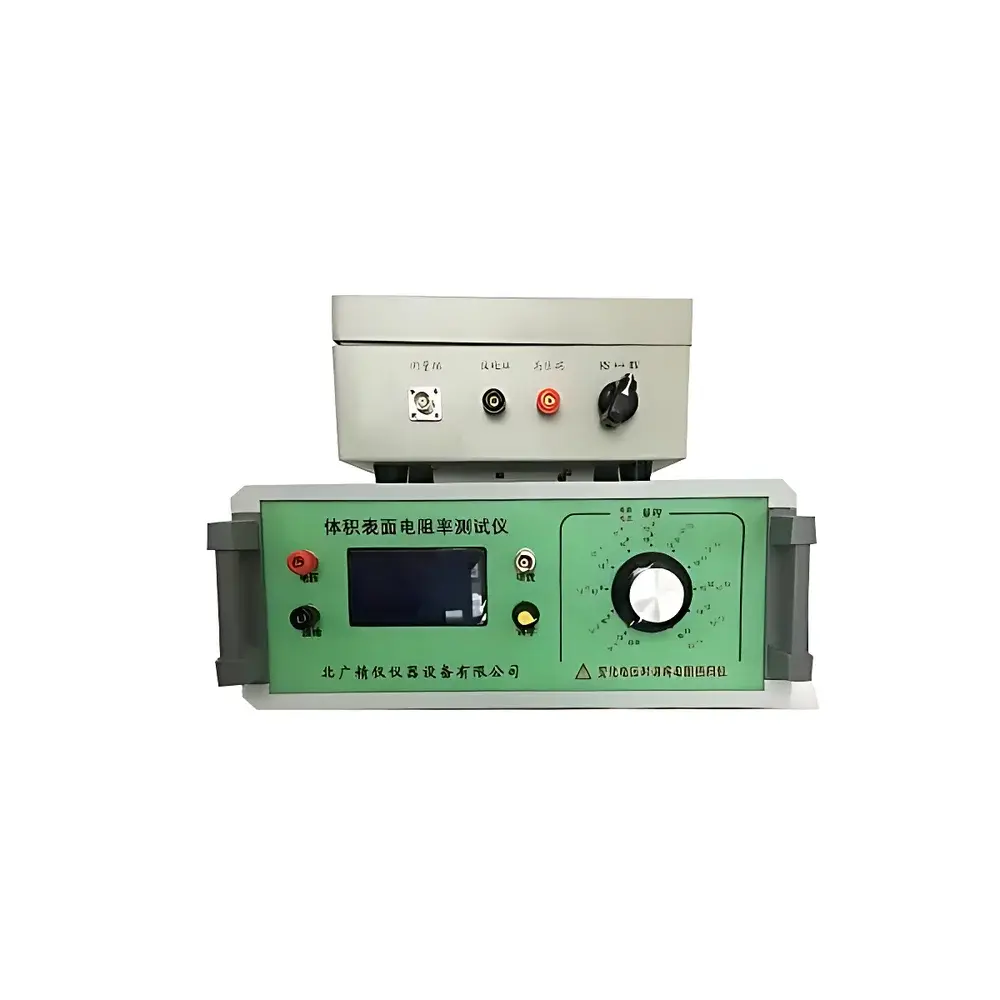
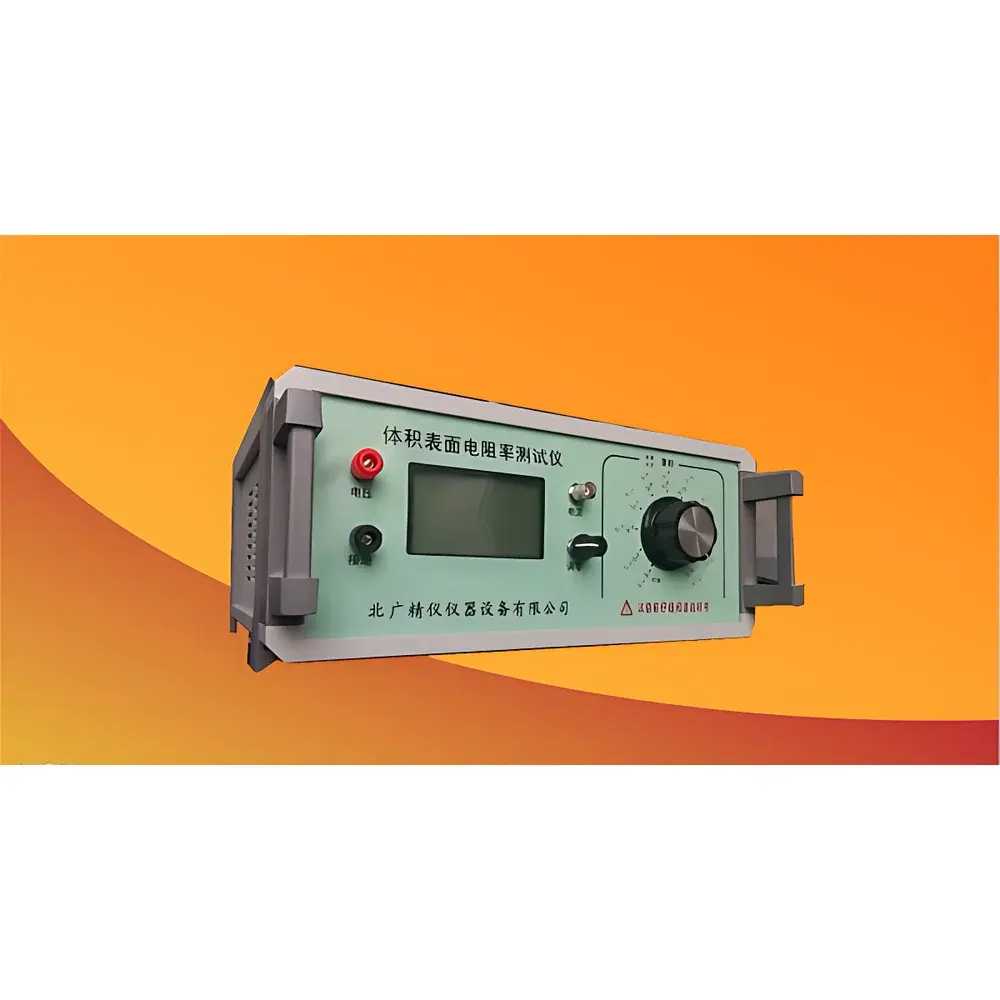
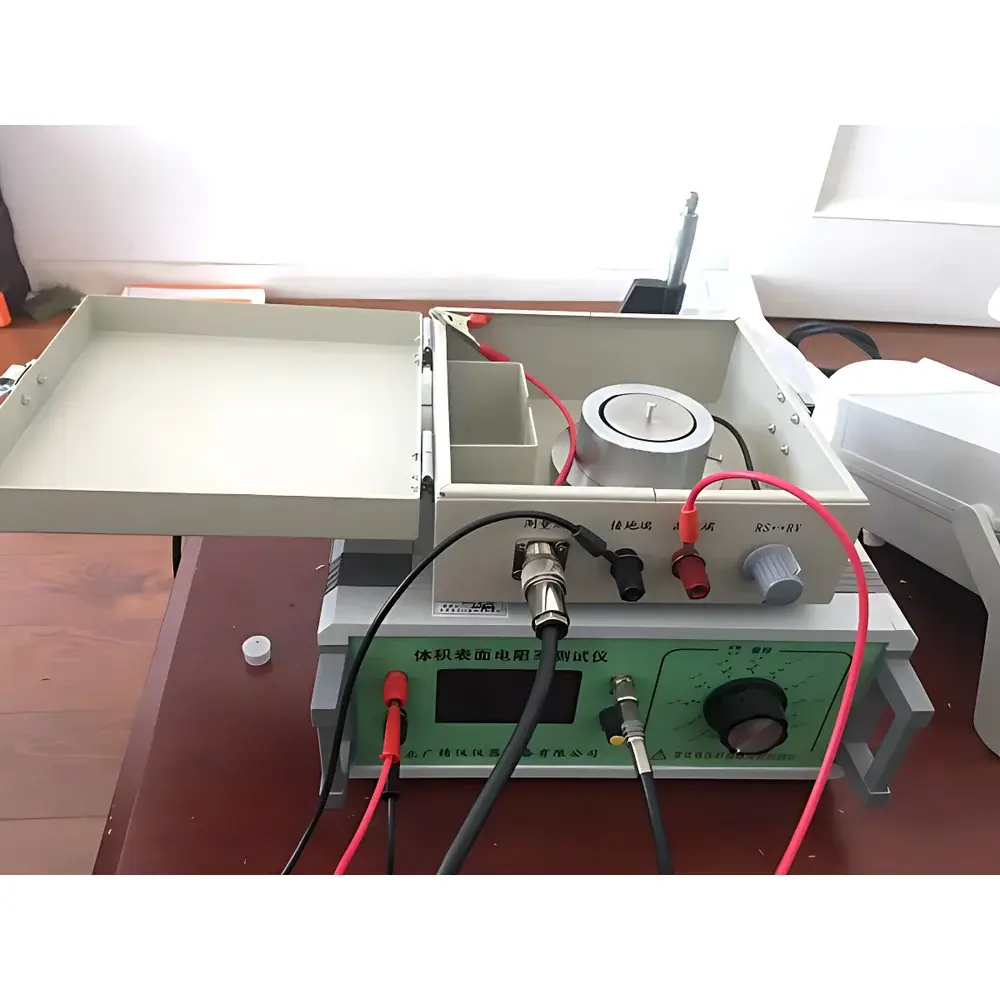
North Guang Precision Instrument GEST-121* GB1410 Volume & Surface Resistivity Tester
| Brand | North Guang Precision Instrument |
|---|---|
| Origin | Beijing, China |
| Manufacturer Type | Direct Manufacturer |
| Product Origin | Domestic (China) |
| Model | GEST-121* |
| Pricing | Upon Request |
| Resistance Range | 1×10⁴ Ω to 1×10¹⁸ Ω |
| Current Range | 2×10⁻⁴ A to 1×10⁻¹⁶ A |
| Test Voltages | 10 V, 50 V, 100 V, 250 V, 500 V, 1000 V (selectable) |
| Basic Accuracy | ±1% |
| Operating Temperature | 0–40 °C |
| Relative Humidity | <80% RH |
| Power Supply | AC 220 V, 50 Hz |
| Power Consumption | ~5 W |
| Dimensions | 285 mm × 245 mm × 120 mm |
| Weight | ~5 kg |
Overview
The North Guang Precision Instrument GEST-121* GB1410 Volume & Surface Resistivity Tester is a precision laboratory instrument engineered for the quantitative determination of volume resistivity (ρv) and surface resistivity (ρs) in insulating and electrostatic-dissipative materials. It operates on the fundamental principle of Ohm’s Law (R = V/I), employing simultaneous high-impedance voltage and ultra-low-current measurement—enabled by integrated analog front-end circuitry and high-resolution A/D conversion—to compute resistance values directly, eliminating nonlinearity inherent in traditional null-balance or analog-scale high-resistance meters. The instrument complies with the core metrological framework defined in GB/T 1410–2006 (Chinese National Standard equivalent to IEC 60093 and ASTM D257), ensuring traceable, reproducible measurements under standardized electrode configurations and polarization times (e.g., 60 s for volume resistance). Its design prioritizes stability in low-current regimes (<100 fA), critical for characterizing polymers, elastomers, coatings, powders, and thin films where charge carrier mobility is inherently limited.
Key Features
- Simultaneous dual-parameter readout: real-time digital display of both resistance (Ω) and current (A) without manual scaling or coefficient correction
- Six programmable DC test voltages (10 V to 1000 V) with internal relay-controlled switching—enabling compliance with material-specific test protocols per GB/T 1410, ASTM D257, and ISO 3915
- Extended measurement range: 1×10⁴ Ω to 1×10¹⁸ Ω for resistance; 2×10⁻⁴ A to 1×10⁻¹⁶ A for current—suitable for ultra-high-resistivity insulators and low-leakage electronic components
- Integrated guard terminal and shielded triaxial cabling architecture to minimize leakage current errors and electromagnetic interference (EMI), essential for sub-picoampere stability
- Compact benchtop form factor (285 × 245 × 120 mm) with lightweight aluminum chassis—designed for integration into QC labs, R&D cleanrooms, and university teaching laboratories
- Thermal drift compensation and auto-zeroing circuitry ensure long-term baseline stability across ambient temperature fluctuations (0–40 °C)
Sample Compatibility & Compliance
The GEST-121* supports volumetric and superficial resistivity assessment across solid, powdered, liquid, and semi-solid (e.g., gels, pastes) dielectric specimens using interchangeable electrode fixtures—including guarded concentric ring electrodes (for surface resistivity), parallel plate electrodes (for volume resistivity of sheets/films), and powder cell assemblies. It meets functional requirements for testing antistatic footwear (GB 21148), conductive flooring (SJ/T 10694), polymer composites (ISO 3915), and medical device packaging (ISO 11607-1). All measurements adhere to standard environmental conditioning per ISO 291 (23 ± 2 °C, 50 ± 5% RH), and reporting aligns with GLP documentation expectations—requiring explicit recording of specimen geometry, electrode configuration, preconditioning history, applied voltage, polarization time, and ambient conditions.
Software & Data Management
While the GEST-121* operates as a standalone instrument with front-panel digital display, it features RS-232 serial interface for optional data logging and remote control via host PC. Third-party software (supplied free of charge) enables automated sequence execution—including voltage ramping, timed readings at fixed polarization intervals (e.g., 15 s, 60 s, 600 s), and batch export to CSV/Excel formats. Audit-trail functionality records operator ID, timestamp, test voltage, and raw V/I pairs—supporting 21 CFR Part 11 readiness when deployed in regulated manufacturing environments (e.g., pharmaceutical packaging validation or Class 8 cleanroom qualification). Firmware updates are provided at no cost for the instrument’s operational lifetime.
Applications
- Quality control of ESD-safe materials: footwear soles, workbench mats, tote boxes, and IC handling trays per ANSI/ESD S20.20
- Volume resistivity mapping of polymer blends, carbon-black-filled rubbers, and ceramic substrates during formulation development
- Surface resistivity verification of conformal coatings, anti-reflective films, and photovoltaic encapsulants
- Dark current characterization of photodiodes, avalanche photodetectors, and radiation sensors
- Electrochemical interface studies involving passivation layers, solid electrolytes, and battery separator films
- Academic research in dielectric physics, charge transport mechanisms, and aging behavior of insulating systems
FAQ
Why does the reading fluctuate during high-resistance measurement?
Fluctuations reflect intrinsic material behavior—not instrument error. Many insulating polymers exhibit non-Ohmic conduction (e.g., thermally activated hopping, space-charge-limited currents), resulting in time-dependent current decay. Per GB/T 1410, the 60-second stabilized value is the reported reference; short-term variance is expected and documented in test reports.
Can I change the test voltage mid-measurement?
No. Voltage switching under load induces transient discharge currents through sample capacitance, risking amplifier saturation or irreversible damage to input protection circuits. Always de-energize the sample and select the appropriate voltage range before initiating measurement.
What electrode configuration is required for volume resistivity?
A guarded two-electrode system (e.g., ASTM D257 Fig. 2) is mandatory to exclude surface leakage paths. Electrode geometry must be documented—diameter, spacing, and guard width—as ρv = R × (t / A), where t = specimen thickness and A = effective electrode area.
Is calibration traceable to national standards?
Yes. Factory calibration uses NIST-traceable high-value resistors (10⁹–10¹⁴ Ω) and calibrated picoammeters. Users receive a certificate listing uncertainty budgets per ISO/IEC 17025 guidelines, valid for 12 months.
Does the instrument support automated compliance reporting?
Standard firmware includes configurable report templates aligned with GB/T 1410 Annex A and ASTM D257 Section 12—populating fields for material ID, electrode specs, environmental data, voltage, polarization time, and calculated ρv/ρs with units (Ω·m or Ω/sq).
Related Products



