
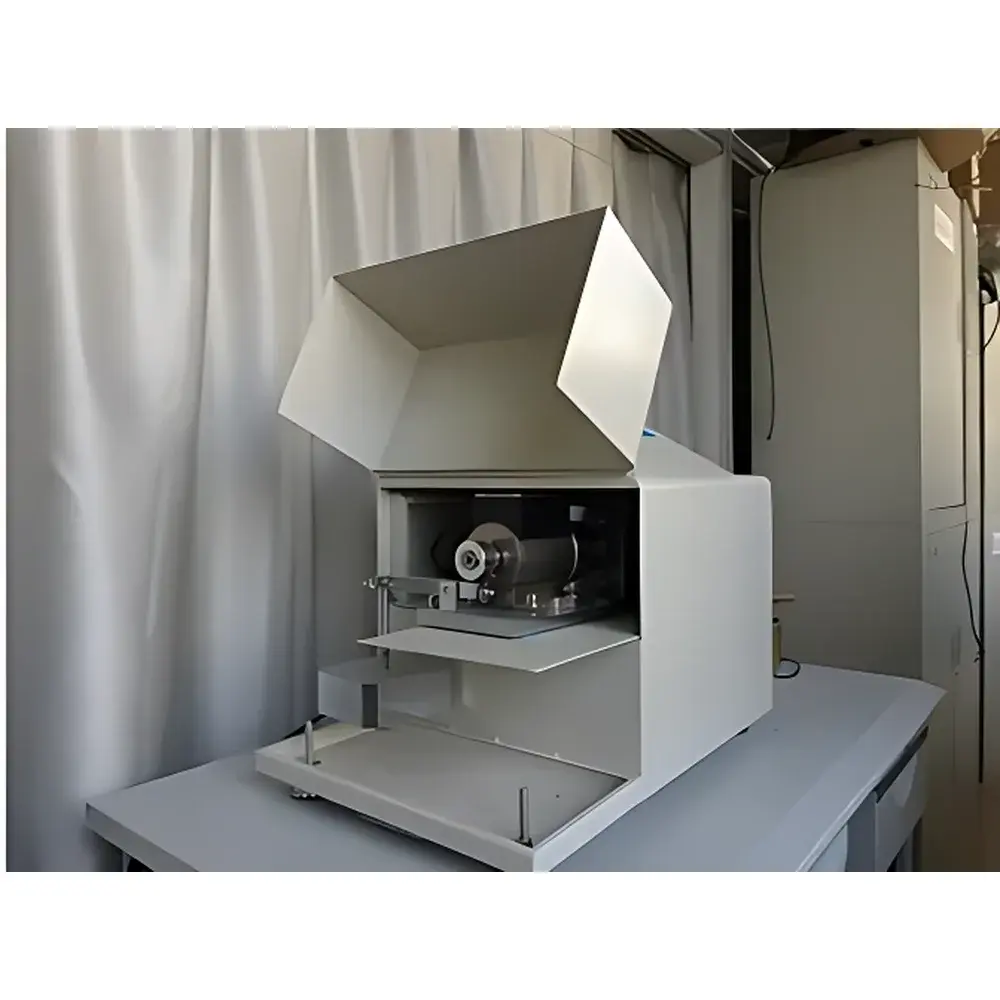
Beiguang Jingyi M-200 Precision Tribological Tester for Plastic Wear and Friction Testing
| Brand | Beiguang Jingyi / All Precision Instrument |
|---|---|
| Origin | Beijing, China |
| Manufacturer Type | Direct Manufacturer |
| Model | M-200 |
| Maximum Friction Force | 2000 N |
| Friction Force Resolution | 1 N |
| Friction Torque Range | 0–15 N·m |
| Friction Torque Accuracy | ±3% FS (at >10% full scale) |
| Test Load | 196 N ±0.1% (extendable to 392 N) |
| Rotational Speed | 0–400 rpm (infinitely variable, dual-axis independent control) |
| Specimen Dimensions | 30 mm × 7 mm × 6 mm |
| Counterface Ring | Ø40 × 10 mm, hardened 45# steel (HRC 40–45), surface roughness Ra ≤ 0.8 µm |
| Temperature Control | Ambient to 150 °C (PID-regulated, oil-bath heating) |
| Data Acquisition | Embedded industrial PC with HX proprietary software |
| Compliance | GB/T 3960–2016 |
Overview
The Beiguang Jingyi M-200 Precision Tribological Tester is an engineered solution for quantitative evaluation of wear resistance, coefficient of friction (COF), and tribological behavior of polymeric materials under controlled sliding contact conditions. Based on the pin-on-disk configuration per GB/T 3960–2016, the system applies a calibrated normal load to a stationary plastic specimen (pin) while a rotating metallic counterface (disk or ring) generates shear stress at the interface. Friction torque is measured in real time via high-stiffness load cell instrumentation, and wear volume is derived from post-test mass loss or dimensional change analysis. Designed for R&D laboratories and QC departments in polymer formulation, composite development, and automotive interior material validation, the M-200 supports reproducible, traceable testing across temperature-controlled oil-bath environments—enabling simulation of service conditions ranging from ambient operation to thermally accelerated aging. Its modular architecture accommodates custom counterface geometries and alternative lubricants, facilitating method development aligned with ASTM D3702, ISO 7148-1, and DIN 50324 standards.
Key Features
- Independent dual-axis drive system: Upper axis (specimen holder) rotates at 180/360 rpm; lower axis (counterface) at 200/400 rpm — enabling both unidirectional and reciprocating sliding modes.
- Precision servo motor control (Japan-sourced) with closed-loop torque regulation ensures constant rotational speed across load variations, critical for kinetic friction stability.
- Integrated embedded industrial PC running proprietary HX software provides synchronized acquisition of time, torque, rotation count, temperature, and elapsed duration — all timestamped with millisecond resolution.
- Real-time graphical display of time–torque, time–temperature, and time–rotation curves during test execution; exportable CSV/Excel data files support GLP-compliant reporting.
- Modular specimen fixture design accepts standard 30 × 7 × 6 mm plastic samples; optional adapters available for cylindrical or irregular geometries.
- Oil-bath thermal enclosure (18–20 L capacity) with PID-controlled heating and external cooling port enables stable temperature maintenance from ambient to 150 °C (±1 °C accuracy).
- Full mechanical safety interlock: automatic shutdown upon lid opening, over-temperature detection, torque overload cutoff, and emergency stop circuitry compliant with IEC 61000-6-2 EMC requirements.
Sample Compatibility & Compliance
The M-200 is validated for thermoplastics (e.g., PA6, POM, PEEK, PP), thermosets (epoxy, phenolic), elastomers (NBR, silicone), and filled composites (glass-, carbon-, or mineral-reinforced). Counterface materials include hardened 45# steel (standard), stainless steel (AISI 304), WC-Co sintered carbide, and alumina ceramics — selected per ISO 20806 or ASTM G99 recommendations. Test protocols align with national and international frameworks: GB/T 3960–2016 (plastic wear), ASTM D1894 (COF of plastic film), ISO 8295 (plastic sheet friction), and ISO 15143-1 (wear particle analysis preparation). For regulated environments, audit trails, user access levels, and electronic signature support can be enabled to meet FDA 21 CFR Part 11 and EU Annex 11 expectations when integrated with validated LIMS platforms.
Software & Data Management
HX Control Suite v4.2 operates on Windows-based embedded hardware, offering intuitive test setup wizards, multi-channel waveform visualization, and automated pass/fail threshold evaluation. All raw sensor data are stored locally in encrypted binary format with SHA-256 checksum integrity verification. Export modules generate PDF reports containing test metadata (operator ID, calibration date, environmental conditions), statistical summaries (mean COF, wear rate ± SD), and annotated curve overlays. Software architecture supports OPC UA connectivity for enterprise-level integration with MES or SAP QA modules. Calibration certificates (traceable to CNAS-accredited labs) and firmware update logs are archived within the system’s secure database, fulfilling ISO/IEC 17025 documentation requirements for accredited testing facilities.
Applications
- Quantifying abrasive wear resistance of automotive interior trim materials subjected to repeated seatbelt or control knob contact.
- Evaluating low-friction performance of self-lubricating engineering plastics (e.g., PTFE-filled PEEK) under dry and oil-lubricated conditions.
- Comparing wear mechanisms (adhesive, abrasive, fatigue) across polymer blends used in medical device housings and surgical instrument components.
- Accelerated life testing of cable jacketing compounds exposed to dynamic bending and environmental heat cycling.
- Screening anti-wear additive efficacy in polymer matrix composites for aerospace bearing applications.
- Supporting failure analysis investigations where surface degradation correlates with functional loss in consumer electronics enclosures.
FAQ
What is the recommended maintenance interval for the oil bath medium?
Replace the heat-transfer oil every 12 months or after 2000 operational hours, whichever occurs first. Verify flash point (>200 °C) and viscosity index prior to reuse.
Can the M-200 perform tests under inert atmosphere?
Yes — optional nitrogen purge adapter kit (PN: M-200-N2-KIT) enables sealed chamber operation with O₂ < 100 ppm, suitable for oxidation-sensitive polymers.
Is third-party calibration certification included with delivery?
A factory-issued calibration report (CNAS-traceable) is provided; on-site ISO/IEC 17025 accreditation by customer-designated metrology lab is available as an add-on service.
How is zero-point drift compensated during long-duration tests?
Automatic zero-tracking algorithm executes periodic null compensation at user-defined intervals (1–60 min), correcting for thermal expansion-induced baseline shift in the torque transducer.
Does the system support automated specimen exchange?
Not natively — manual loading is required per test cycle. Robotic integration (e.g., UR5e + custom end-effector) is feasible via RS-485/Modbus RTU interface and can be scoped separately.



