
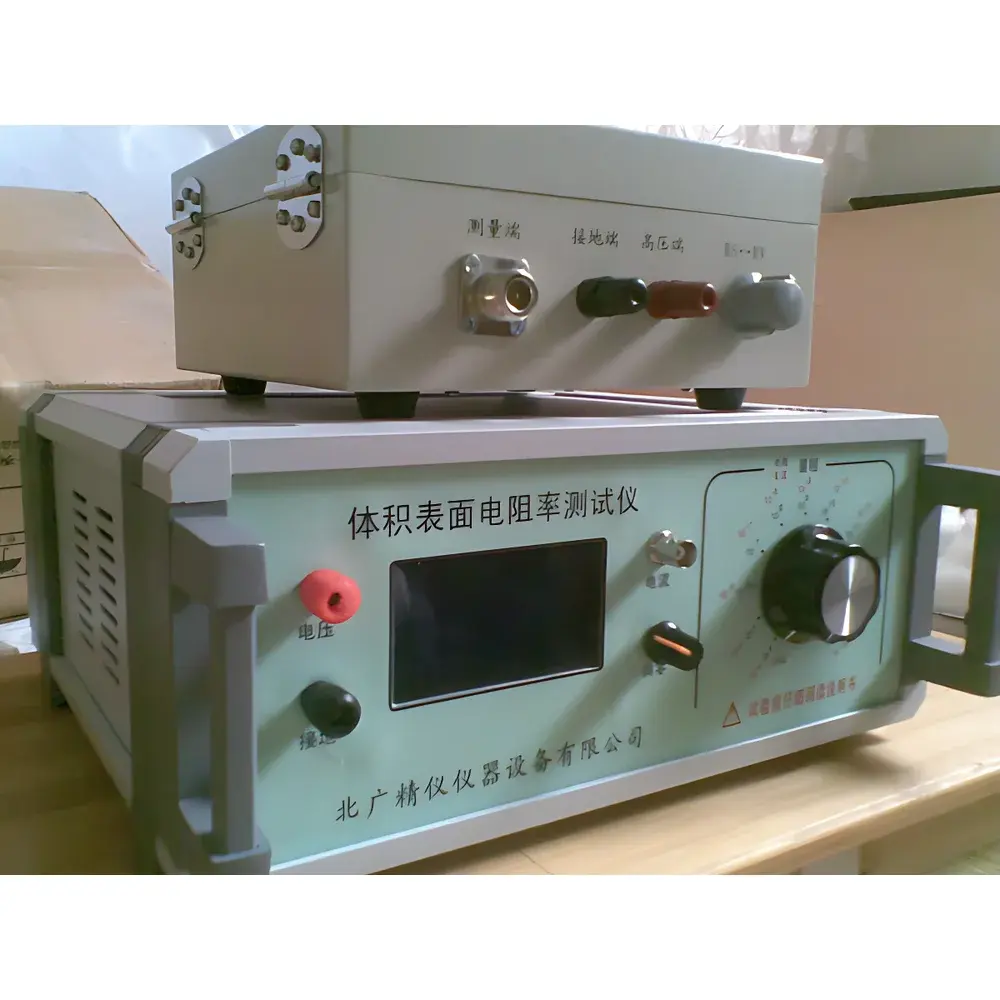
Beiguang BEST-121 High-Resistance Meter for Volume and Surface Resistivity Measurement of Liquids, Solids, Powders, and Pastes
| Brand | Beiguang Precision Instrument |
|---|---|
| Origin | Beijing, China |
| Manufacturer Type | Direct Manufacturer |
| Country of Origin | China |
| Model | BEST-121 |
| Price | USD 2,800 (FOB Beijing) |
| Test Voltage Range | DC 10 V, 50 V, 100 V, 250 V, 500 V, 1000 V |
| Resistance Measurement Range | 1×10⁴ Ω to 1×10¹⁸ Ω (10 decades) |
| Current Measurement Range | 2×10⁻⁴ A to 1×10⁻¹⁶ A |
| Accuracy | ±1% (up to 10¹² Ω), ±5% + 2 digits (10¹³–10¹⁴ Ω), ±10–15% + 5 digits (>10¹⁴ Ω) |
| Display | Full-digit LCD |
| Operating Temperature | –10 °C to +50 °C |
| Relative Humidity | <90% RH |
| Power Supply | AC 220 V, 50 Hz, ~10 W |
| Dimensions | 300 mm × 280 mm × 150 mm |
| Weight | ~3.0 kg |
Overview
The Beiguang BEST-121 High-Resistance Meter is a precision instrument engineered for the quantitative determination of volume resistivity (ρ) and surface resistivity (σ) in insulating materials—including liquids, solids, powders, and pastes—according to standardized electrostatic principles derived from Ohm’s Law (R = V/I). Unlike conventional analog megohmmeters that rely on fixed-voltage excitation and nonlinear scale interpretation, the BEST-121 employs synchronous dual-parameter acquisition: it simultaneously measures applied DC test voltage (V) and resulting leakage current (I) across the sample, then computes resistance in real time via high-stability analog-to-digital conversion and embedded arithmetic logic. This architecture eliminates voltage drift-induced error and ensures linear, traceable resistance output across its full 14-decade dynamic range (10⁴–10¹⁸ Ω). Designed for compliance-driven laboratories, the instrument supports temperature-controlled testing when interfaced with external thermostatic baths (e.g., for ASTM D257-compliant resistivity evaluation of polymer films or liquid dielectrics at elevated temperatures). Its measurement integrity is validated against Q/TPGG 7–2008, the enterprise standard governing high-resistance instrumentation in China, and aligns with foundational metrological requirements referenced in IEC 62631-3-1 and ISO 3915.
Key Features
- Simultaneous digital readout of both resistance value (Ω) and corresponding leakage current (A) — enabling immediate verification of measurement validity and detection of surface conduction artifacts.
- Six selectable DC test voltages (10 V, 50 V, 100 V, 250 V, 500 V, 1000 V) with ±10% tolerance, supporting application-specific stress conditions per ASTM D257, IEC 60093, and GB/T 1410.
- Auto-ranging resistance measurement across ten calibrated decades (10⁴–10¹⁸ Ω), eliminating manual range switching and coefficient multiplication errors.
- High-sensitivity current measurement down to 1×10⁻¹⁶ A, achieved through low-noise electrometer-grade input circuitry and guarded triaxial signal paths to minimize stray capacitance and triboelectric interference.
- Compact benchtop form factor (300 × 280 × 150 mm) with robust aluminum chassis and EMI-shielded enclosure, suitable for QC labs, R&D cleanrooms, and production line environments.
- Full-digit LCD display with ambient-light optimization; no analog needle drift or parallax error; direct numeric output without scaling factors.
Sample Compatibility & Compliance
The BEST-121 accommodates diverse physical states via standardized electrode configurations: two-terminal coaxial probes for liquids and pastes; guarded three-terminal fixtures for surface resistivity of flat solids (e.g., PCB substrates, polymer sheets); and powder-compaction cells with pressure-controlled electrodes for bulk resistivity assessment of granular dielectrics. It meets the electrical safety and measurement repeatability prerequisites of ISO/IEC 17025-accredited testing laboratories. While not inherently 21 CFR Part 11 compliant (lacking electronic signature and audit trail functions), its stable analog front-end and deterministic firmware support GLP/GMP-aligned manual data recording workflows. When used with calibrated reference resistors traceable to NIM (National Institute of Metrology, China) or NIST SRMs, measurement uncertainty budgets can be established per GUM (JCGM 100:2008). The instrument operates within environmental limits defined in IEC 61000-4-2 (ESD immunity) and conforms to CE-marked EMC Class B emission profiles.
Software & Data Management
The BEST-121 operates as a standalone instrument with no proprietary software dependency. All measurements are displayed and retained locally on the LCD screen during active operation; however, no internal memory or USB/RS-232 interface is provided. For regulated data capture, users integrate the meter into external systems using optional analog voltage-output modules (0–1 V proportional to log₁₀(R)) or third-party DAQ hardware. When deployed in validated environments, operators document results manually in bound lab notebooks or LIMS-integrated spreadsheets, referencing instrument ID, calibration certificate number (e.g., CNAS-L0792), test voltage, ambient T/RH, and electrode geometry. This design prioritizes long-term reliability over connectivity—eliminating firmware update risks, cybersecurity vulnerabilities, and software obsolescence common in embedded GUI platforms.
Applications
- Quality control of transformer oils, silicone greases, and battery electrolytes per ASTM D1169 and IEC 60247.
- Evaluation of antistatic additives in polyolefin films and conductive polymer composites.
- Resistivity mapping of printed electronics substrates (e.g., PET, PI) before and after metallization.
- Stability testing of ceramic slurries and nanoparticle dispersions under thermal ramping (with water/oil bath coupling).
- Verification of insulating coatings on medical device housings per ISO 10993-1 biocompatibility screening protocols.
- Research-grade characterization of MOF-based solid electrolytes and ionogels in energy storage material development.
FAQ
What standards does the BEST-121 support for resistivity testing?
It enables testing per ASTM D257 (DC resistance of insulating materials), IEC 60093 (methods of test for volume and surface resistivity), ISO 3915 (conductive plastics), and GB/T 1410 (Chinese national standard for solid insulating materials).
Can the instrument measure resistivity of conductive liquids like aqueous salt solutions?
No — the BEST-121 is optimized for high-resistivity media (>10⁴ Ω). Conductive liquids (<10³ Ω) fall below its lower measurement threshold and may saturate the current amplifier; dedicated conductivity meters (e.g., based on AC four-electrode methods) are recommended instead.
Is calibration traceable to international standards?
Yes — Beiguang provides factory calibration certificates traceable to NIM reference standards. Users must perform periodic verification using certified high-value resistors (e.g., 10¹² Ω, 10¹⁴ Ω) with documented uncertainty budgets.
Does the instrument include temperature compensation?
No — temperature compensation is not built-in. Resistivity temperature dependence must be evaluated externally using a calibrated bath and manual data correlation per ASTM D1711.
What safety certifications does the BEST-121 hold?
It complies with GB 4793.1–2007 (safety requirements for electrical equipment for measurement) and carries CE marking for EMC Directive 2014/30/EU and Low Voltage Directive 2014/35/EU.



