Beijing North Guang Precision Instrument BWR-300A Heat Deflection Temperature (HDT) and Vicat Softening Point Tester
| Brand | Beijing North Guang Precision Instrument |
|---|---|
| Origin | Beijing, China |
| Manufacturer Type | Direct Manufacturer |
| Product Origin | Domestic (China) |
| Model | BWR-300A |
| Temperature Range | Ambient to 300 °C |
| Heating Rate Options | 50 ±1 °C/h or 120 ±1 °C/h |
| Temperature Resolution | 0.01 °C |
| Max. Temperature Accuracy | ±0.5 °C |
| Deformation Measurement Method | Digital Dial Gauge (Grating-based) |
| Deformation Range | 0–5.0 mm |
| Deformation Accuracy | ±0.001 mm |
| Sample Stations | 3 independent test stations per bath |
| Heating Medium | Methyl silicone oil (flash point ≥300 °C, kinematic viscosity 200 cSt at 25 °C, 20 L required) |
| Heating Power | 2.5 kW |
| Cooling Method | Natural cooling above 150 °C |
| Overtemperature Protection | Adjustable upper limit (ambient to 300 °C) with hardware cutoff at 300 °C |
| Load Rod + Indenter Mass | 88 g |
| Test Loads | Vicat A = 10.0 N ±0.2 N |
| Power Supply | AC 220 V ±10%, 50 Hz, 30 A |
| Compliance Standards | GB/T 1633, GB/T 1634, GB/T 8802, ISO 306:2020, ISO 75-1:2013, ISO 75-2:2017 |
Overview
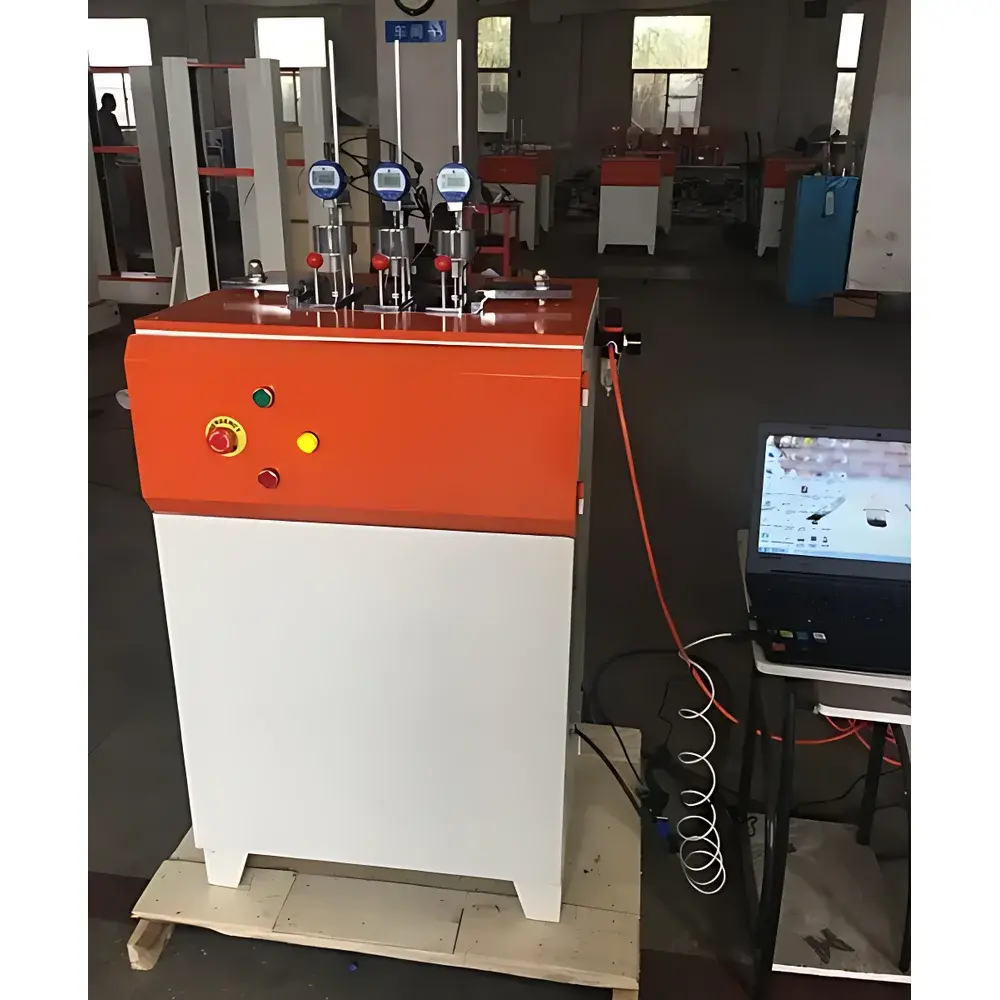
The Beijing North Guang Precision Instrument BWR-300A Heat Deflection Temperature (HDT) and Vicat Softening Point Tester is a dual-function thermal characterization instrument engineered for precise determination of the temperature-dependent mechanical response of thermoplastic polymers, elastomers, rigid PVC, nylon, epoxy composites, and electrically insulating materials. It operates on two standardized principles: (1) the Vicat softening point method (ISO 306), which measures the temperature at which a flat-ended needle penetrates 1 mm into a specimen under defined load and heating rate; and (2) the heat deflection temperature method (ISO 75-2), which determines the temperature at which a standardized cantilevered beam deflects by 0.34 mm under specified flexural stress. Both methods rely on controlled immersion in a thermally stable silicone oil bath, precise temperature ramping, and high-resolution deformation monitoring—enabling direct correlation between polymer microstructure, processing history, and service temperature limits.
Key Features
- Triple independent test stations operating simultaneously within a single thermostatic bath—maximizing throughput without cross-contamination or thermal lag.
- High-stability digital grating dial gauges (0.001 mm resolution, ±0.001 mm accuracy) for traceable deformation measurement, compliant with ISO 306 Annex C calibration protocols.
- Dual programmable heating rates (50 ±1 °C/h and 120 ±1 °C/h) meeting both ISO 306 Type A/B and ISO 75-2 Method A/B/C requirements.
- Temperature control range from ambient to 300 °C with 0.01 °C resolution and ±0.5 °C uniformity across all stations—validated via NIST-traceable Pt100 sensors.
- Hardware-enforced overtemperature protection with dual-stage cutoff: user-configurable upper limit (adjustable in 0.1 °C increments) and hardwired 300 °C safety fuse.
- Integrated load system supporting Vicat loads of 10.0 N (1000 g) and 50.0 N (5000 g), plus HDT loads derived dynamically from specimen geometry and selected fiber stress (0.45, 1.80, or 8.00 MPa).
- 2.5 kW high-efficiency heating module with optimized thermal mass distribution—ensuring linear ramp stability and minimal overshoot.
Sample Compatibility & Compliance
The BWR-300A accommodates standard ISO/ASTM-compliant specimens: rectangular bars (80 × 10 × 4 mm for Vicat; 120 × 10–15 × 3–13 mm for HDT) and cylindrical rods up to Ø10 mm. It supports both unreinforced and fiber-reinforced thermoplastics, thermosets, and elastomeric compounds—including polypropylene (PP), polyethylene (PE), polycarbonate (PC), ABS, PEEK, and phenolic resins. The instrument fully satisfies the metrological and procedural requirements of ISO 306:2020 (Vicat), ISO 75-1:2013 and ISO 75-2:2017 (HDT), ASTM D648 (HDT), ASTM D1525 (Vicat), GB/T 1633–2000, GB/T 1634–2004, and GB/T 8802–2001. All critical parameters—including temperature ramp linearity, load application repeatability, and deformation transducer calibration—are verifiable using documented procedures aligned with ISO/IEC 17025 internal audit frameworks.
Software & Data Management
The HDT/V Control Software Suite (v4.2+) runs natively on Windows 7/10/11 (64-bit) and provides full GLP-compliant operation. It supports real-time multi-channel monitoring of temperature and deformation across all three stations, with synchronized data logging at 1 Hz resolution. Key capabilities include: automated zeroing prior to ramp initiation; customizable test grouping (up to 10 concurrent trials); dual-axis curve visualization (deformation vs. temperature, temperature vs. time, or dual-Y time-series); CSV/TXT data export with timestamped metadata; and PDF/XLS report generation with embedded calibration certificates. The software implements audit-trail functionality per FDA 21 CFR Part 11 requirements—recording user login, parameter changes, calibration events, and test execution logs with immutable timestamps. Database backups are encrypted and version-controlled, supporting restoration without data loss. All configuration files and raw datasets are stored in structured directories compliant with ISO 15197:2022 archival standards.
Applications
This instrument serves as a core qualification tool in polymer R&D labs, QC departments of compounders and extruders, and third-party testing facilities accredited to ISO/IEC 17025. Typical use cases include: comparative ranking of heat resistance among polymeric formulations; validation of annealing or post-molding thermal treatments; specification conformance testing for automotive interior trim, electrical enclosures, and pipe systems; regulatory submission support for UL 746B, IEC 60695-10-2, and EN 60695-10-2; and failure analysis of thermally induced warpage or creep collapse. Its ability to execute parallel Vicat and HDT tests under identical thermal conditions enables robust structure–property correlation—particularly valuable when evaluating crystallinity effects, plasticizer migration, or filler dispersion homogeneity.
FAQ
What heating medium is required, and why is methyl silicone oil specified?
Methyl silicone oil with a flash point ≥300 °C and kinematic viscosity of 200 cSt at 25 °C is mandatory to ensure thermal stability, low volatility, and uniform heat transfer across the full 300 °C operating range—preventing oxidation, vapor lock, or viscosity drift that would compromise ramp accuracy.
Can the BWR-300A be used for ASTM D648 Method A (0.45 MPa) and Method B (1.80 MPa) without hardware modification?
Yes—the instrument’s load calculation engine automatically computes the required deadweight based on user-input specimen dimensions and selected fiber stress, eliminating manual recalibration between test methods.
Is third-party calibration documentation included with shipment?
Each unit ships with a factory calibration certificate covering temperature sensor linearity (at 50, 100, 150, 200, and 250 °C), deformation transducer accuracy (0–5 mm range), and heating rate verification—traceable to national standards via CNAS-accredited providers.
How is compliance with ISO/IEC 17025 maintained during routine operation?
The software enforces scheduled recalibration intervals (temperature sensors every 6 months; dial gauges annually), logs all verification results, and flags expired calibrations before test initiation—supporting internal quality audits and external accreditation assessments.
Does the system support remote monitoring or integration with LIMS?
While native LIMS integration is not built-in, the software exports ASCII-formatted data files (CSV/TXT) with structured headers compatible with common laboratory informatics platforms; custom OPC UA or REST API interfaces can be commissioned as an optional upgrade.