
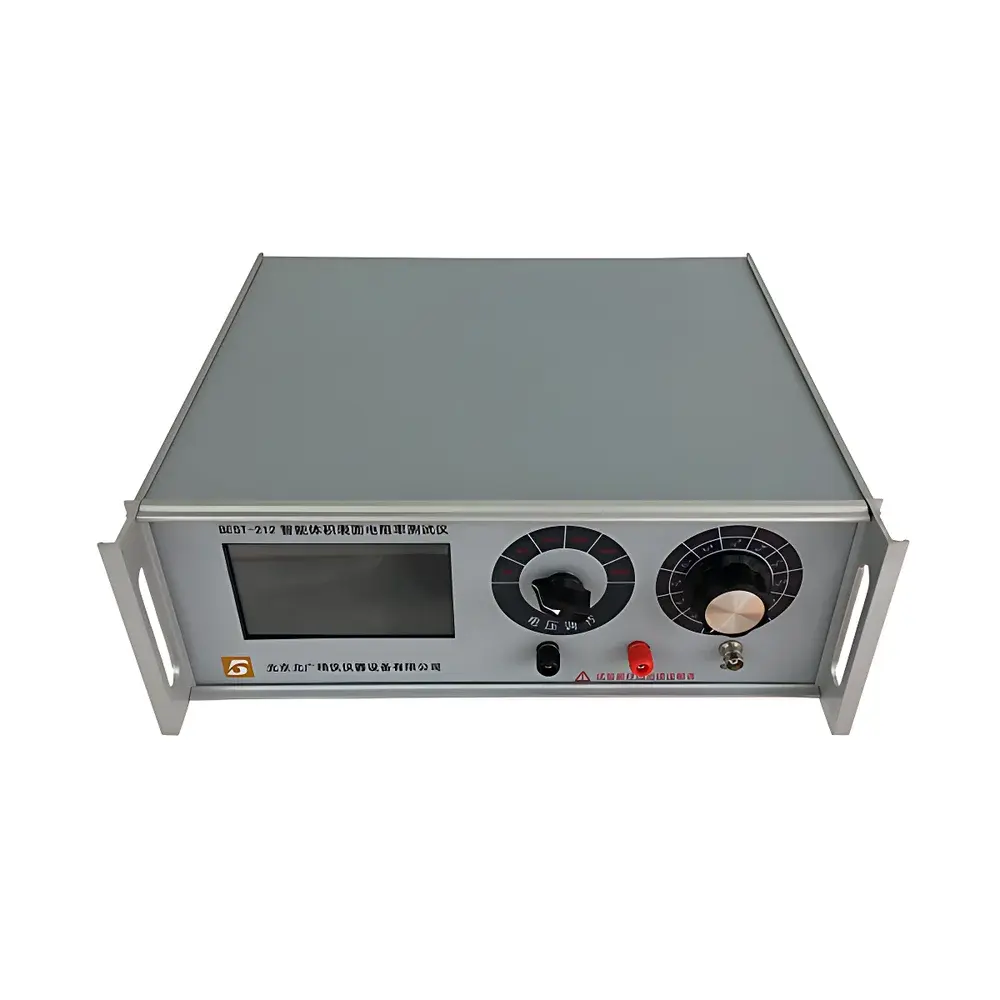
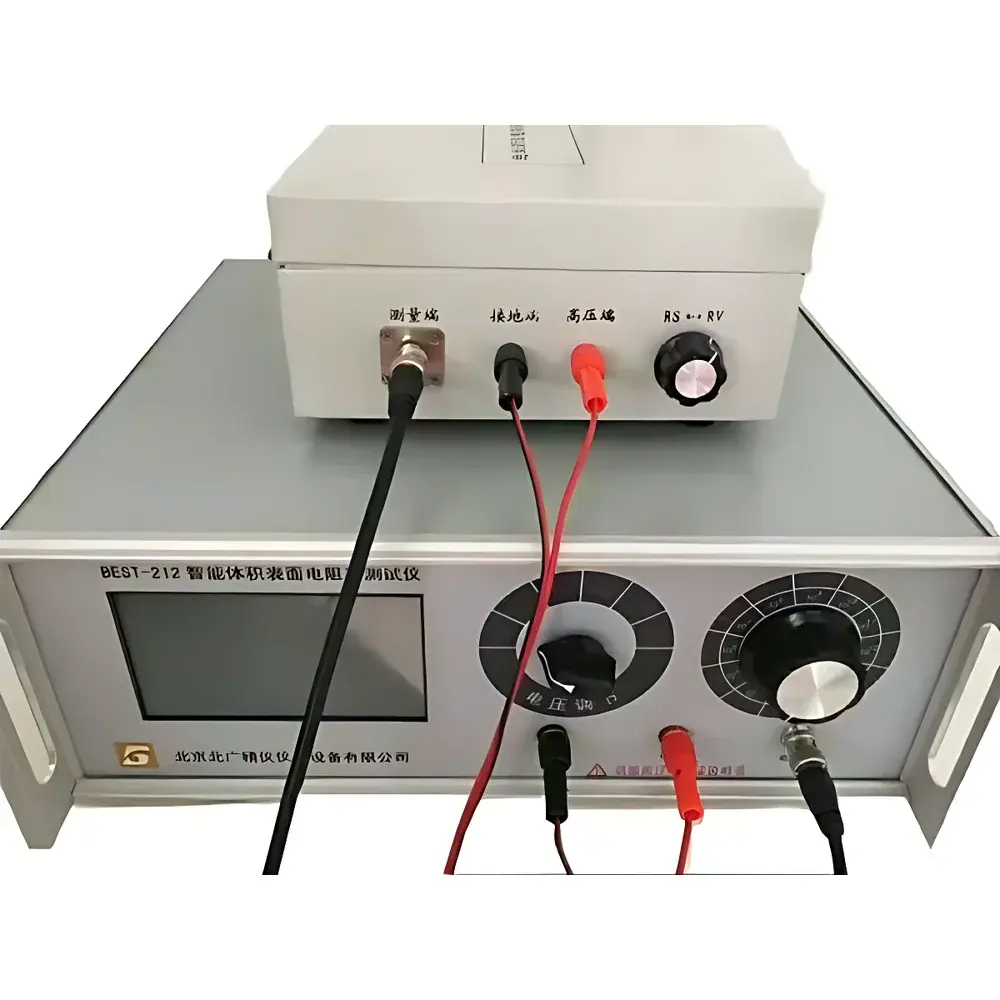
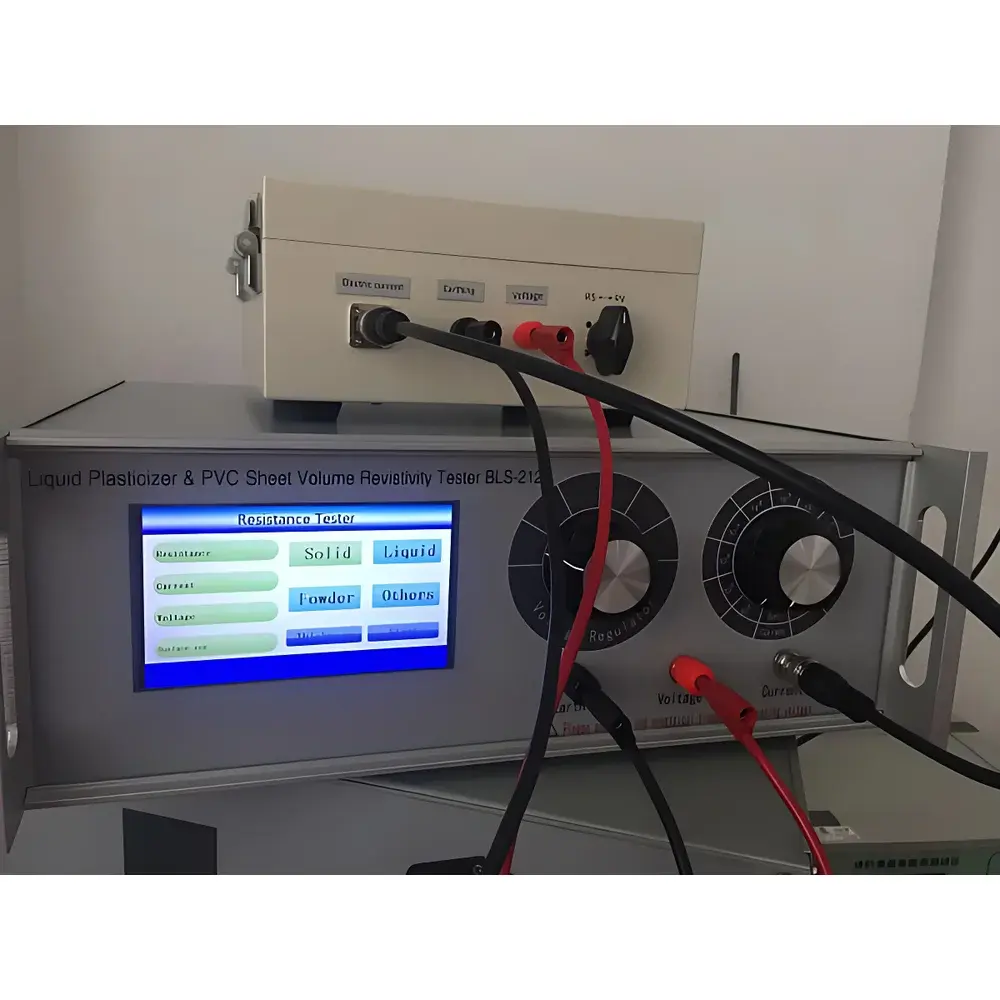
Beiguang Jingyi BGJY-212 High-Resistance Tester for Volume and Surface Resistivity of Vulcanized Rubber
| Brand | Beiguang Jingyi / All Precision Instrument |
|---|---|
| Origin | Beijing, China |
| Manufacturer Type | Direct Manufacturer |
| Country of Origin | China |
| Model | BGJY-212 |
| Price | USD 1,700 (FOB Beijing) |
| Resistance Range | 1×10⁴ Ω to 1×10¹⁸ Ω |
| Current Range | 2×10⁻⁴ A to 1×10⁻¹⁶ A |
| Test Voltages | 10 V, 50 V, 100 V, 250 V, 500 V, 1000 V (user-selectable, DC) |
| Basic Accuracy | ±1% |
| Operating Temperature | 0–40 °C |
| Relative Humidity | <80% RH |
| Power Supply | AC 220 V, 50 Hz |
| Power Consumption | ~5 W |
| Dimensions | 285 mm × 245 mm × 120 mm |
| Weight | ~5 kg |
Overview
The Beiguang Jingyi BGJY-212 High-Resistance Tester is a precision electrometric instrument engineered for the quantitative determination of volume resistivity (ρv) and surface resistivity (ρs) of insulating and antistatic materials—particularly vulcanized rubber, elastomers, plastics, thin films, powders, and liquid dielectrics. It operates on the fundamental principle of Ohm’s Law (R = V/I), employing a dual-parameter measurement architecture: simultaneous high-stability DC voltage sourcing and ultra-low-current sensing via guarded electrometer circuitry. Unlike conventional analog megohmmeters with nonlinear scales and fixed test voltages, the BGJY-212 digitizes both applied voltage and resulting current in real time, computes resistance directly via high-resolution A/D conversion, and displays results in ohms with full-range linearity and minimal drift. This architecture eliminates scaling errors associated with manual range multiplication and ensures traceable, repeatable measurements across 14 decades of resistance—from 10⁴ Ω (conductive polymers) to 10¹⁸ Ω (high-purity silicone rubber or PTFE). The instrument complies with core electrostatic discharge (ESD) and dielectric characterization requirements defined in ASTM D257, IEC 60093, and GB/T 1410, supporting standardized test protocols for quality assurance in aerospace sealing components, medical device housings, semiconductor cleanroom flooring, and automotive NVH gaskets.
Key Features
- Simultaneous digital readout of resistance (Ω) and current (A) without manual range correction or coefficient application
- Six user-selectable DC test voltages (10 V to 1000 V) with stable regulation (<0.1% load variation) and low ripple (<1 mVpp)
- Guarded triaxial input architecture minimizing leakage current errors and enhancing measurement integrity at >10¹⁵ Ω
- Auto-zeroing electrometer amplifier with input bias current <1 fA and noise floor <0.5 fA/√Hz
- Integrated safety interlock and overvoltage protection circuitry compliant with IEC 61010-1 CAT II
- Compact benchtop form factor (285 × 245 × 120 mm) with EMI-shielded enclosure and grounded chassis
- Front-panel LED display with 4½-digit resolution and auto-ranging capability
Sample Compatibility & Compliance
The BGJY-212 accommodates diverse specimen geometries through interchangeable electrode fixtures—including concentric ring electrodes (for surface resistivity per ASTM D257 Annex A4), parallel plate electrodes (for volume resistivity per ASTM D257 Section 6), and needle-type probes for irregular solids or pastes. It supports standardized sample conditioning per ISO 291 (23 ± 2 °C, 50 ± 5% RH, ≥48 h equilibration) and enables post-test data annotation per GLP requirements (sample ID, electrode type, voltage, dwell time, ambient conditions). Measurement reports generated manually or via optional RS232 output satisfy documentation traceability under ISO/IEC 17025 and FDA 21 CFR Part 11 when paired with validated laboratory information management systems (LIMS). The instrument itself is CE-marked and conforms to electromagnetic compatibility (EMC) standards EN 61326-1 and electrical safety standard EN 61010-1.
Software & Data Management
While the BGJY-212 operates as a standalone instrument with no embedded OS, its RS232 serial interface (standard) enables bidirectional communication with external PCs running custom or third-party data acquisition software (e.g., LabVIEW, MATLAB, or Python-based PySerial scripts). Users may log timestamped resistance/current values, trigger automated voltage sweeps, and export CSV-formatted datasets for statistical analysis (e.g., mean, standard deviation, confidence intervals per ISO 5725). Firmware updates are delivered free-of-charge throughout the instrument’s service life, ensuring continued compatibility with evolving operating systems and cybersecurity practices. Audit trails—including operator ID, test date/time, voltage setting, and measured value—are retained in volatile memory and can be exported upon request, supporting internal QA audits and regulatory inspections.
Applications
- Quality control of vulcanized rubber compounds used in high-voltage cable insulation, automotive bushings, and railway vibration dampers
- ESD qualification of conductive/antistatic footwear, workbench mats, and polymer-based cleanroom flooring per ANSI/ESD S20.20
- Volume resistivity mapping of polymer nanocomposites during R&D of piezoresistive sensors or battery separator films
- Surface resistivity verification of molded plastic enclosures for medical electronics (IEC 60601-1 clause 8.7)
- Dark current characterization of photodetectors and organic photovoltaic (OPV) devices
- Dielectric stability assessment of lubricating greases and transformer oils under controlled humidity
FAQ
Why does the reading fluctuate during high-resistance measurement?
Fluctuations reflect intrinsic material behavior—not instrument error. Many insulating polymers exhibit time-dependent conduction mechanisms (e.g., ionic drift, dipole relaxation), leading to non-Ohmic current decay. Per ASTM D257, volume resistivity is defined at 60 s post-voltage application; therefore, stabilization time must be observed before recording. External EMI or inadequate shielding of test leads may also contribute—use only supplied triaxial cables and ground the guard terminal properly.
Can I switch test voltage mid-measurement?
No. Abrupt voltage changes induce transient displacement currents through specimen capacitance, risking instrument overload or dielectric breakdown. To change voltage, first reduce the range selector to 10⁴ Ω, power-cycle the unit, then reconfigure the voltage setting via rear-panel DIP switches.
What electrode configuration is required for surface resistivity testing?
A concentric ring electrode (per ASTM D257 Figure A4.1) is mandatory to isolate surface current from bulk conduction. The guard ring must be actively driven at the same potential as the inner electrode to eliminate fringing-field errors.
Is calibration traceable to national standards?
Yes. Factory calibration uses NIST-traceable reference resistors (10⁴–10¹² Ω) and calibrated current sources (10⁻⁶–10⁻¹⁴ A). A certificate of calibration—including uncertainty budgets per GUM (JCGM 100:2008)—is provided with each unit.
Does the instrument support automated compliance reporting?
It provides raw measurement data and metadata (voltage, time, temperature/humidity if externally logged); full report generation requires integration with LIMS or QA software configured to ASTM/ISO template structures.



