
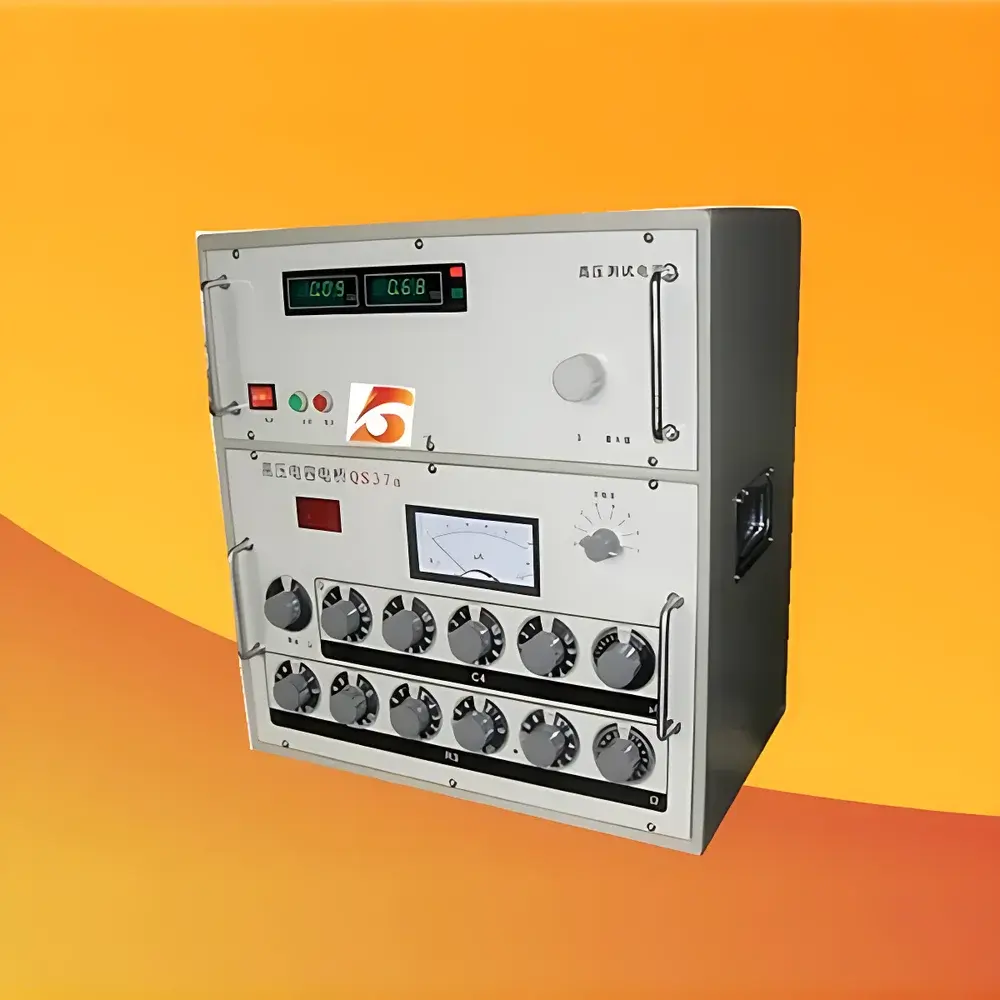
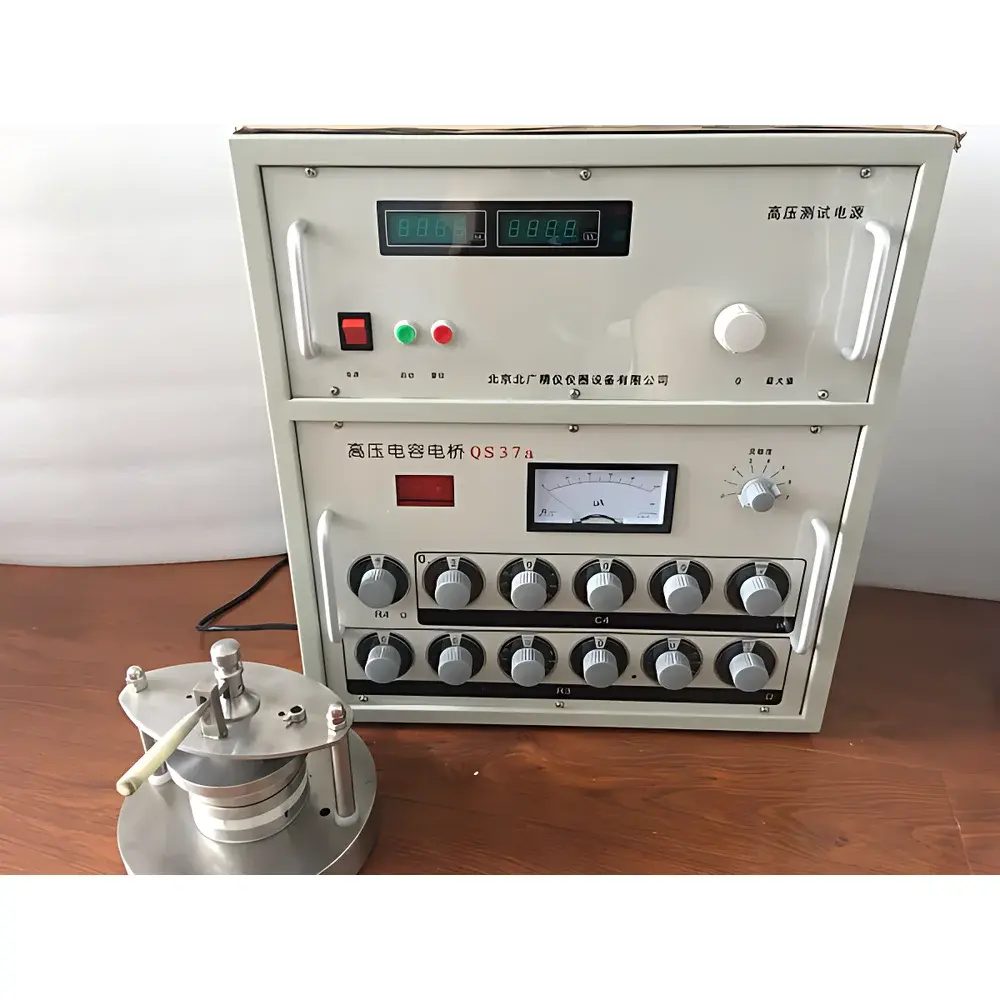
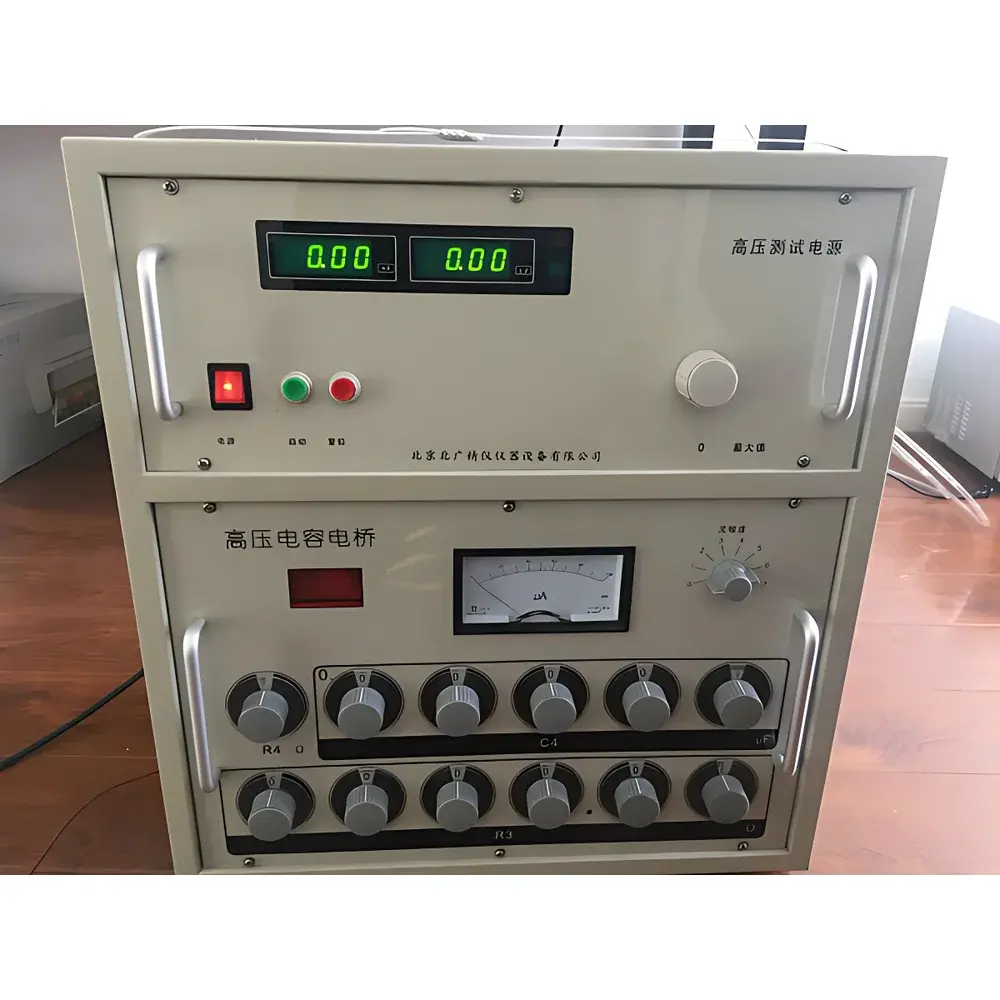
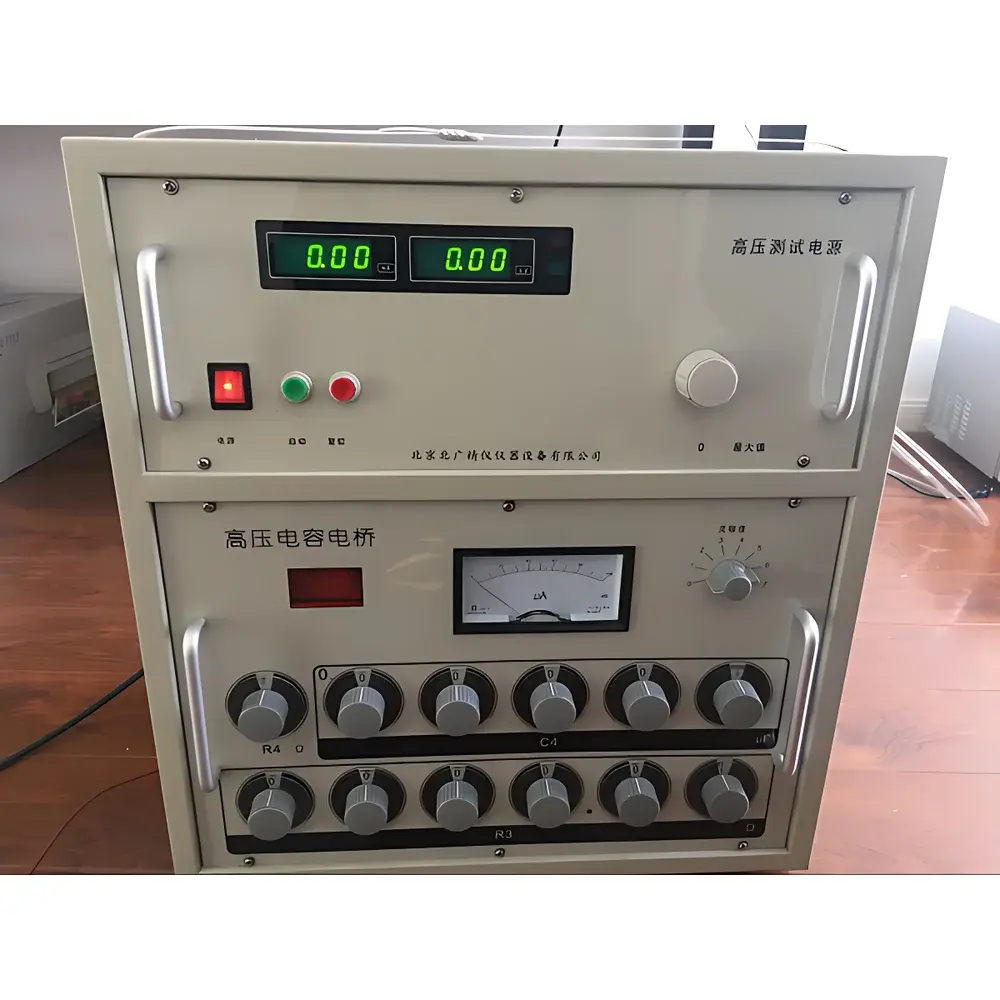
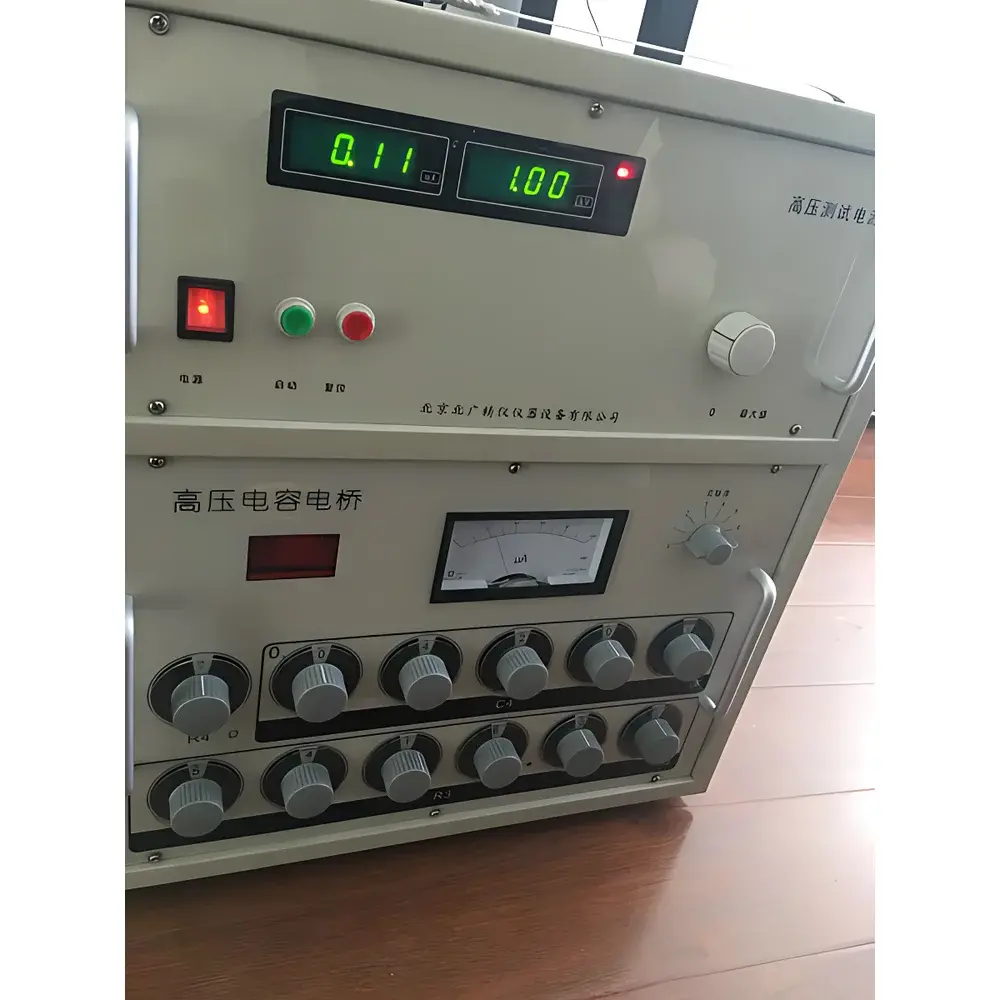
Beiguang Jingyi BQS-37a Power-Frequency Dielectric Constant and Dissipation Factor Bridge
| Brand | Beiguang Jingyi / All Precision Instrument |
|---|---|
| Origin | Beijing, China |
| Manufacturer Type | Manufacturer |
| Product Origin | Domestic (China) |
| Model | BQS-37a |
| Price | USD 2,650 (approx.) |
Overview
The Beiguang Jingyi BQS-37a Power-Frequency Dielectric Constant and Dissipation Factor Bridge is a precision high-voltage AC impedance bridge engineered for the accurate determination of relative permittivity (εr) and dielectric loss tangent (tan δ) of solid insulating materials at industrial power frequency (50 Hz). Based on the classical Schering bridge topology, it implements a balanced four-arm AC bridge configuration with automatic auxiliary potential tracking to suppress parasitic capacitance and electromagnetic interference. The instrument operates under sinusoidal excitation at nominal 50 Hz (±0.1 Hz), with measurement voltage up to 2.5 kV (rms), and is explicitly designed for compliance with GB/T 1409, GB/T 5654, GB/T 1693, and ASTM D150–1998(2004) standards for dielectric characterization of electrical insulation materials. Its core architecture integrates dual electrostatic shielding, thermally aged passive components, and a digitally calibrated high-voltage source (±3% accuracy), ensuring long-term stability and metrological traceability in laboratory and QC environments.
Key Features
- Classical Schering bridge circuit with integrated auxiliary balance bridge for real-time suppression of stray capacitance and ground-loop effects
- Dual-layer electrostatic shielding (outer chassis + inner guard shield) to minimize external EMI coupling and improve signal integrity
- Onboard 0–2500 V (rms), digitally regulated high-voltage source with built-in overcurrent protection per decade resistor arm (≤15 mA at 10 kΩ, ≤150 mA at 10 Ω)
- Calibrated internal standard capacitor: 100 pF, tan δ < 5×10⁻⁵, temperature-stabilized ceramic construction
- High-reliability decade switches with low contact resistance (100,000-cycle mechanical life for R3 and C4 arms
- Zero-indicator with voltage sensitivity ≥1×10⁻⁶ V/div and current sensitivity ≥2×10⁻⁹ A/div at 50 Hz; harmonic rejection >25 dB (2nd), >50 dB (3rd)
- Automatic potential tracker maintaining equipotential between bridge node B and inner shield (S) during balancing, eliminating manual guarding
Sample Compatibility & Compliance
The BQS-37a accommodates solid dielectric specimens—including polymer films, epoxy resins, ceramics, transformer oils (with optional liquid cell), and laminated composites—mounted between standardized electrode systems (e.g., guarded three-terminal electrodes per IEC 60250). It supports both internal (100 pF) and external standard capacitors (user-provided, up to 10 nF), enabling extended range measurements. The system complies with national and international standards governing dielectric testing: GB/T 1409 (measurement methods for permittivity and tan δ), GB/T 5654 (liquid insulating materials), GB/T 1693 (rubber and plastics), and ASTM D150–1998(2004). Its design adheres to fundamental safety requirements outlined in IEC 61010-1 for electrical equipment for measurement, control, and laboratory use, including reinforced insulation, grounding continuity verification, and controlled voltage ramping protocols.
Software & Data Management
The BQS-37a is a manually operated analog bridge and does not incorporate embedded microprocessors or digital data logging. All measurements are performed via visual null detection using the front-panel galvanometer. However, the instrument’s deterministic linear response enables full integration into GLP/GMP-compliant workflows when used with external documentation systems. Users record raw R3 and C4 dial positions, applied test voltage (U), and ambient conditions (20 ± 5 °C, 30–80% RH) in bound laboratory notebooks or LIMS-compatible spreadsheets. Calculations for Cx = R4 × Cn / R3 and tan δ = ω·R4·C4 are performed per ASTM D150 Annex A1, with frequency correction applied if operating outside 50 Hz (tan δactual = f′/f × tan δmeasured). Audit trails, calibration records, and uncertainty budgets must be maintained externally per ISO/IEC 17025 requirements.
Applications
This bridge serves as a reference-grade tool in quality control laboratories for incoming inspection of insulating materials used in high-voltage equipment manufacturing (e.g., bushings, cable insulation, motor windings). It supports R&D validation of new dielectric formulations, aging studies under thermal/electrical stress, and comparative analysis of moisture absorption effects on polymeric substrates. In academic settings, it is employed for teaching fundamental AC bridge theory, complex impedance modeling, and dielectric relaxation phenomena in condensed matter physics. Its robust analog architecture ensures immunity to digital noise in high-EMI industrial testing bays, making it suitable for factory-floor verification where repeatability and operator independence are prioritized over automation.
FAQ
What is the maximum recommended test voltage for routine operation?
The BQS-37a is rated for continuous operation up to 2.5 kV (rms) across terminals A–B. Voltage ramping must be gradual; abrupt application is prohibited per safety protocol Section 4.5.
Can the bridge measure low-loss materials (tan δ < 0.0001)?
Yes — with optimized sensitivity settings and stable environmental conditions (20 ± 1 °C, <50% RH), the instrument achieves resolution down to ±1×10⁻⁵ in tan δ, validated against NIST-traceable reference standards.
Is external calibration required before first use?
Initial verification against the internal 100 pF standard capacitor is mandatory. Full calibration per JJG 622–2019 (Chinese metrological regulation for high-voltage bridges) is recommended annually or after any physical shock or repair.
Does the instrument support 60 Hz operation?
Yes — the bridge functions at 60 Hz; however, tan δ values must be corrected using the formula tan δ60Hz = (60/50) × tan δ50Hz, as specified in ASTM D150 Section 10.3.
What maintenance is required to ensure long-term accuracy?
Decade switch contacts should be cleaned annually with electronic-grade isopropyl alcohol; all passive components undergo accelerated aging during factory burn-in, and no user recalibration is permitted — only certified service centers may adjust internal gain or offset circuits.



