
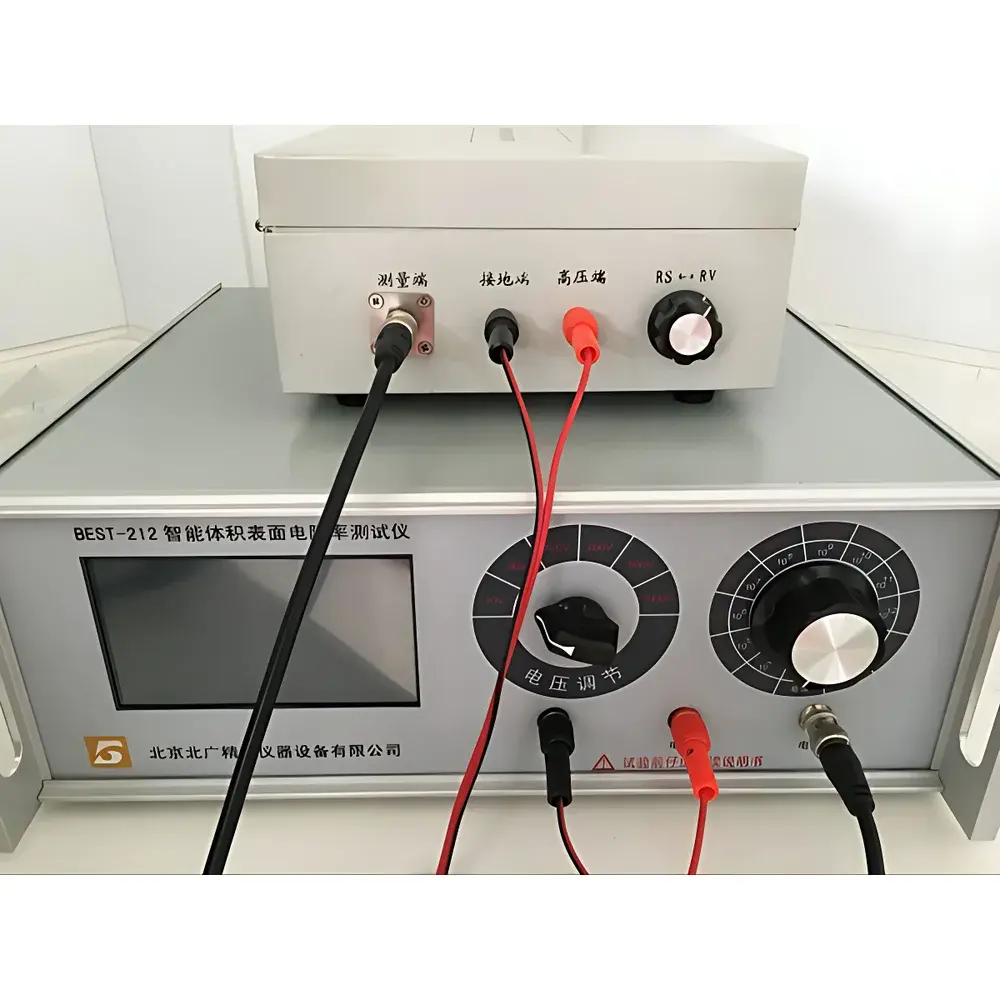
North Guang Precision Instrument BEST-212 Volume & Surface Resistivity Tester for Rubber and Plastics
| Brand | North Guang Precision Instrument |
|---|---|
| Origin | Beijing, China |
| Manufacturer Type | Direct Manufacturer |
| Product Model | BEST-212 |
| Price | ¥18,000 |
| Compliance | GB/T 1410–2006, ASTM D257–99, GB/T 2439–2001, GB/T 10581–2006, GB/T 1692–2008, GB/T 12703.4–2010, GB/T 10064–2006 |
| Measurement Principle | Three-Electrode DC Method |
| Resistance Range | 0.01 × 10⁴ Ω to 1 × 10¹⁸ Ω |
| Current Range | 2 × 10⁻⁴ A to 1 × 10⁻¹⁶ A |
| Test Voltages | 10 V, 25 V, 100 V, 250 V, 500 V, 1000 V (selectable) |
| Accuracy | ±1% to ±5% |
| Display | LCD + Touchscreen Interface |
| Sample Types | Solid, Liquid, Powder, Paste, Thin Films |
| Electrode Configurations | Solid electrode set, liquid electrode, powder electrode, paste electrode |
| Shielded Enclosure Dimensions | 200 × 200 × 100 mm |
| Main Unit Dimensions | 300 × 170 × 120 mm / 360 × 350 × 170 mm |
| Weight | 5 kg |
| Core IC | U.S.-sourced large-scale integrated circuit |
| Certifications Available From | China Academy of Metrology (No. 514 Institute), No. 304 Institute, Chinese Academy of Sciences institutes |
| Warranty | 3 years full coverage, lifetime technical support |
Overview
The North Guang Precision Instrument BEST-212 Volume & Surface Resistivity Tester is a precision digital high-resistance meter engineered for quantitative characterization of electrical insulation and conduction behavior in elastomeric, polymeric, and composite materials. It operates on the standardized three-electrode DC measurement principle—comprising guarded, guarded, and guard electrodes—to isolate volume current from surface leakage paths, thereby enabling accurate determination of both volume resistivity (ρv, in Ω·m) and surface resistivity (ρs, in Ω/sq) per IEC 60093 and ASTM D257–99. The instrument applies stable, calibrated DC test voltages (10 V to 1000 V) across sample geometries and measures resulting currents down to 1 × 10⁻¹⁶ A with dual 3½-digit digital readouts for resistance and current simultaneously. Its design conforms rigorously to GB/T 1410–2006, the Chinese national standard equivalent to ISO 3915, ensuring metrological traceability and interlaboratory reproducibility for QC/QA, R&D, and regulatory submissions in rubber, plastic, and advanced functional material development.
Key Features
- Ultra-wide resistance measurement range: 1 × 10⁴ Ω to 1 × 10¹⁸ Ω, covering insulating polymers, antistatic additives, conductive composites, and carbon-black-filled elastomers.
- Sub-femtoampere current sensitivity (1 × 10⁻¹⁶ A), essential for evaluating high-dielectric-loss or low-conductivity materials under elevated voltage stress.
- Programmable DC test voltages (10 V, 25 V, 100 V, 250 V, 500 V, 1000 V) compliant with ASTM D257 Annex A1 for voltage-dependent resistivity profiling.
- Integrated electrostatic shielding enclosure (200 × 200 × 100 mm) minimizes environmental noise and eliminates stray capacitance effects during ultra-high-impedance measurements.
- Modular electrode system—including solid disc electrodes, liquid bath cells, powder compression fixtures, and paste-compatible probes—enables standardized testing across heterogeneous physical states without reconfiguration delays.
- Microprocessor-controlled operation with real-time LCD + touchscreen interface supports intuitive parameter selection, auto-ranging, and on-screen data logging.
- Compact benchtop footprint (300 × 170 × 120 mm; 5 kg) facilitates integration into controlled-environment labs, cleanrooms, and production-line quality stations.
Sample Compatibility & Compliance
The BEST-212 is validated for use with solid sheets, molded vulcanizates, extruded profiles, solvent-cast films, thermoplastic pellets, powdered fillers (e.g., carbon black, graphene, metal oxides), viscous pastes (e.g., conductive adhesives), and low-conductivity liquids (e.g., uncured rubber compounds, dielectric oils). Its three-electrode architecture satisfies mandatory requirements in GB/T 2439–2001 (for vulcanized rubber), GB/T 1692–2008 (rubber insulation), and GB/T 12703.4–2010 (textile static evaluation), making it suitable for GLP-compliant testing in accredited rubber compounding labs and ISO/IEC 17025-certified material testing facilities. All measurement protocols align with statistical repeatability criteria defined in ASTM D257–99 Section 11, supporting audit-ready documentation for FDA-regulated medical device packaging or automotive component qualification.
Software & Data Management
While the BEST-212 operates as a standalone instrument with embedded firmware, its analog/digital output ports (RS-232 optional) support integration with laboratory information management systems (LIMS) and custom data acquisition platforms. Raw resistance and current values are timestamped and stored internally for up to 100 test records. When paired with North Guang’s optional PC-based analysis software (v3.2+), users can generate ASTM-compliant reports—including resistivity calculations per thickness and electrode geometry, statistical summaries (mean, SD, CV%), and trend charts across batch lots. Audit trail functionality logs operator ID, test date/time, voltage setting, and electrode configuration—meeting minimum requirements for 21 CFR Part 11 electronic record integrity where configured with user authentication and electronic signatures.
Applications
- Quality control of carbon-black–loaded SBR/NR/EPDM compounds for automotive tires and seals.
- Development of ESD-safe thermoplastics (e.g., ABS, PC, PEEK) used in electronics housings and cleanroom tooling.
- Characterization of antistatic coatings on polymer films for food packaging and pharmaceutical blister cards.
- Evaluation of filler dispersion homogeneity in conductive rubber composites via spatial resistivity mapping.
- High-temperature resistivity screening (per GB/T 10581–2006) of silicone elastomers for aerospace gasketing.
- Regulatory testing of insulating materials per GB/T 10064–2006 for power cable jacketing and transformer bushings.
- Research on ion-conductive polymer electrolytes for solid-state batteries using low-voltage (<25 V) polarization protocols.
FAQ
What standards does the BEST-212 fully comply with?
It meets all technical and procedural requirements of GB/T 1410–2006, ASTM D257–99, GB/T 2439–2001, GB/T 1692–2008, GB/T 10581–2006, GB/T 12703.4–2010, and GB/T 10064–2006.
Can it measure both volume and surface resistivity on the same sample?
Yes—using the included three-electrode system, operators can switch between volume and surface configurations without hardware modification, following standardized electrode placement per GB/T 1410 Clause 6.
Is calibration traceable to national metrology institutes?
Calibration certificates issued by authorized bodies—including China Academy of Metrology (No. 514 Institute) and No. 304 Institute—are available upon request and include uncertainty budgets per ISO/IEC 17025.
Does it support temperature-controlled measurements?
The base unit does not integrate environmental chambers; however, its electrode fixtures are compatible with external temperature-controlled stages (–40 °C to +150 °C), and voltage/current stability is maintained across ambient fluctuations per IEC 61000-4-8 immunity testing.
What maintenance is required during the 3-year warranty period?
No scheduled maintenance is required; periodic verification using certified high-resistance standards (e.g., 10¹² Ω and 10¹⁵ Ω) is recommended annually to confirm accuracy drift within ±5% tolerance limits.







