
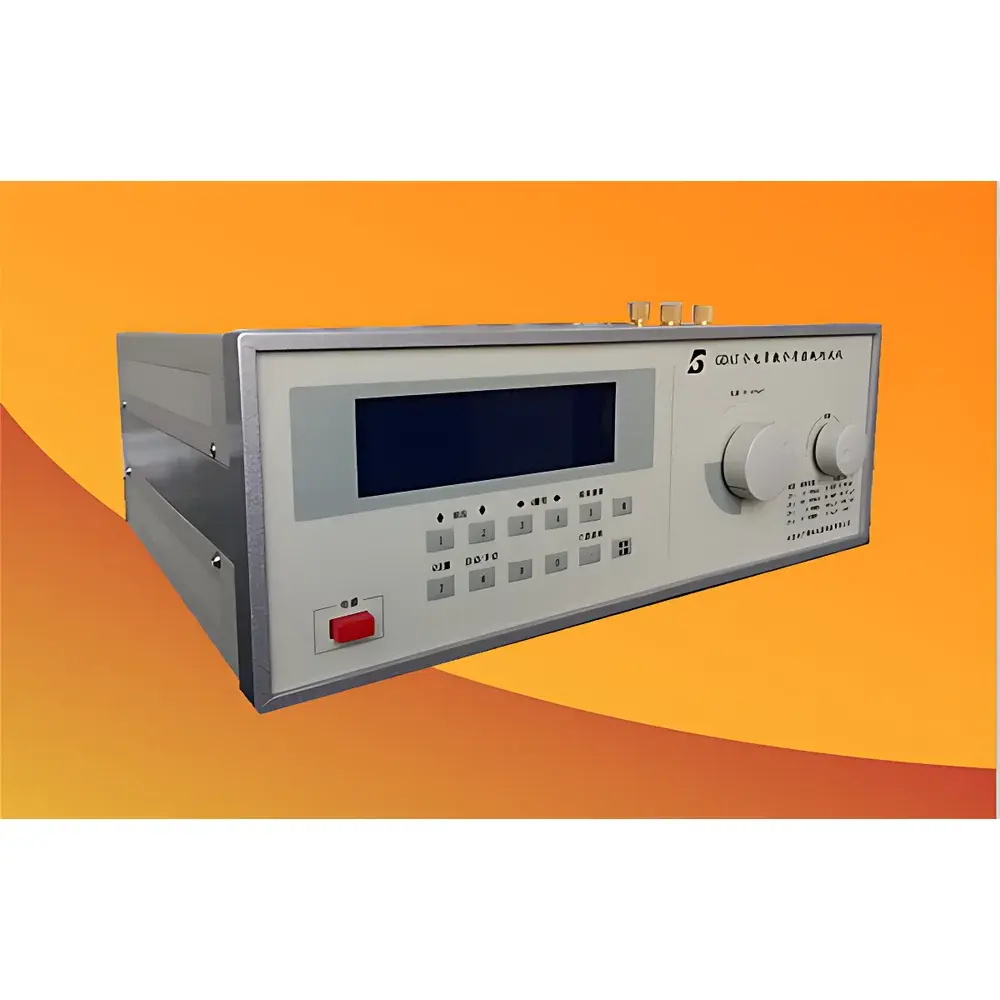
Beijing North Guang Precision Instrument GDAT-A High-Frequency Q-Meter for Dielectric Constant and Dissipation Factor Measurement
| Brand | Beijing North Guang Precision Instrument |
|---|---|
| Origin | Beijing, China |
| Manufacturer Type | Manufacturer |
| Product Category | Domestic |
| Model | GDAT-A |
| Price | USD 2,100 (approx.) |
Overview
The Beijing North Guang Precision Instrument GDAT-A High-Frequency Q-Meter is an engineered precision instrument designed for the quantitative determination of dielectric constant (εr) and dissipation factor (tan δ) of solid insulating materials across a broad frequency spectrum—from 10 kHz to 160 MHz. It operates on the principle of high-frequency resonant cavity impedance analysis, utilizing a calibrated parallel-resonant LC circuit where the test sample forms part of the capacitance element. By measuring shifts in resonant frequency and Q-factor (quality factor) before and after sample insertion into a standardized electrode configuration—typically a parallel-plate capacitor or coaxial cylindrical cell—the instrument computes εr and tan δ via established analytical relationships derived from ASTM D150, IEC 60250, and GB/T 1409–2006. Its core architecture integrates direct digital synthesis (DDS) signal generation, automatic resonance tracking, and low-residual-inductance tuning circuits (<8 nH), enabling high reproducibility in high-frequency dielectric characterization—particularly critical for low-loss materials such as PTFE, quartz, alumina ceramics, and FR-4 PCB substrates.
Key Features
- Wide frequency coverage: 10 kHz to 160 MHz, segmented into seven calibrated bands with frequency accuracy of ±2×10⁻⁴ ±1 digit
- Dual-mode tuning: Sensor-based capacitive sensing (GDAT-A) or stepper-motor-driven precision capacitance adjustment (GDAT-C variant)
- Automated resonance search: Real-time detection of series/parallel resonance points with simultaneous readout of Q, C, L, and fres
- Q-value measurement range: 5–999, with auto/manual ranging across 30, 100, 300, and 999 scales; resolution down to 0.1 Q
- Capacitance measurement: 1–460 pF direct range; main capacitor 40–500 pF with ±1.5 pF (≤150 pF) or ±1% (≥150 pF) accuracy
- Low-residual tuning circuit: Optimized layout reduces parasitic inductance to <8 nH, minimizing measurement uncertainty at frequencies up to 100 MHz
- Integrated DDS signal source: Stable, low-distortion output usable as standalone RF source (1 kHz–60 MHz / 50 kHz–160 MHz)
- VFD graphical display: Full Chinese-language menu interface with real-time parameter monitoring, error alerts, and status prompts
Sample Compatibility & Compliance
The GDAT-A supports standardized dielectric testing of rigid and semi-rigid solid insulators including epoxy laminates, ceramic substrates, polymer films (≥25 µm thickness), and printed circuit board (PCB) materials. Sample geometry follows GB/T 1409–2006 requirements: disc-shaped specimens with diameter Φ15–40 mm and thickness 2.0 ± 0.5 mm, dimensioned according to expected permittivity range (e.g., Φ15–20 mm for εr > 30). The system accommodates both air-dielectric reference calibration and guarded-electrode configurations to suppress fringing effects. It complies fully with ASTM D150–18 (Standard Test Method for Dielectric Breakdown Voltage of Insulating Oils), IEC 60250 (Measurement of the Dielectric Properties of Solid Electrical Insulating Materials at Power, Audio and Radio Frequencies), and GB/T 1409–2006 (Recommended Methods for Measuring Permittivity and Dielectric Loss of Electrical Insulating Materials). All firmware and data handling routines support GLP-aligned audit trails when used with optional RS232-linked PC software.
Software & Data Management
The GDAT-A includes embedded microcontroller-based firmware with non-volatile memory for storing calibration coefficients, user-defined test profiles, and up to 200 measurement records. An optional Windows-compatible communication application enables bidirectional data exchange via RS232 serial interface—including automated export of εr, tan δ, Q, C, L, and fres values in CSV format. The software supports statistical analysis (mean, SD, CV%), trend plotting across frequency sweeps, and comparative overlay of multiple material datasets. All measurement sessions include timestamping and operator ID fields. While not FDA 21 CFR Part 11-certified out-of-the-box, the system’s deterministic response, fixed calibration intervals, and traceable hardware-based measurement chain make it suitable for GMP-aligned QC environments when deployed with documented SOPs and periodic verification using NIST-traceable reference standards (e.g., sapphire, fused quartz, and alumina discs supplied separately).
Applications
This instrument serves as a primary metrology tool in R&D laboratories and quality control departments evaluating high-frequency performance of advanced dielectrics. Typical use cases include: verification of εr stability in RF substrate materials (e.g., Rogers RO4000®, Taconic RF-35) across temperature and humidity stress; quantification of moisture-induced tan δ increase in epoxy-glass laminates; screening of low-loss polymer films for 5G antenna substrates; validation of curing degree in thermoset composites via dielectric relaxation profiling; and certification of capacitor dielectrics per MIL-PRF-123 or IEC 60384 standards. Its ability to resolve tan δ down to 5×10⁻⁵ makes it especially valuable for characterizing ultra-low-loss ceramics (e.g., CaTiO3-based compositions) and single-crystal insulators used in microwave resonators and filters.
FAQ
What standards does the GDAT-A comply with?
It meets the technical requirements of GB/T 1409–2006, ASTM D150–18, and IEC 60250 for dielectric constant and loss tangent measurement.
Can the GDAT-A measure thin films less than 25 µm thick?
No—minimum recommended thickness is 2.0 mm for disc specimens per standard methodology; thinner films require alternative techniques such as split-post dielectric resonator (SPDR) or free-space transmission methods.
Is external calibration required before first use?
Yes—users must perform initial open/short/load calibration using provided reference fixtures and optionally validate against certified dielectric standards (e.g., sapphire discs) to establish traceability.
Does the instrument support automated frequency sweeps?
Manual frequency stepping is supported per band; full automated sweep functionality requires the optional PC software package and RS232 connection.
What maintenance is recommended for long-term accuracy?
Annual verification of frequency accuracy, Q-scale linearity, and capacitance calibration is advised; keep the tuning mechanism clean and avoid mechanical shock to preserve sensor integrity.



