
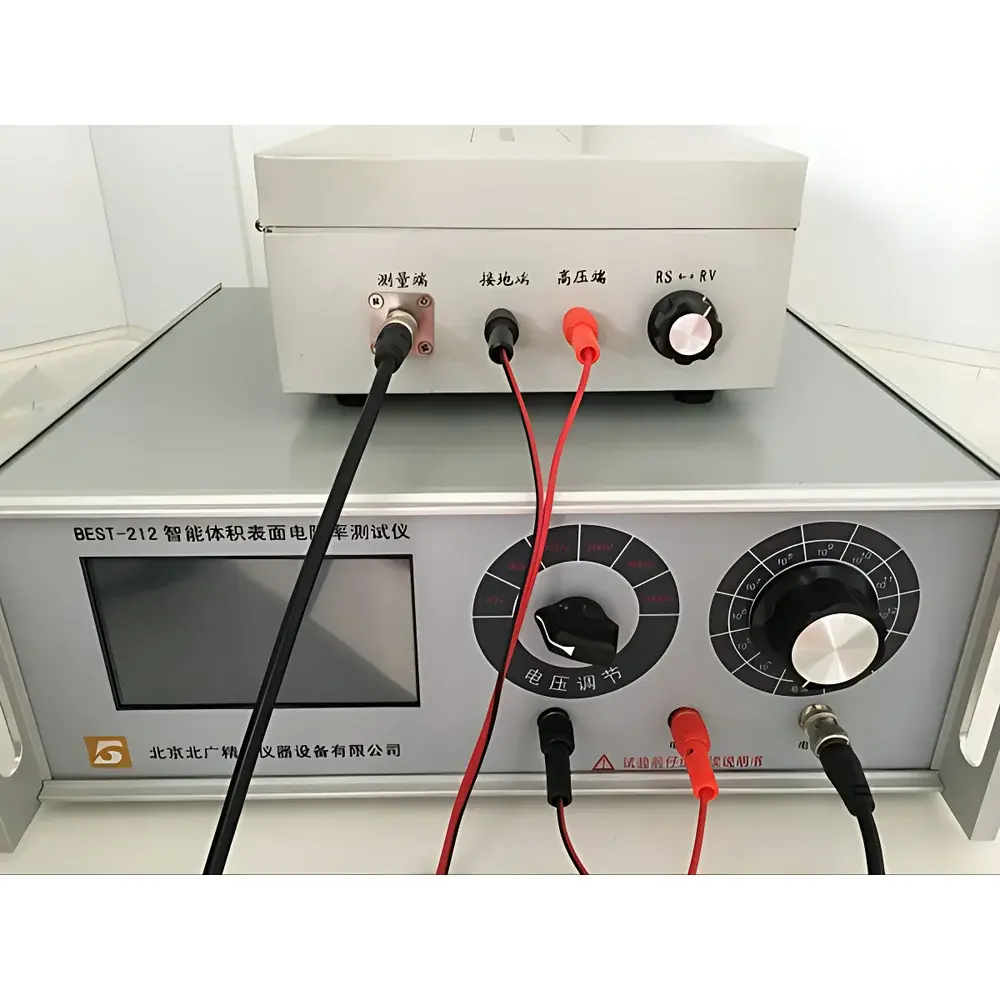
North Guang BEST-212 Volume & Surface Resistivity Tester for Vulcanized Rubber and Insulating Materials
| Brand | North Guang / All Precision Instrument |
|---|---|
| Origin | Beijing, China |
| Manufacturer Type | Direct Manufacturer |
| Product Category | Domestic |
| Model | BEST-212 |
| Application | Multi-format resistivity measurement (solid, powder, liquid) |
| Compliance | GB/T 1410-2006, ASTM D257-99, GB/T 1692-2008, GB/T 2439-2001, GB/T 10064-2006, GB/T 12703.4-2010 |
| Resistance Range | 1×10⁴ Ω to 1×10¹⁸ Ω |
| Current Range | 2×10⁻⁴ A to 1×10⁻¹⁶ A |
| Test Voltages | 10 V, 50 V, 100 V, 250 V, 500 V, 1000 V |
| Accuracy | ±1% |
| Display | 64-bit true-color capacitive touchscreen |
| Power Supply | AC 220 V, 50 Hz, ~5 W |
| Operating Environment | 0–40 °C, RH < 80% |
Overview
The North Guang BEST-212 Volume & Surface Resistivity Tester is an engineered solution for precise, standardized DC resistivity characterization of insulating and semiconductive materials—including vulcanized rubber, plastics, elastomers, films, powders, and liquids. Based on the principle of constant-voltage DC resistance measurement with guarded electrode configuration, the instrument implements Ohm’s law (ρ = R × A / t for volume resistivity; σₛ = R × P / L for surface resistivity) in real time, eliminating manual calculation and minimizing operator-induced error. It directly computes and displays volume resistivity (Ω·m), surface resistivity (Ω/sq), resistance (Ω), and current (A) simultaneously—requiring only user input of sample thickness (for volume) or electrode geometry (for surface). Designed in full alignment with international and national standards—including ASTM D257-99, GB/T 1410-2006, and GB/T 1692-2008—the BEST-212 supports traceable, audit-ready testing in QC laboratories, R&D centers, and production environments governed by GLP, ISO/IEC 17025, or internal quality management systems.
Key Features
- True-color 64-bit capacitive touchscreen interface enabling intuitive sample type selection (solid, powder, or liquid) and automatic parameter mapping
- Integrated multi-range voltage source (10 V to 1000 V, selectable in six discrete steps) with auto-ranging current measurement from 2×10⁻⁴ A down to 1×10⁻¹⁶ A
- Simultaneous real-time display of resistance, current, voltage, volume resistivity, and surface resistivity—no post-test conversion required
- Standard-compliant electrode support: includes solid-state single-electrode fixture; optional guarded ring electrodes, powder cells, and liquid conductivity cells available upon request
- High-stability analog front-end and low-noise shielding architecture ensure repeatability ≤±1% across the full 14-decade resistance range (1×10⁴ Ω to 1×10¹⁸ Ω)
- Compact benchtop design (W×D×H: 320×280×150 mm), lightweight (<5 kg), and energy-efficient (~5 W typical power draw)
Sample Compatibility & Compliance
The BEST-212 accommodates heterogeneous sample formats without hardware reconfiguration: flat solids ≥100 mm diameter (standard electrode), granular powders (using compression cell), and conductive/non-conductive liquids (via dedicated immersion probe). Its firmware enforces standard-specific test protocols—for example, GB/T 1692-2008 mandates 1-minute stabilization at 500 V for vulcanized rubber, while ASTM D257-99 defines guard-ring electrode geometry and humidity-controlled conditioning. The instrument logs timestamped test conditions (voltage, dwell time, ambient T/RH) to support regulatory review. All calibration and verification procedures align with ISO/IEC 17025 requirements, and raw data export (CSV) enables third-party validation against reference standards such as NIST SRM 1901b.
Software & Data Management
No external PC software is required—the embedded firmware handles all calculations, unit conversions, and result formatting per selected standard. Each test record stores material ID, electrode type, thickness (if applicable), applied voltage, measured current/resistance, computed resistivity, and operator timestamp. Data is retained onboard (internal flash memory) and exportable via USB to CSV for integration into LIMS or statistical process control (SPC) platforms. Audit trails are maintained per FDA 21 CFR Part 11 principles: user login (optional password protection), immutable test logs, and electronic signature-capable reporting. Firmware updates are delivered via USB stick, with version history and change logs accessible within system settings.
Applications
This instrument serves critical roles in polymer formulation labs evaluating carbon-black dispersion in EPDM or SBR compounds; tire manufacturing QA verifying static-dissipative tread compound consistency; aerospace composites screening for ESD-safe elastomeric seals; and battery separator R&D assessing ionic insulation integrity. It further supports academic research on conductive polymer nanocomposites, quality control of antistatic packaging films (per GB/T 12703.4-2010), and regulatory submission testing for medical device insulators (IEC 60601-1). Its ability to resolve sub-picoamp currents enables detection of subtle aging effects—e.g., oxidation-induced resistivity drift in silicone rubber after thermal cycling.
FAQ
Does the BEST-212 comply with ASTM D257-99 and GB/T 1692-2008?
Yes—its voltage sourcing, current measurement architecture, and electrode interface meet all electrical and procedural requirements specified in both standards.
Can it measure both volume and surface resistivity on the same sample?
Yes, provided appropriate electrode fixtures are used: concentric ring electrodes for surface resistivity; parallel plate or guarded electrode assemblies for volume resistivity.
Is calibration traceable to national standards?
Factory calibration uses certified reference resistors (±0.1% tolerance) traceable to CNAS-accredited labs; users may perform intermediate verification using supplied check standards.
What sample preparation is required for powder measurements?
Powders must be uniformly compressed to a defined density (e.g., 10 MPa) in the optional powder cell; thickness and cross-sectional area are entered manually for volume resistivity calculation.
Does the instrument support GLP-compliant data archiving?
Yes—test records include immutable timestamps, operator ID, environmental metadata, and full parameter traceability, satisfying core GLP documentation requirements for nonclinical laboratory studies.
Related Products





