
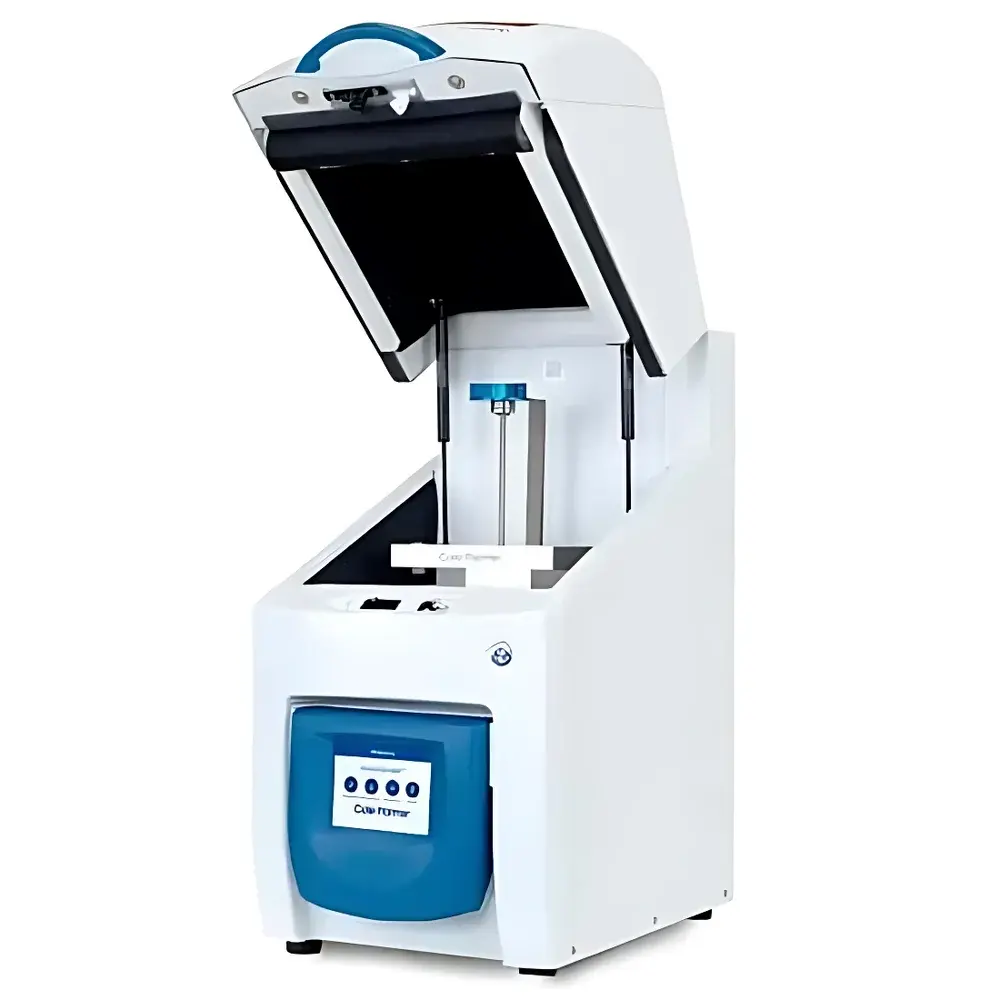
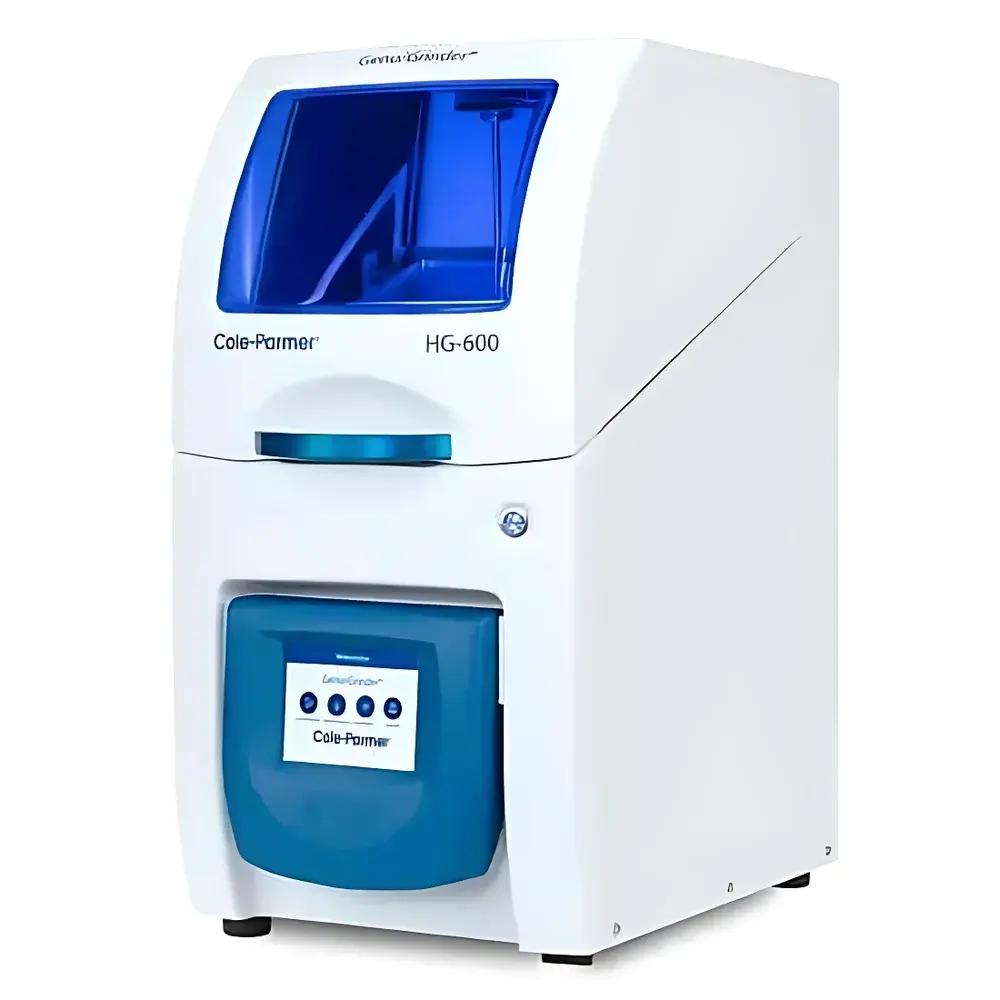
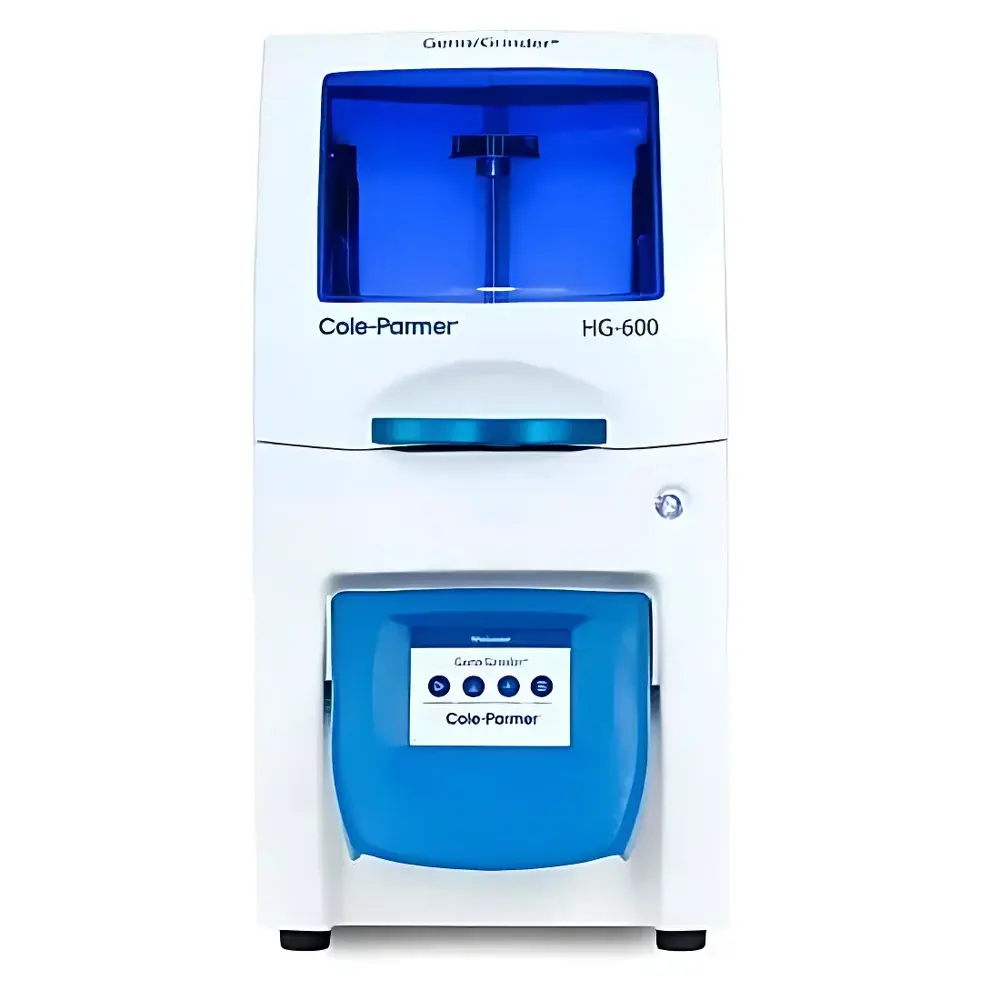
Cole-Parmer Geno/Grinder HG-600 High-Throughput Programmable Tissue Grinder
| Brand | Cole-Parmer |
|---|---|
| Origin | USA |
| Model | HG-600 |
| Dimensions (W×D×H) | 35.6 × 57.2 × 71.1 cm |
| Weight | 48 kg |
| Power Supply | 230 V AC |
| Power Consumption | 245 W |
| Amplitude | 3.2 cm |
| Frequency Range | 500–1750 cycles/min |
| Sample Capacity | 6 × 96-well deep-well plates |
Overview
The Cole-Parmer Geno/Grinder HG-600 is a high-throughput, programmable tissue grinder engineered for rapid, reproducible mechanical lysis of biological samples through vertical reciprocating motion. Unlike rotary or bead-beating systems relying on orbital agitation, the HG-600 employs a precisely controlled vertical oscillation mechanism—generating high-energy impacts between grinding media and sample matrices. This principle enables efficient disruption of tough cellular structures including plant cell walls (roots, stems, leaves, seeds), fibrous animal tissues, and microbial pellets. The instrument’s design adheres to fundamental principles of mechanical energy transfer in solid-liquid and solid-solid systems, where kinetic energy from oscillation is converted into shear, compression, and impact forces sufficient to fracture cellular integrity without excessive heat generation—critical for preserving labile analytes such as nucleic acids, proteins, and small-molecule metabolites.
Key Features
- Programmable touchscreen interface with adjustable tilt angle for ergonomic access and real-time parameter monitoring
- Storage capacity for up to 500 user-defined methods—including time, frequency, amplitude, cycle count, and pause intervals
- Administrative lockout functionality supporting password-protected protocol restrictions—enabling lab managers to enforce SOP compliance and prevent unauthorized method modifications
- Integrated self-diagnostic system with status indicators for motor performance, thermal load, and mechanical alignment
- Enhanced optical visibility via enlarged observation window and reoriented sample clamping architecture—reducing loading/unloading time and minimizing operator-induced variability
- Modular compatibility with four core subsystems: base unit, fixture adapters, consumables (grinding beads, ceramic pins, vials, plates), and optional cryogenic modules (LN2-compatible cold blocks and insulated chambers)
Sample Compatibility & Compliance
The HG-600 accommodates diverse sample formats across life science, food safety, and environmental testing workflows. Validated configurations include 96-well deep-well plates (for high-throughput genomics), 50 mL conical tubes (QuEChERS pesticide extraction), 15 mL and 2 mL microcentrifuge tubes (proteomics), and large-volume jars (up to 750 mL) for bulk tissue homogenization. All standard fixtures are manufactured to ISO 9001-certified tolerances and designed for repeatable clamping force distribution. When used in regulated environments—including GLP and GMP laboratories—the instrument supports audit-ready operation when paired with validated software protocols compliant with FDA 21 CFR Part 11 requirements for electronic records and signatures. Its mechanical architecture meets IEC 61000-6-2 (immunity) and IEC 61000-6-4 (emission) standards for laboratory electromagnetic compatibility.
Software & Data Management
Method programming occurs directly via the embedded color touchscreen, eliminating dependency on external PCs. Each stored protocol includes timestamped metadata (operator ID, date/time, run parameters), enabling traceability per ISO/IEC 17025 and CLIA guidelines. Optional data export via USB port allows CSV-formatted logs for integration into LIMS or ELN platforms. While the HG-600 does not feature network connectivity or cloud synchronization, its local storage architecture ensures data integrity during power interruptions and avoids cybersecurity vulnerabilities associated with connected instrumentation. For labs requiring full digital workflow integration, third-party middleware solutions can be deployed to bridge method execution logs with enterprise data systems using standardized OPC UA or Modbus TCP interfaces.
Applications
- Genomic DNA/RNA isolation: Efficient lysis of recalcitrant plant tissues (e.g., maize kernels, pine needles) and fibrous mammalian organs (e.g., heart, skeletal muscle) prior to column-based or magnetic bead purification
- QuEChERS sample preparation: Accelerated homogenization of 10–15 g fruit/vegetable matrices in 50 mL centrifuge tubes containing MgSO4, NaCl, and acetonitrile—demonstrated to improve pesticide recovery by ≥15% versus manual shaking (per AOAC 2007.01 validation studies)
- Proteomics and metabolomics: Consistent disruption of yeast, bacterial, and fungal cultures while maintaining native protein conformation and low-abundance metabolite stability
- Pharmaceutical QC: Uniform particle size reduction of botanical extracts and herbal powders for dissolution testing and HPLC assay development
- Environmental analysis: Homogenization of soil, sediment, and compost samples for heavy metal leaching assays and microbial community profiling
FAQ
What types of grinding media are compatible with the HG-600?
Stainless steel, zirconium oxide, silicon dioxide, and ceramic grinding balls or pins—available in diameters from 0.5 mm to 10 mm—are supported across all fixture types. Ceramic pins are specifically recommended for QuEChERS applications to minimize metal contamination.
Can the HG-600 be operated under cryogenic conditions?
Yes—when equipped with the optional cryogenic module, the system supports liquid nitrogen-cooled sample holders and insulated fixtures, enabling sub-zero grinding to suppress enzymatic degradation and thermal denaturation.
Is the HG-600 suitable for regulated pharmaceutical testing?
It meets mechanical and electrical safety requirements for ISO 13485 and USP environments; however, full qualification (IQ/OQ/PQ) must be performed by the end user in accordance with site-specific validation protocols.
How does vertical oscillation compare to horizontal bead beating in terms of reproducibility?
Vertical motion delivers more consistent energy transfer across multi-well formats due to uniform gravitational loading on all wells simultaneously—reducing inter-well CVs to ≤3.5% for DNA yield (n=96), compared to ≥8.2% observed with orbital shakers under equivalent conditions.



