
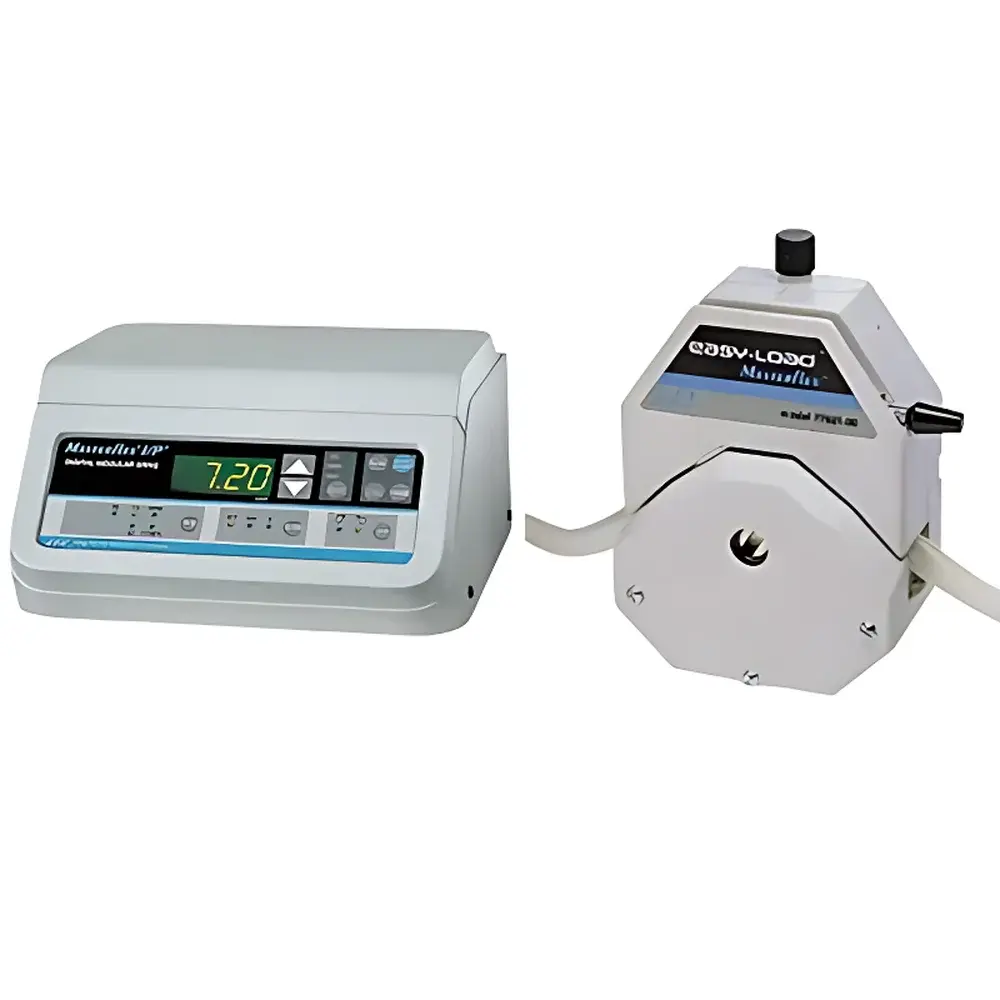
Masterflex® I/P Digital Dispensing Pump System, Model 77970-27
| Brand | Masterflex |
|---|---|
| Origin | USA |
| Model | 77970-27 |
| Pump Type | Peristaltic Pump |
| Flow Rate Range | 0.2–8 L/min |
| Motor | Bidirectional 1/5 hp |
| Display | 4-digit LED |
| Control Distance | Up to 7.6 m (motor-to-controller) |
| Calibration | Non-volatile memory storage for tube-specific calibration factors |
| Power Supply | 230 VAC, 50/60 Hz |
Overview
The Masterflex® I/P Digital Dispensing Pump System (Model 77970-27) is an industrial-grade, modular peristaltic pump engineered for high-precision fluid dispensing and repeatable volumetric transfer in regulated laboratory, pilot-scale, and process environments. Utilizing the fundamental principle of peristalsis—where rollers compress elastomeric tubing to create a sealed, pulse-free fluid displacement—the system delivers accurate, contamination-free flow without valving or seals contacting the fluid path. Its split architecture separates the motor-driven pump head from the digital controller, enabling flexible installation in confined hoods, integrated automation platforms, or remote workstations while maintaining full operational integrity. Designed for compliance-critical workflows, the system supports traceable dispensing protocols through non-volatile calibration storage and programmable parameter logging.
Key Features
- Modular I/P (Isolated Pump) architecture: Motor unit and controller are physically decoupled, allowing independent placement up to 7.6 meters apart via shielded cable—ideal for cleanroom integration or hazardous area separation.
- Bidirectional 1/5-hp brushless DC motor: Enables forward/reverse operation for priming, cleaning, and backflushing of tubing—critical for preventing cross-contamination between samples or reagents.
- Four-parameter 4-digit LED display: Simultaneously shows real-time values for flow rate (with adaptive resolution: 0.01 / 1 / 10 mL/min depending on tubing ID), dispensed volume (0.1–999 L), cycle interval (1–999 s), repetition count (1–99 cycles), and motor speed (1 rpm resolution).
- Programmable dispensing modes: Supports single-shot, timed, volumetric, and multi-cycle dispensing with user-defined pause intervals—enabling complex protocols such as serial dilution, reagent addition sequences, or batch filling.
- Tube-specific calibration memory: Stores up to one set of calibrated flow coefficients per tubing size in non-volatile EEPROM; eliminates recalibration when swapping common Masterflex® I/P-compatible tubing (e.g., PharMed® BPT, Norprene®, Viton®).
- Sealed membrane keypad with lock function: Prevents accidental parameter changes during operation; all functions—including start/stop, prime, reverse, manual calibration, and program execution—are accessible without external software.
Sample Compatibility & Compliance
The system accommodates a broad range of chemically resistant, USP Class VI-certified tubing materials (ID 0.8–6.4 mm), ensuring compatibility with aqueous buffers, organic solvents, acids, bases, and biological media. Its sealless, wetted-path design eliminates dead volumes and particle generation—meeting requirements for ISO 8573-1 (compressed air purity) and ASTM D4169 (distribution environment testing). While not intrinsically rated for Class I Div 1 environments, its 230 VAC, 50/60 Hz power input complies with IEC 61000-6-3 (EMC emission standards) and IEC 61000-6-2 (immunity). The controller’s firmware supports audit-ready operation: all calibration events, parameter changes, and dispensing logs can be timestamped and retained locally—facilitating GLP/GMP documentation under FDA 21 CFR Part 11 when paired with validated electronic record systems.
Software & Data Management
This standalone system operates without host PC dependency; however, optional analog/digital I/O (0–10 V, 4–20 mA, TTL) enables integration into PLC-controlled lines or SCADA architectures. Remote start/stop, direction control, and status feedback (e.g., “running”, “complete”, “error”) are supported via dry-contact or voltage-level signals. Although no proprietary software is bundled, the controller’s internal memory retains last-used parameters and calibration data across power cycles. For laboratories requiring electronic records, third-party LabVIEW™ or Python-based acquisition scripts can interface via RS-232 (optional adapter) to log timestamps, volume totals, and error codes—supporting ALCOA+ data integrity principles when implemented with procedural controls.
Applications
- Automated reagent dispensing in clinical chemistry analyzers and ELISA wash stations
- Volumetric dosing of catalysts or initiators in polymer synthesis reactors
- Controlled nutrient feed in bioreactors and fermentation vessels
- Calibration standard preparation with gravimetric verification (traceable to NIST SRMs)
- Cleaning-in-place (CIP) solution circulation with reversible flow for tubing passivation
- Environmental sample preservation—adding preservatives (e.g., HNO₃, HgCl₂) to field-collected water specimens
FAQ
What tubing sizes are compatible with Model 77970-27?
The pump head accepts Masterflex® I/P series tubing with inner diameters ranging from 0.8 mm to 6.4 mm; recommended part numbers include 96410-15 (PharMed® BPT, 3.2 mm ID) and 96400-14 (Norprene®, 4.8 mm ID).
Does the system support flow rate validation per ISO 8466-1?
Yes—manual calibration mode allows gravimetric or volumetric verification against certified reference standards; stored calibration factors are applied linearly across the full speed range (1–100 rpm), satisfying interpolation requirements of ISO 8466-1 Annex C.
Can dispensing programs be exported or backed up externally?
No—calibration and program settings reside exclusively in onboard non-volatile memory; backup requires manual documentation or integration via analog/digital I/O with external data loggers.
Is the controller rated for continuous duty at maximum flow?
Yes—the 1/5-hp motor and thermal management system are rated for indefinite operation at full speed (100 rpm) with appropriate tubing and ambient temperatures ≤40 °C.
How is tubing wear compensated during long-term use?
Users may perform manual recalibration at any time using the front-panel keypad; the system retains both original and updated calibration factors separately, enabling comparison and drift assessment over time.



