
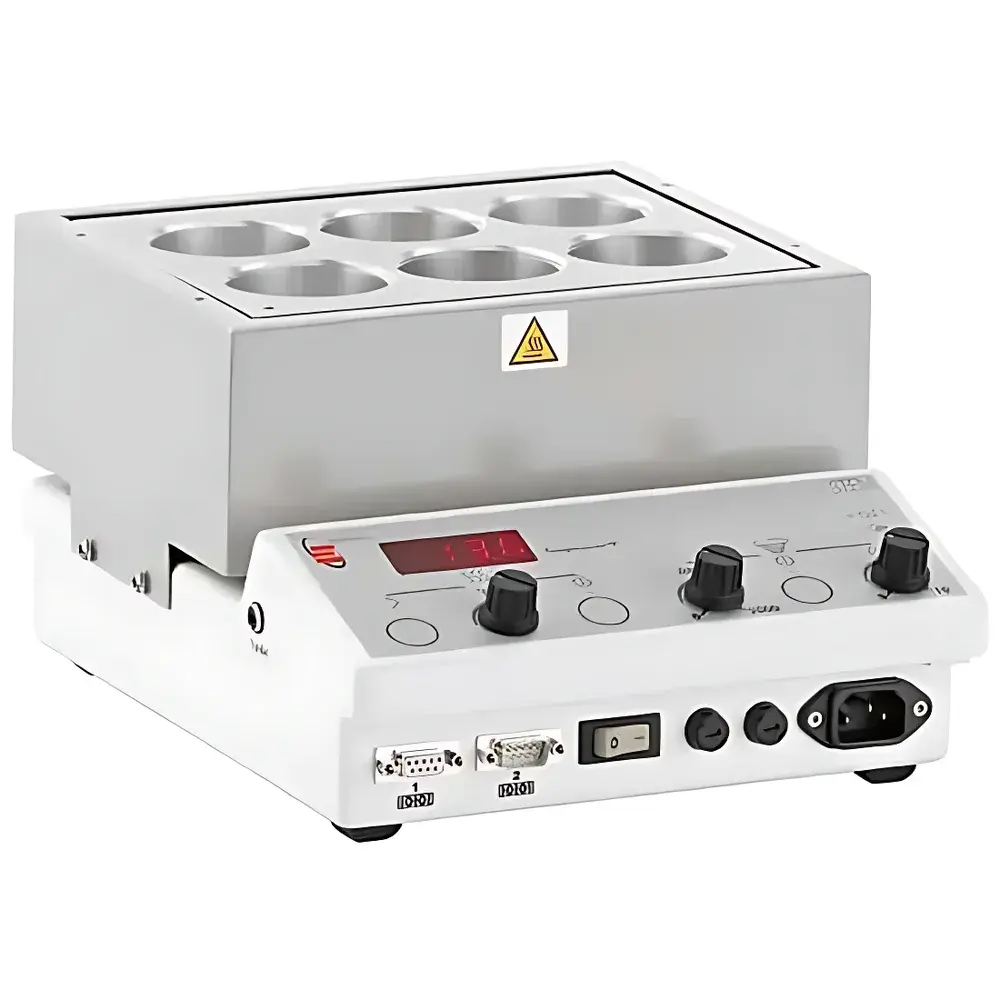
Electrothermal STEM RS600 Six-Position Temperature-Controlled Reaction Station
| Brand | Electrothermal |
|---|---|
| Origin | USA |
| Model | RS600 |
| Vessel Capacity | Up to 250 mL per position |
| Construction Material | Stainless Steel |
| Operating Pressure | Medium-pressure rated |
| Temperature Range | Ambient +5°C to 250°C |
| Stirring Speed | 400–2000 rpm (bidirectional option available) |
| Control Interface | RS232 / RS485 |
| Footprint | Compact, robot-integration optimized |
| Compliance | Designed for GLP-compliant lab environments |
| Power Supply | 230 V / 115 V, 50–60 Hz, 300 W |
Overview
The Electrothermal STEM RS600 is a precision-engineered six-position temperature-controlled reaction station designed for reproducible, parallel synthesis and kinetic studies under controlled thermal and mechanical conditions. Built upon Couette-type stirring geometry and PID-regulated resistive heating, the RS600 delivers uniform thermal distribution across all six reaction zones while maintaining independent yet synchronized control of temperature and agitation. Its stainless steel construction ensures chemical compatibility with organic solvents, acidic/basic reagents, and elevated-temperature catalytic systems—making it suitable for applications ranging from pharmaceutical intermediate synthesis to materials precursor development. Unlike batch-style hotplates or single-vessel reactors, the RS600 enables statistically robust experimental design through simultaneous operation of multiple reaction vessels under identical setpoints, significantly reducing inter-run variability and accelerating method development cycles.
Key Features
- Six independently addressable reaction positions, each accommodating vessels up to 250 mL capacity with standard 57.5 mm diameter footprint
- Interchangeable adapter sleeves support alternative vessel geometries—including 40 mm, 24 mm, and 11 mm OD tubes—enabling seamless transition between macro-, meso-, and micro-scale reaction formats
- Wide operational temperature range: ambient +5°C to 250°C, with ±1.0°C stability at steady state and programmable ramp rates
- High-torque stirring mechanism delivering 400–2000 rpm with bidirectional rotation capability; soft-start function prevents splashing and improves reagent mixing homogeneity
- Dual-control architecture: local front-panel operation plus external command via RS232/RS485 serial interface for integration into automated lab platforms (e.g., liquid handlers, robotic arms, or LIMS-linked workflows)
- Compact form factor (W × D × H ≈ 280 × 320 × 220 mm) with low center of gravity—optimized for benchtop use and modular integration into ISO Class 5 cleanroom-compatible automation cells
Sample Compatibility & Compliance
The RS600 accommodates a broad spectrum of reaction vessels—including borosilicate glass vials, PTFE-lined screw-cap tubes, stainless steel autoclave inserts, and custom-engineered flow-through cartridges—provided they conform to mechanical mounting constraints and thermal expansion tolerances. All wetted surfaces are electropolished 316 stainless steel, certified per ASTM A967 for corrosion resistance in aggressive media. The system meets general requirements for laboratory equipment under IEC 61010-1:2010 (Safety Requirements for Electrical Equipment for Measurement, Control, and Laboratory Use) and supports audit-ready documentation practices aligned with FDA 21 CFR Part 11 when paired with validated third-party SCADA or ELN software. It is routinely deployed in GMP-adjacent R&D labs conducting DOE-driven process optimization per ICH Q5 and Q8 guidelines.
Software & Data Management
While the RS600 operates autonomously via its embedded controller, full remote orchestration is enabled through ASCII-based serial command protocols compatible with Python, LabVIEW, MATLAB, and commercial automation suites (e.g., Agilent VEE, Thermo Fisher SampleManager). Time-stamped temperature/stirring logs can be streamed in real time or buffered for post-hoc analysis. When integrated with compliant electronic lab notebooks (ELNs), the device supports structured metadata tagging—including operator ID, protocol version, vessel ID, and environmental timestamp—to satisfy ALCOA+ data integrity principles. Optional firmware upgrades provide enhanced logging resolution (0.1°C/1 rpm), extended dwell-time sequencing, and fail-safe thermal cutoff triggers configurable per position.
Applications
- Parallel screening of catalysts, ligands, or reagent stoichiometries in cross-coupling, esterification, and condensation reactions
- Thermal stability profiling of active pharmaceutical ingredients (APIs) and excipients under accelerated aging conditions (ICH Q1A)
- Crystallization kinetics studies requiring precise supersaturation control and nucleation induction timing
- Preparative-scale synthesis of metal–organic frameworks (MOFs) and covalent organic frameworks (COFs) under solvothermal conditions
- Method transfer validation between discovery and pilot-scale reactors, supporting Quality by Design (QbD) initiatives
- Training platform for undergraduate and graduate chemistry curricula emphasizing reproducibility, error propagation, and multivariate experimental design
FAQ
Can the RS600 operate under inert atmosphere or vacuum?
Yes—when used with gas-tight vessel caps and optional pressure-rated adapters, the station supports operation under nitrogen or argon blanket (up to 2 bar gauge) and mild vacuum (down to 100 mbar abs), provided vessel integrity is verified per ASME B31.3 guidelines.
Is calibration traceable to NIST standards?
Temperature sensors are factory-calibrated against NIST-traceable references; users may perform on-site verification using certified RTD probes and documented SOPs compliant with ISO/IEC 17025.
What maintenance intervals are recommended?
Annual inspection of heater elements, stir motor brushes, and serial interface integrity is advised; no routine lubrication is required due to sealed bearing design.
Does the RS600 support gradient temperature programming across positions?
No—the RS600 maintains identical setpoints across all six positions simultaneously; for differential thermal profiling, consider the RS1000 series or custom-configured multi-zone variants.
Are replacement parts and service manuals available internationally?
Yes—Electrothermal provides global spare parts distribution and technical documentation access via secure customer portal, including exploded diagrams, firmware binaries, and RoHS/REACH compliance certificates.



