
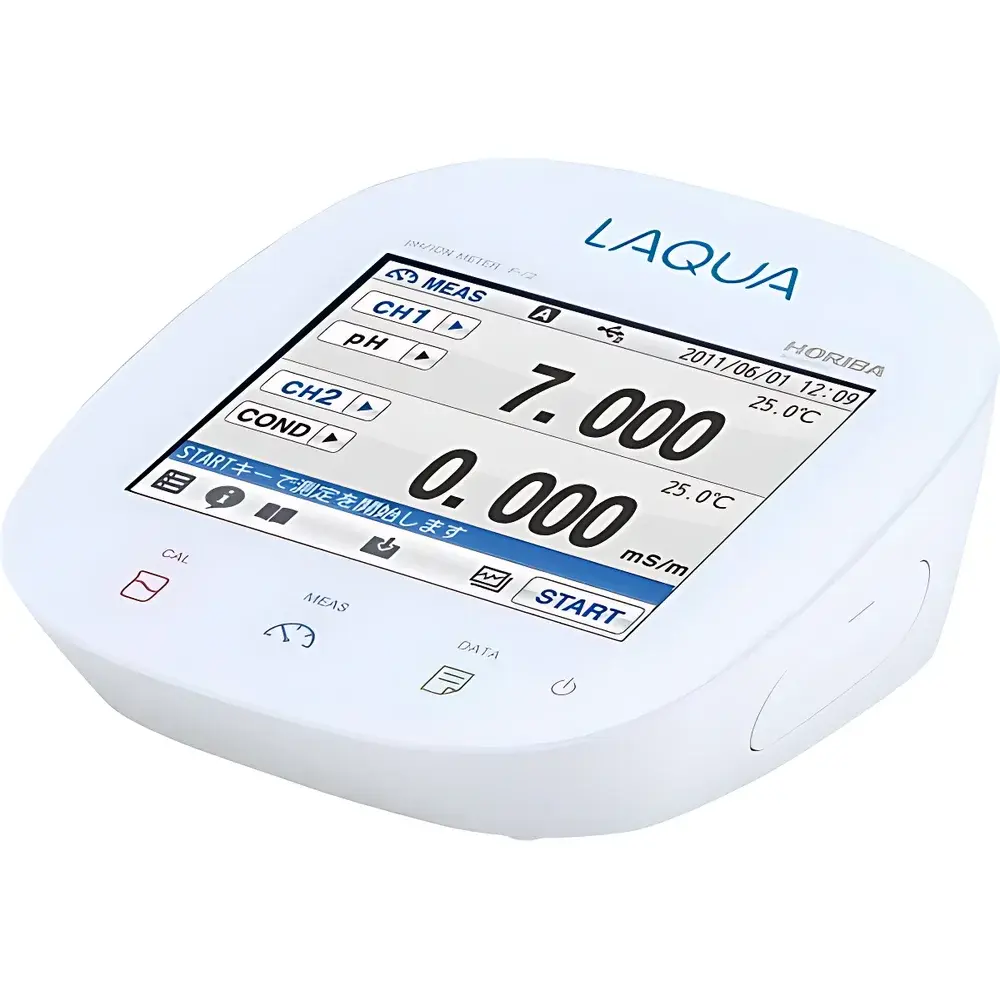
HORIBA EC1100 Benchtop Conductivity Meter
| Brand | HORIBA |
|---|---|
| Origin | Japan |
| Model | EC1100 |
| Portability | Benchtop |
| Conductivity Range | 0.00–19.99 µS/cm |
| TDS Range | 0.01–9.99 ppm |
| Resistivity Range | 0.000 Ω·cm–20.000 Ω·cm |
| Salinity Range | 0.0–100.0 ppt |
| Temperature Range | −30.0–130.0 °C |
| Accuracy | ±0.6% F.S. (±1.5% F.S. above 18.0 mS/cm for conductivity |
| Resolution | 0.05% F.S. |
| Calibration Points | 4-point (auto/manual) |
| TDS Conversion Curves | EN 27888, US EPA 442, Linear (0.40–1.0), NaCl |
| Salinity Curves | NaCl, Seawater |
| Temperature Compensation | Adjustable α (0.0–10.0 %/°C), Reference Temp: 15–30 °C (selectable) |
| Cell Constant | 0.1 / 1.0 / 10.0 cm⁻¹ |
| Data Storage | 500 measurements with timestamp (RTC), Auto-Log enabled |
| Interface | RS232C, USB-B, BNC + audio jack input |
| Power | AC adapter (100–240 V, 50/60 Hz) |
| Dimensions | 170 × 174 × 73 mm |
| Weight | 500 g |
Overview
The HORIBA EC1100 is a high-precision benchtop conductivity meter engineered for routine and regulatory-compliant measurement of electrical conductivity (EC), total dissolved solids (TDS), resistivity, salinity, and temperature in aqueous solutions. Based on four-electrode or two-electrode AC conductometric principles—depending on cell configuration—the instrument applies a low-frequency alternating current to minimize polarization effects and electrode fouling, ensuring stable, reproducible readings across wide dynamic ranges. Its dual-range architecture enables seamless auto-ranging from ultra-low conductivity ultrapure water (sub-µS/cm) to highly conductive industrial brines (>2 S/m equivalent), eliminating manual range switching errors. Designed for laboratories operating under GLP, ISO/IEC 17025, or pharmaceutical water quality protocols (e.g., USP ), the EC1100 delivers traceable, audit-ready data with full temperature compensation and configurable reference conditions.
Key Features
- 5.5-inch chemically resistant, scratch-resistant tempered glass touchscreen with intuitive icon-based navigation and tactile feedback
- Integrated electrode stand with vertical height adjustment (0–650 mm via modular extension kit) and detachable base serving as a stable sample platform for beakers and vials
- Real-time electrode health monitoring: programmable calibration reminders, post-calibration electrode condition logging, and automatic fault detection with audible/visual alerts upon sensor degradation or open-circuit failure
- Fuzzy logic stability algorithm automatically detects signal convergence and locks the displayed value only when statistical variation falls below user-defined thresholds—critical for low-conductivity ultrapure water validation
- Comprehensive self-diagnostic system reporting up to 10 distinct error codes (e.g., E03: temperature sensor out-of-range, E07: cell constant mismatch), enabling rapid root-cause troubleshooting without service dispatch
- Rugged k = 1.0 conductivity cell (model 93004-25) with integrated Pt1000 temperature sensor, IP67-rated housing, and 1-m shielded cable terminating in BNC + 3.5 mm audio jack for universal compatibility
Sample Compatibility & Compliance
The EC1100 supports direct measurement of deionized water, boiler feedwater, wastewater effluents, seawater dilutions, electroplating baths, pharmaceutical purified water (PW) and water-for-injection (WFI) samples, and nutrient solutions in hydroponics and bioreactor monitoring. It complies with ASTM D1125 (Standard Test Methods for Electrical Conductivity and Resistivity of Water), ISO 7888 (Water quality — Determination of electrical conductivity), and EN 27888 (Water quality — Guidance on the determination of electrical conductivity). For regulated environments, its real-time clock (RTC), sample ID tagging, and timestamped internal memory (500 entries) satisfy basic ALCOA+ data integrity requirements. While not natively 21 CFR Part 11 compliant, audit trails can be exported via USB or RS232C for external validation and archiving in validated LIMS or ELN systems.
Software & Data Management
Measurements are stored internally with full metadata: date/time stamp (RTC-synchronized), sample ID, operator code (user-definable), measured parameter, unit, temperature, and cell constant. Auto-Log mode records at user-defined intervals (1 s–99 min) without PC connection. Data export is supported via USB-B (mass storage class) or RS232C (ASCII protocol) to printers, PCs, or USB flash drives. No proprietary software is required—CSV-formatted exports enable immediate import into Excel, LabArchives, or custom QA/QC dashboards. The instrument accepts external calibration standards traceable to NIST SRMs (e.g., 84 µS/cm KCl, 1413 µS/cm KCl, 12.88 mS/cm KCl, 111.8 mS/cm KCl), and supports multi-point calibration verification per ISO/IEC 17025 clause 7.7.
Applications
- Pharmaceutical QC labs verifying conductivity limits for Purified Water (PW) and Water for Injection (WFI) per USP
- Power generation facilities monitoring condensate purity and steam cycle chemistry
- Environmental testing labs analyzing surface water, groundwater, and wastewater per EPA Method 120.1
- Food & beverage R&D assessing mineral content and process water quality
- Academic research requiring high-stability measurements in electrochemistry, colloidal science, and membrane filtration studies
- Microelectronics manufacturing controlling rinse water resistivity in wafer cleaning lines
FAQ
Does the EC1100 support automatic temperature compensation (ATC)?
Yes—it features selectable linear temperature compensation with adjustable temperature coefficient (α = 0.0–10.0 %/°C) and user-defined reference temperature (15–30 °C).
Can I use non-HORIBA conductivity cells with the EC1100?
Yes, provided the cell has standard BNC output and a known cell constant (0.1, 1.0, or 10.0 cm⁻¹); manual entry is required during setup.
Is the internal memory battery-backed?
No—the 500-entry memory retains data only while powered; however, all logged data can be exported before shutdown.
What is the minimum detectable conductivity in ultra-pure water mode?
At the 0.00–19.99 µS/cm range, the instrument resolves changes of ≤0.01 µS/cm (0.05% F.S.), suitable for PW verification per USP Stage 1.
Does the EC1100 meet IP rating requirements for lab splash zones?
The main unit has no formal IP rating; however, the front panel glass is chemically inert and wipe-clean, and the integrated electrode stand provides physical separation from wet work surfaces.





