
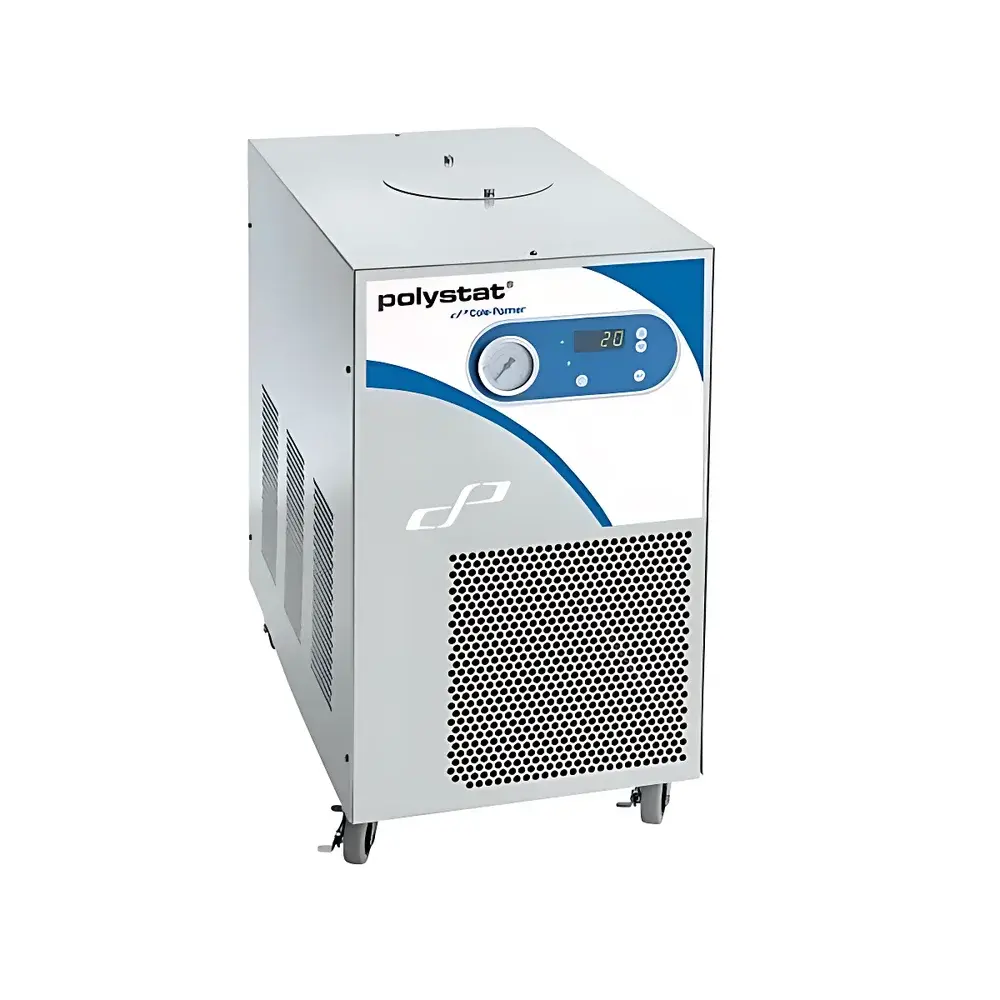
Polystat Large-Capacity Circulating Chiller Model 12911-02
| Brand | Polystat |
|---|---|
| Origin | USA |
| Model | 12911-02 |
| Bath Volume | 18.9 L |
| Temperature Range | −10 to 30 °C |
| Temperature Stability | ±0.1 °C |
| Pump Flow Rate (max) | 14 L/min |
| Maximum Pump Pressure | 95 psi (6550 mbar) |
| Cooling Capacity | 375 W at 0 °C / 1025 W at 20 °C |
| Compressor Power | 3/4 HP |
| Electrical Supply | 208–230 VAC, 60 Hz, 10.1 A |
| Refrigerant | R-404A |
| Control Resolution | 0.1 °C or 1 °C selectable |
| Pump Type | External/internal recirculation |
| Compliance | CE, UL Listed, RoHS compliant |
Overview
The Polystat Large-Capacity Circulating Chiller Model 12911-02 is a precision-engineered, closed-loop temperature control system designed for demanding laboratory and pilot-scale applications requiring stable, programmable thermal management of external equipment. Operating on vapor-compression refrigeration with an R-404A refrigerant circuit and integrated electric heating elements, this chiller delivers simultaneous cooling and heating capability across a continuous range of −10 to 30 °C. Its 18.9 L stainless steel reservoir ensures thermal mass stability and minimizes temperature fluctuations during high-load operation—critical for maintaining consistent conditions in chromatography columns, reactor jackets, spectrophotometer cells, and laser systems. The unit employs a robust scroll-type compressor (3/4 HP), optimized heat exchanger geometry, and low-noise centrifugal pump architecture to achieve up to 2.0 kW total thermal transfer capacity under closed-loop recirculation. Designed for integration into automated workflows, it supports analog (0–10 VDC) and digital (RS-485 Modbus RTU) communication interfaces for remote setpoint control and status monitoring.
Key Features
- High-capacity 18.9 L stainless steel bath with splash-resistant fill port and integrated pressure gauge mounted on front panel for real-time system pressure verification
- Dual-mode temperature control: independent refrigeration and resistive heating circuits enable precise ramping, hold, and overshoot suppression
- Intuitive digital controller with moisture-resistant membrane keypad, backlit icons, and user-selectable display resolution (0.1 °C or 1 °C)
- Three pump configuration options available (standard, high-flow, high-pressure); Model 12911-02 ships with high-flow pump delivering up to 14 L/min at 95 psi (6550 mbar)
- Over-temperature and under-temperature alarm outputs with relay contacts for interlocking with external safety systems
- Integrated flow sensor with low-flow shutdown protection to prevent dry-run damage and ensure thermal safety
- Factory-calibrated PT100 sensor with traceable NIST documentation; temperature stability maintained at ±0.1 °C over full operating range
Sample Compatibility & Compliance
The Polystat 12911-02 is compatible with water, water-glycol mixtures (up to 50% v/v), silicone oils, and other non-corrosive heat transfer fluids meeting ASHRAE Standard 15 chemical compatibility guidelines. Its fluid path is constructed from 316 stainless steel, EPDM seals, and brass fittings—resistant to degradation under prolonged thermal cycling. The unit complies with UL 61010-1 (2nd Ed.), EN 61010-1:2010, CE marking requirements, and RoHS Directive 2011/65/EU. It supports GLP/GMP environments through optional audit-trail-enabled firmware (v3.2+), which logs all parameter changes, alarm events, and operational states with timestamp and user ID—fully aligned with FDA 21 CFR Part 11 data integrity requirements when paired with validated LIMS integration.
Software & Data Management
The chiller includes embedded firmware supporting both local and networked operation. Via RS-485 Modbus RTU, it integrates seamlessly with LabVIEW, MATLAB, DeltaV, and Siemens PCS7 SCADA platforms. Optional Polystat Connect™ software (Windows-based) provides real-time graphing, multi-unit fleet monitoring, scheduled temperature profiles, and CSV export of time-stamped temperature, pressure, flow, and power consumption data. All logged data are stored in encrypted binary format with SHA-256 checksums to ensure immutability. Firmware updates are performed via USB drive with cryptographic signature validation to prevent unauthorized modification—essential for regulated pharmaceutical and biotech laboratories conducting ICH Q5, Q7, and ISO 17025-compliant testing.
Applications
- Temperature stabilization of HPLC and UHPLC column ovens, autosamplers, and detector flow cells
- Cooling of high-power lasers, RF amplifiers, and optical bench components requiring sub-ambient thermal control
- Process jacketing for small-scale bioreactors, crystallizers, and catalytic reaction vessels
- Calibration of thermocouples, RTDs, and infrared sensors in metrology labs per ASTM E220 and ISO/IEC 17025
- Environmental stress screening of electronic assemblies under controlled thermal cycling protocols (MIL-STD-810G, Method 502.6)
- Support of ASTM D2856 (gas adsorption), D3616 (viscosity), and ISO 11357 (DSC) sample preparation stages
FAQ
What is the recommended heat transfer fluid for extended service life?
Deionized water with 20–30% propylene glycol (inhibited) is recommended for general use; silicone oil (e.g., DC200) may be used above 30 °C but requires separate pump seal specification.
Does the unit support external temperature feedback control?
Yes—via optional external PT100 input (0–100 Ω), enabling cascade control where the chiller regulates based on process temperature rather than bath temperature.
Can the chiller operate continuously at −10 °C ambient?
It is rated for indoor installation only (15–32 °C ambient, ≤80% RH non-condensing); sustained operation below 15 °C ambient requires condensate management and derating per manufacturer’s environmental derating curves.
Is validation documentation provided for IQ/OQ protocols?
Yes—factory-supplied DQ/IQ/OQ templates, calibration certificates (NIST-traceable), and FAT reports are included with each unit; PQ support is available upon request.
How is maintenance access designed for routine service?
Front-accessible compressor compartment, slide-out condenser tray, and quick-disconnect fluid lines allow full preventive maintenance without disassembly of structural panels.
Related Products



