
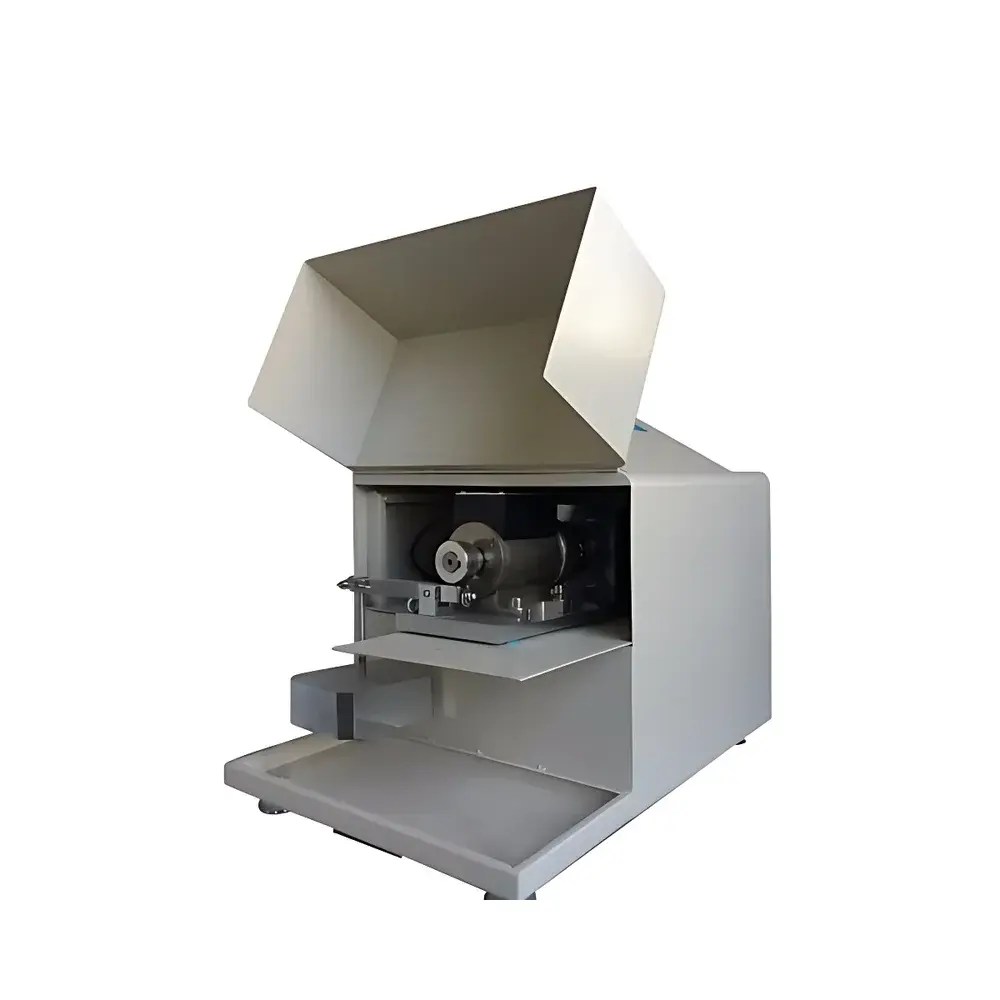
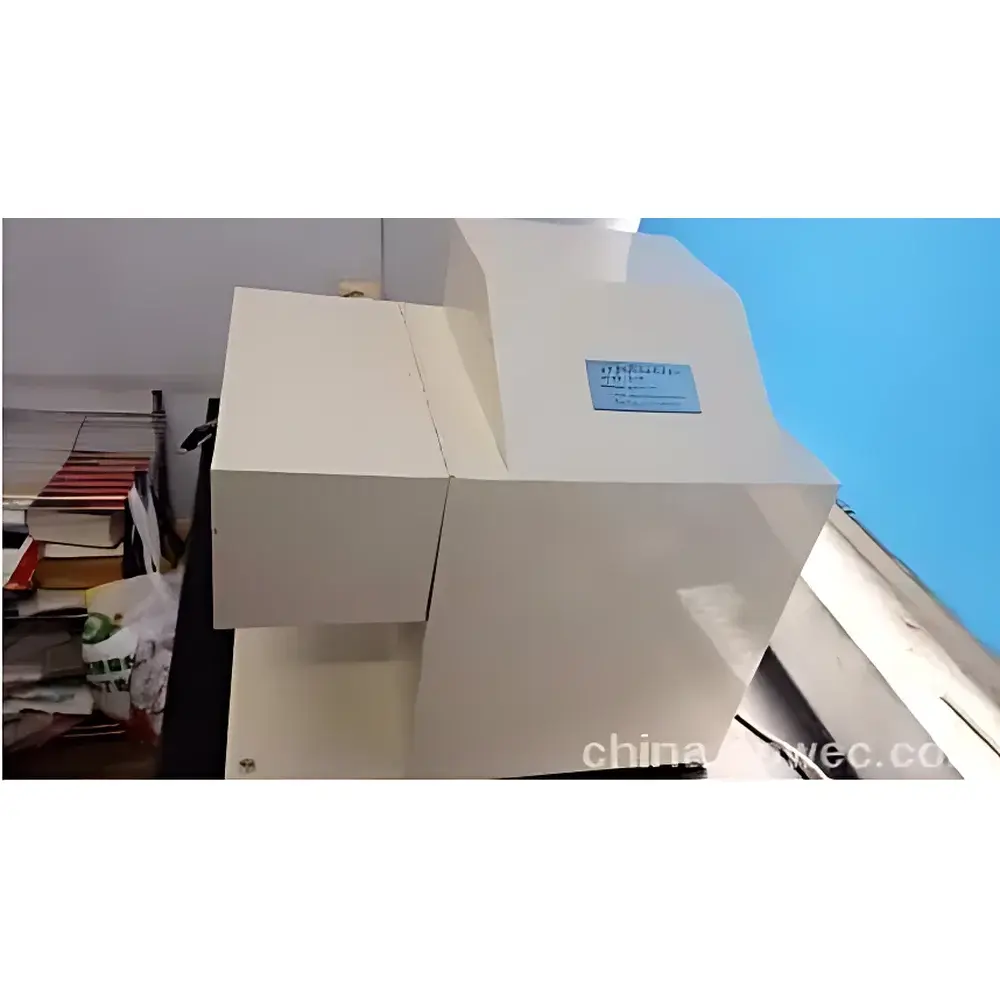
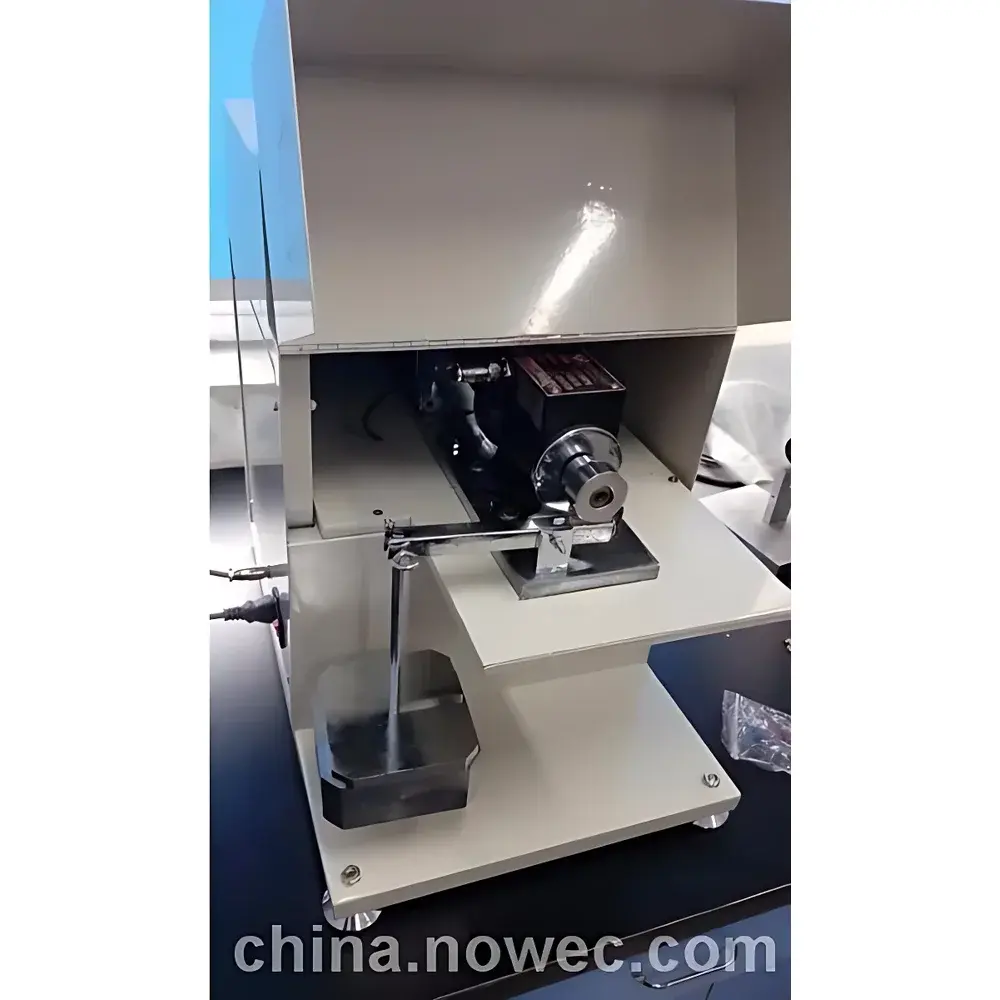
Beiguang Jingyi M-200 Tribological Tester for Rubber and Polymeric Materials
| Brand | Beiguang Jingyi / All Precision Instrument |
|---|---|
| Origin | Beijing, China |
| Manufacturer Type | Direct Manufacturer |
| Instrument Type | Coefficient of Friction and Wear Tester |
| Maximum Friction Force | 2000 N |
| Friction Force Resolution | 0.1% FS |
| Rotational Speed Range | 0–400 rpm (infinitely variable) |
| Load Capacity | 196 N ±0.2% (expandable to 392 N) |
| Friction Torque Range | 0–15 N·m |
| Torque Measurement Accuracy | ±3% FS (≥10% full scale) |
| Test Specimen Dimensions | 30 mm × 7 mm × 6 mm ±0.1 mm |
| Counter Range | 1 s – 9999 min / 1–999999 revolutions |
| Temperature Control | Not integrated (ambient operation only) |
Overview
The Beiguang Jingyi M-200 Tribological Tester is a precision-engineered benchtop instrument designed for standardized evaluation of sliding friction behavior and wear resistance in elastomeric and polymeric materials—particularly vulcanized rubber compounds, thermoplastics, composites, and coated surfaces. It operates on the principle of controlled pin-on-disk (or block-on-ring) tribometry under defined normal load, rotational speed, and environmental conditions. Compliant with GB/T 3960–2016 (“Plastics—Determination of coefficient of friction and wear rate under sliding conditions”), the system delivers reproducible quantification of dynamic friction force, coefficient of friction (COF), and volumetric or mass-based wear loss over time or revolution count. Its dual-axis configuration supports both stationary upper specimen (block) and rotating lower counterpart (ring), enabling precise simulation of real-world contact kinematics encountered in seals, gaskets, conveyor belts, tires, and automotive NVH components. The instrument employs high-stability microcontroller-based electronics and calibrated torque sensing to ensure metrological traceability and inter-laboratory comparability.
Key Features
- Microprocessor-controlled test execution with fully automated start/stop sequencing, real-time parameter monitoring, and programmable test duration or revolution limits.
- Dual-speed motor drive supporting selectable rotational speeds: 180/360 rpm (upper axis) and 200/400 rpm (lower axis), with continuous speed adjustment across 0–400 rpm range.
- High-fidelity torque transducer (0–15 N·m range, ±3% FS accuracy ≥10% full scale) coupled with 0.1% full-scale resolution for friction force measurement.
- Load application via calibrated dead-weight system: standard 4 kg mass + four 1 kg masses, enabling stepwise loading up to 392 N with ≤0.2% load uncertainty.
- Integrated data acquisition module synchronously records time, friction torque, rotational count, and elapsed test duration; outputs timestamped raw values for post-processing.
- Pre-configured specimen geometry compliance: accepts standard 30 mm × 7 mm × 6 mm ±0.1 mm rectangular specimens; includes four precision-ground friction rings (Ø40 × 10 mm, concentricity <0.01 mm).
- Self-contained control unit with LCD interface, plus optional PC connectivity via RS232/USB for extended data logging, curve plotting (time vs. torque, time vs. COF), and report generation.
Sample Compatibility & Compliance
The M-200 is validated for testing solid, non-powdered, machinable specimens meeting GB/T 3960 dimensional tolerances. It accommodates cured rubber formulations (NR, SBR, EPDM, FKM), engineering thermoplastics (PA6, POM, PTFE composites), and fiber-reinforced polymer laminates. Specimen mounting requires flat, parallel surfaces and adequate rigidity to prevent elastic deformation under load. The instrument does not support liquid lubricants or elevated temperature operation (no integrated heating/cooling). Regulatory alignment includes conformance to GB/T 3960–2016 and technical equivalence to ASTM D1894 (Standard Test Method for Coefficient of Friction of Plastic Film and Sheeting) and ISO 8295 (Plastics—Film and Sheet—Determination of the Coefficients of Friction) when adapted per clause-defined boundary conditions. Data integrity meets GLP documentation requirements, with audit-ready digital logs exportable in CSV format.
Software & Data Management
The proprietary HX acquisition software provides real-time visualization of torque-time, COF-time, and cumulative revolution curves. Users define test protocols—including target load, speed setpoint, stop condition (time, revolutions, or torque threshold), and sampling interval (10–1000 ms). All measurements are timestamped and stored with metadata (operator ID, sample ID, calibration date, environmental notes). Export functions generate PDF or Excel reports containing summary statistics (mean COF, max/min torque, wear volume estimation), annotated graphs, and tabulated raw data. Software supports 21 CFR Part 11-compliant user access control (role-based login), electronic signatures for test approval, and immutable audit trails for QA/QC workflows. No cloud dependency—data resides locally on the host PC or embedded controller memory.
Applications
This tester serves R&D labs, quality assurance departments, and certification bodies engaged in material qualification for automotive sealing systems, industrial hose linings, railway brake pads, medical tubing, and footwear outsoles. Typical use cases include comparative wear ranking of carbon-black-filled versus silica-reinforced rubber compounds; screening anti-friction additives in thermoplastic elastomers; validating surface treatments (e.g., silicone coating, plasma etching) for reduced stick-slip behavior; and generating input data for finite element modeling of contact stress distribution. Its repeatability (friction force reproducibility ≤2% RSD across five replicate runs per ASTM D1894 guidelines) makes it suitable for internal specification development and supplier qualification against OEM material standards.
FAQ
Does the M-200 support elevated temperature testing?
No. The base configuration operates at ambient laboratory temperature (15–30°C). High-temperature modules are not available.
Can I test curved or irregularly shaped samples?
Only flat-faced, prismatic specimens conforming to the 30 × 7 × 6 mm dimension and parallelism tolerance are supported per GB/T 3960.
Is calibration certification included?
Yes. Each unit ships with a factory calibration certificate traceable to Chinese national standards (CNAS-accredited reference masses and torque standards).
What maintenance is required?
Routine tasks include cleaning the friction ring surface with isopropanol, verifying torque sensor zero drift monthly, and inspecting bearing play annually. Full service intervals are recommended every 24 months.
How is wear volume calculated?
Wear is inferred from mass loss measured pre- and post-test using an analytical balance (not included), then converted to volume using material density. The instrument itself measures only friction force and torque—not direct wear depth or mass.



