
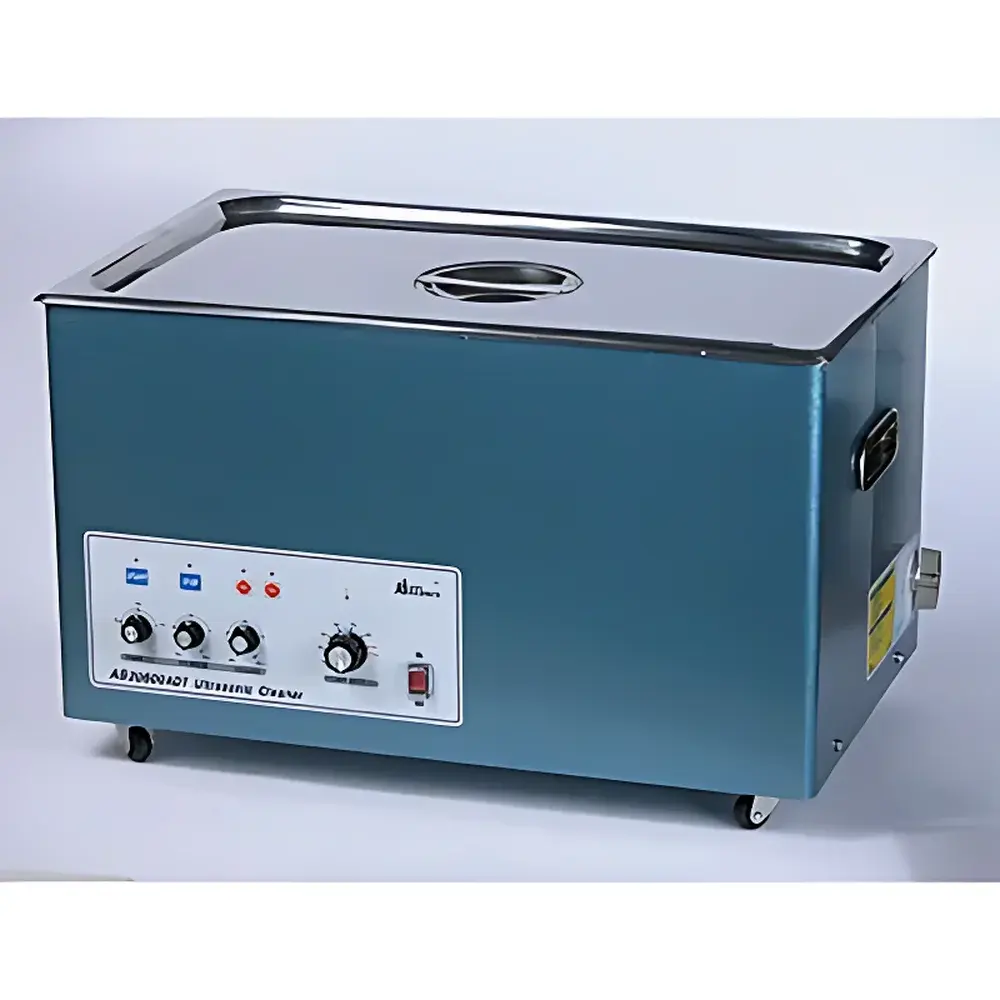
Otisience AS20500ADT Advanced Dual-Frequency Ultrasonic Cleaner
| Brand | Otisience |
|---|---|
| Origin | Tianjin, China |
| Model | AS20500ADT |
| Capacity | 22 L |
| Ultrasonic Frequency | 40 kHz or 60 kHz |
| Ultrasonic Power | 500 W (adjustable 30–100%) |
| Heating Range | RT + 5 °C to 80 °C |
| Heating Power | 1000 W |
| Timer | 1–18 min (continuous) |
| Sound-Dampening Lid | Included |
| Manual Drain/Inlet | Yes |
| Construction | Aluminum Alloy Housing |
| External Dimensions (W×L×H) | 530 × 350 × 335 mm |
| Tank Dimensions (W×L×D) | 490 × 295 × 150 mm |
Overview
The Otisience AS20500ADT is a benchtop dual-frequency ultrasonic cleaner engineered for precision laboratory cleaning, degassing, and sample preparation tasks. It operates on the principle of acoustic cavitation—where high-frequency sound waves generate microbubbles in liquid media that collapse violently upon reaching resonance, producing localized shockwaves and intense shear forces. This physical mechanism effectively dislodges particulate contaminants, organic residues, and loosely adhered biofilms from surfaces without mechanical abrasion or chemical aggression. Designed for versatility across analytical, pharmaceutical, materials science, and quality control laboratories, the AS20500ADT supports both 40 kHz (optimized for high-energy cleaning of robust or heavily soiled components) and 60 kHz (enhanced for fine-detail cleaning of intricate geometries, blind holes, or delicate substrates). Its stable 500 W transducer output, coupled with independent thermal and temporal control, ensures reproducible cleaning cycles under defined process parameters—critical for method validation and routine QC workflows.
Key Features
- Dual-frequency operation (40 kHz / 60 kHz) selectable via front-panel switch, enabling optimization for substrate geometry, contaminant type, and solvent viscosity.
- Adjustable ultrasonic power output (30–100% in 10% increments), permitting fine-tuned energy delivery to prevent sample erosion or emulsification of sensitive analytes.
- Integrated heating system (1000 W) with PID-controlled temperature regulation from ambient +5 °C to 80 °C, supporting thermally assisted cleaning protocols per ASTM D4771 and ISO 14971 Annex C guidelines.
- Precise digital timer (1–18 minutes, continuous mode) with automatic shutdown, ensuring compliance with standardized cleaning durations outlined in USP and CLSI EP25-A.
- Acoustically damped stainless-steel tank (490 × 295 × 150 mm internal dimensions) housed within a corrosion-resistant aluminum alloy chassis (530 × 350 × 335 mm external footprint).
- Removable perforated stainless-steel basket and hinged sound-reducing lid minimize airborne noise (<55 dB(A) at 1 m) and enhance operator safety during extended operation.
- Manual drain valve and fill port facilitate rapid solvent exchange and residue removal between batches—essential for cross-contamination prevention in GLP/GMP environments.
Sample Compatibility & Compliance
The AS20500ADT accommodates a broad range of laboratory items including glassware (volumetric flasks, pipettes, cuvettes), metal components (syringe needles, surgical tools), ceramic substrates, and polymer-based microfluidic chips. Its frequency-selective operation ensures compatibility with fragile optics, MEMS devices, and chromatographic hardware such as HPLC injection valves and autosampler vial trays. The unit meets IEC 61000-6-3 (EMC emission) and IEC 61000-6-2 (immunity) standards. While not certified for medical device reprocessing per ISO 15883, its performance aligns with ISO 13485 prerequisite cleaning validation requirements when integrated into documented SOPs. No CE marking is affixed; users must verify local regulatory acceptance prior to deployment in regulated settings.
Software & Data Management
The AS20500ADT is a standalone analog-digital hybrid instrument with no embedded firmware, network interface, or data logging capability. All operational parameters—including frequency selection, power level, temperature setpoint, and timer duration—are configured manually via tactile membrane switches and displayed on a dual-line LCD. This architecture eliminates cybersecurity risks associated with connected instrumentation and simplifies audit readiness: parameter settings are directly observable and verifiable by personnel without software interpretation layers. For laboratories requiring electronic records, manual entry into validated LIMS or ELN systems is recommended, with timestamped entries referencing batch ID, solvent type, and cycle parameters—consistent with FDA 21 CFR Part 11 documentation expectations for non-electronic record instruments.
Applications
- Routine decontamination of HPLC vials, GC liners, and autosampler components prior to trace-level analysis.
- Pre-analytical cleaning of filtration membranes, SPE cartridges, and column frits to reduce background interference.
- Ultrasonic-assisted solvent degassing for mobile phase preparation in reversed-phase and ion-pair chromatography.
- Surface activation of silicon wafers and electrode substrates prior to thin-film deposition or electrochemical testing.
- Removal of polishing compounds and organic binders from sintered metal or ceramic parts in materials R&D labs.
- Supporting ASTM E1669 (ultrasonic cleaning verification) through repeatable parameter control and visual inspection of cleaned surfaces.
FAQ
Is the AS20500ADT suitable for cleaning delicate optical lenses or semiconductor wafers?
Yes—when operated at 60 kHz with low power (30–50%) and low-temperature solvents (e.g., IPA/water mixtures at 30–40 °C), it delivers gentle yet effective particle removal without surface pitting.
Can this unit be used for ultrasonic extraction of plant metabolites?
It is not designed for quantitative extraction; however, it may serve as a preliminary homogenization step for coarse botanical samples prior to Soxhlet or ASE processing.
Does the unit include a built-in degassing function?
No dedicated degassing mode exists, but the 60 kHz frequency combined with elevated temperature (50–60 °C) and extended timing (10–15 min) achieves efficient dissolved gas reduction in common organic solvents.
What maintenance is required for long-term reliability?
Regular descaling of the tank using 5% citric acid solution every 200 operating hours, inspection of transducer adhesion integrity, and periodic verification of temperature sensor calibration against a NIST-traceable thermometer.
Is the aluminum housing resistant to common laboratory solvents?
The anodized aluminum chassis resists incidental splashes of alcohols, acetone, and aqueous buffers; prolonged exposure to chlorinated solvents (e.g., chloroform, DCM) or strong acids/bases is not recommended.



