
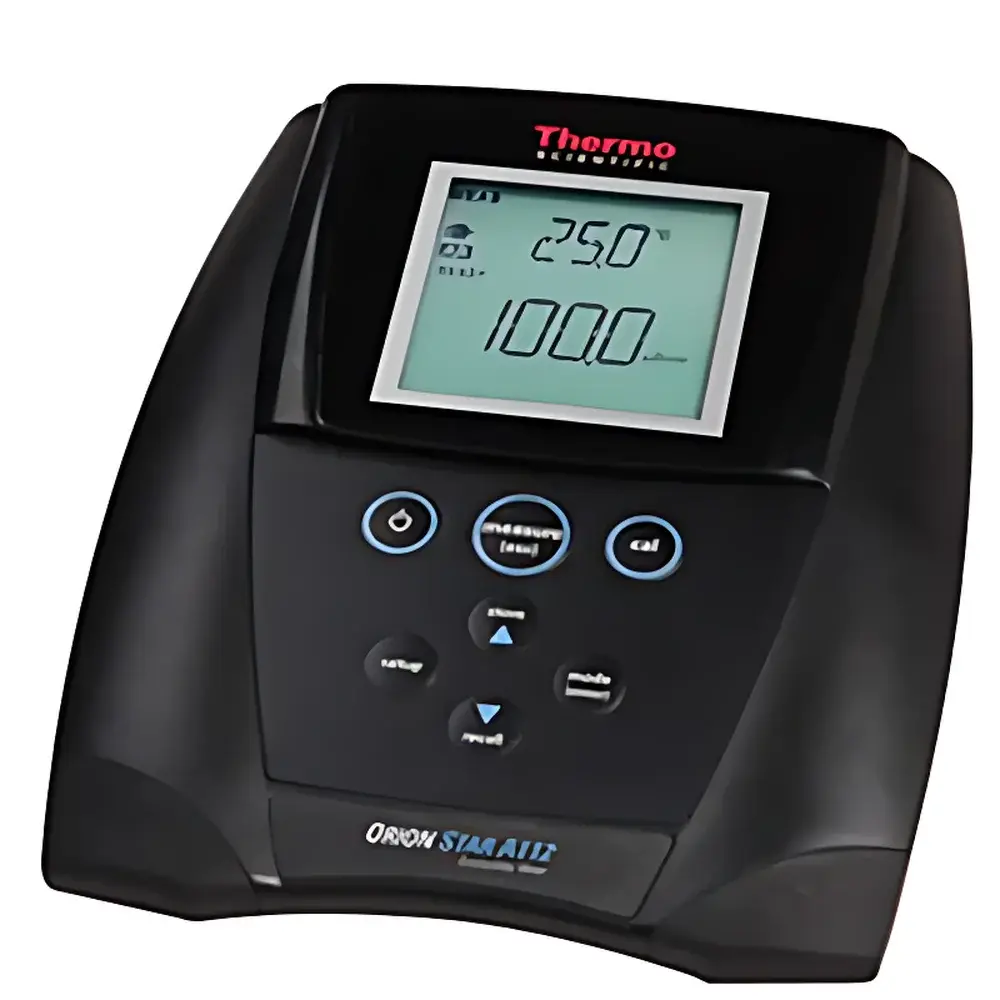
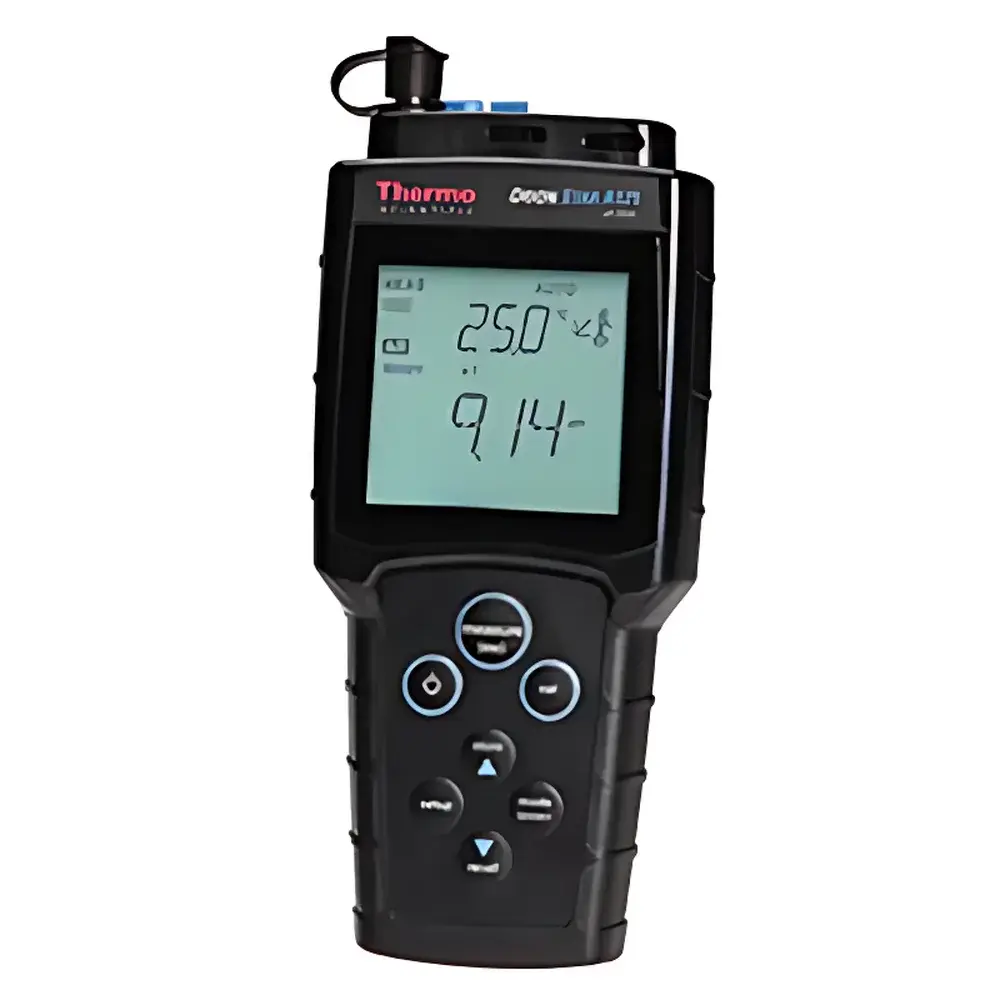
Thermo Scientific Orion Star A110P-01A Benchtop/Portable Basic pH Meter
| Brand | Thermo Scientific Orion |
|---|---|
| Origin | USA |
| Model | 110P-01A |
| pH Range | –2.00 to 16.00 |
| pH Resolution | 0.01 |
| pH Accuracy | ±0.01 |
| mV Range | ±1600.0 mV (mV), ±1999.9 mV (RmV) |
| mV Resolution | 0.1 mV |
| Temperature Range | –5 to 105 °C |
| Temp. Resolution | 0.1 °C |
| Temp. Accuracy | ±0.1 °C |
| Calibration Points | up to 3-point pH |
| Buffer Recognition | USA/NIST/DIN |
| Data Storage | 5000 readings with GLP-compliant metadata |
| Connectivity | USB and RS232 |
| Power | 4×AA batteries or AC adapter |
| IP Rating | IP67 (portable mode) |
Overview
The Thermo Scientific Orion Star A110P-01A is a dual-mode benchtop and portable pH meter engineered for precision, reliability, and regulatory compliance in routine water quality analysis. Based on potentiometric measurement principles—utilizing the Nernst equation to quantify hydrogen ion activity—the instrument delivers stable, traceable pH readings across a broad operational range (–2.00 to 16.00). Its modular architecture supports both laboratory-based stationary operation and field-deployable use, with an IP67-rated enclosure ensuring dust-tight and immersion-resistant performance for up to 30 minutes at 1 m depth. Designed for environmental monitoring laboratories, municipal water treatment facilities, and academic research groups, the Star A110P-01A meets foundational requirements for method validation under EPA Methods 150.1 and 150.2, and aligns with ISO 5667-22 (water quality — sampling — guidance on field measurements) for in situ pH assessment.
Key Features
- Dual operating modes: switch seamlessly between benchtop configuration (with electrode stand and AC power) and ruggedized portable deployment (with AA battery power and protective carrying case).
- AUTO-READ™ intelligent endpoint detection automatically locks readings when stability criteria are met, displaying a visual indicator to minimize operator interpretation error.
- Configurable timed data logging enables unattended acquisition at user-defined intervals (1 sec to 60 min), supporting long-term trend analysis in reservoirs, effluent streams, or distribution systems.
- Integrated buffer recognition for USA, NIST, and DIN standard pH reference solutions reduces calibration setup time and mitigates manual entry errors.
- Editable calibration curves allow post-hoc adjustment of slope and offset values—enabling optimization of calibration integrity without re-performing full multi-point calibrations.
- Built-in seawater salinity compensation curve (based on PSS-78) ensures accurate pH reporting in marine and estuarine samples where ionic strength significantly impacts electrode response.
- Support for both polarographic DO probes and optical RDO sensors via auto-detection—facilitating cross-parameter correlation studies (e.g., pH vs. dissolved oxygen dynamics in biological treatment units).
Sample Compatibility & Compliance
The Star A110P-01A accommodates standard BNC pH electrodes and 8-pin mini-DIN ATC temperature probes—including Thermo Scientific Orion’s 9157BNMD and 9107BNMD Triode™ combination electrodes—ensuring compatibility with a wide range of aqueous matrices: drinking water, wastewater, surface runoff, groundwater, and saline estuaries. All measurements adhere to Good Laboratory Practice (GLP) standards: each stored reading includes timestamp, operator ID (configurable), electrode serial number, calibration history, and temperature-compensated values. Data export supports audit-ready formats compatible with LIMS integration. The instrument satisfies key regulatory expectations for documentation integrity per FDA 21 CFR Part 11 (when used with validated software workflows) and meets essential functional criteria outlined in ASTM D1293 (Standard Test Method for pH of Water).
Software & Data Management
Data transfer and firmware updates are performed via USB or RS232 interface using Thermo Scientific Orion ComStat™ desktop software (included). ComStat enables batch export to CSV or Excel, graphical trending with customizable axes, statistical summary (mean, SD, min/max), and GLP report generation—including calibration verification logs and measurement uncertainty annotations. Audit trails record all parameter changes, calibration events, and user logins with timestamps—supporting internal QA reviews and external accreditation audits (e.g., ISO/IEC 17025). Firmware updates preserve calibration coefficients and user-defined settings, ensuring continuity during instrument lifecycle maintenance.
Applications
- Routine compliance monitoring of pH in drinking water distribution systems per WHO Guidelines and national standards (e.g., China’s GB 5749-2022, US EPA Safe Drinking Water Act).
- Wastewater influent/effluent characterization in activated sludge and membrane bioreactor (MBR) plants, where pH stability correlates with nitrification efficiency.
- Field-based assessment of acid mine drainage (AMD) sites, leveraging IP67 durability and rapid stabilization for low-pH (<3.0) sample evaluation.
- Educational laboratories requiring intuitive multilingual UI (English, Spanish, French, German, Chinese, Japanese) and robust student-proof operation.
- Environmental impact assessments involving pH profiling across vertical water columns or sediment porewater extraction.
FAQ
Does the Star A110P-01A support automatic temperature compensation (ATC)?
Yes—it accepts input from integrated or external ATC probes (e.g., 9107BNMD) and applies real-time Nernstian correction using either linear or non-linear (e.g., seawater-specific) algorithms.
Can calibration data be modified after completion?
Yes—users may review and manually adjust slope, offset, and buffer assignment within the calibration menu to refine curve fit without repeating the entire calibration sequence.
Is the instrument suitable for high-ionic-strength samples such as brines or seawater?
Yes—its built-in PSS-78 seawater salinity curve and optional TDS compensation (ISO/EN 27888 mode) mitigate activity coefficient errors inherent in concentrated electrolyte solutions.
What GLP elements are embedded in data storage?
Each of the 5000 stored records includes date/time stamp, operator ID, electrode ID, calibration status, temperature, and measurement mode—fully traceable and exportable with metadata integrity.
How is firmware updated in the field?
Via USB connection to a Windows PC running ComStat™; updates retain all user configurations, calibration history, and stored data—no factory reset required.
Related Products







