
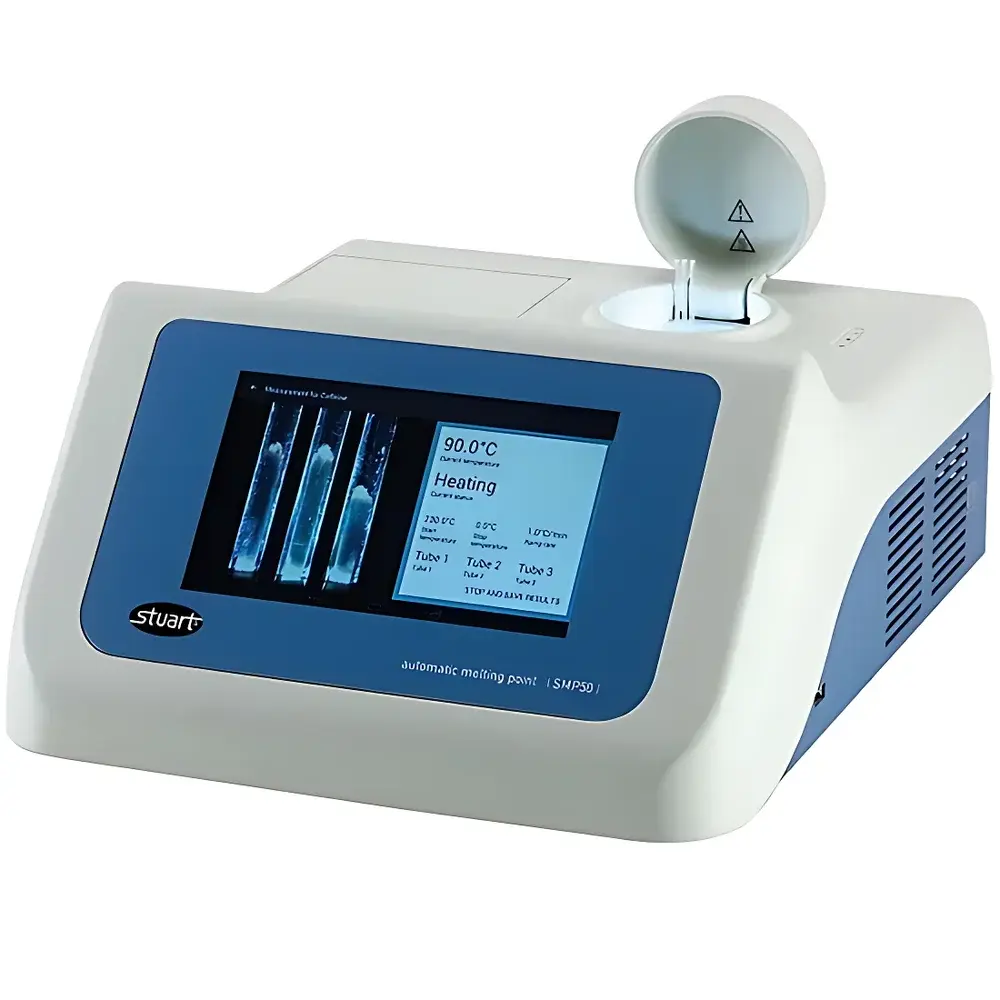
Stuart SMP50 Automated Melting Point Apparatus
| Brand | Stuart |
|---|---|
| Origin | United Kingdom |
| Model | SMP50 |
| Temperature Range | Ambient to 400 °C |
| Heating Rate | 0.1–20 °C/min |
| Temperature Repeatability | ±0.1 °C |
| Temperature Accuracy | ±0.1 °C |
| Capillary Dimensions | 100 mm total length, 1.9 mm OD, 1.3 mm ID, 0.3 mm wall thickness |
| Sample Capacity | 3 capillaries simultaneously |
| Temperature Resolution | 0.1 °C |
| Control Sensor | PT1000 platinum resistance thermometer |
| Heating/Cooling Time | 6 min (50 → 350 °C), 12 min (350 → 50 °C) |
| Display | 7-inch high-resolution capacitive touchscreen |
| Operating System | Android-based embedded UI |
| Onboard Storage | 8 GB flash memory (≈300 full video + metadata records) |
| Power Supply | 230 V AC, 50 Hz |
| Dimensions (H×D×W) | 164 × 360 × 300 mm |
| Net Weight | 4.6 kg |
| Compliance | USP <741>, EP 2.2.17, JP 2.60, GLP-aligned design, FDA 21 CFR Part 11 ready (with optional IQ/OQ documentation package) |
Overview
The Stuart SMP50 Automated Melting Point Apparatus is a CE-marked, laboratory-grade thermal analysis instrument engineered for precise, reproducible, and auditable determination of solid-phase transition temperatures in pharmaceutical, chemical, and materials science applications. It operates on the fundamental principle of optical endpoint detection via real-time digital image analysis: a high-resolution CMOS camera continuously captures the visual evolution of crystalline samples sealed in standard glass capillaries during controlled heating. As the sample undergoes phase transition—characterized by meniscus formation, shrinkage, collapse, and complete liquefaction—the system’s embedded algorithm identifies the onset and clear-point temperatures with sub-degree resolution. Unlike analog or thermocouple-only instruments, the SMP50 decouples temperature measurement (via calibrated PT1000 sensor) from optical event recognition, eliminating subjective operator interpretation while preserving traceability through synchronized video-temperature metadata.
Key Features
- Triple-sample parallel analysis with independent thermal profiling—enables comparative testing or statistical validation per ICH Q5C guidelines.
- Android-based 7-inch capacitive touchscreen interface offering intuitive workflow navigation, customizable method templates, and rapid access to all core functions from the home screen.
- Full HD video capture (1080p) synchronized with temperature timestamps—each recorded melt sequence includes real-time thermal overlay, supporting retrospective verification and regulatory audit requirements.
- Manual intervention capability: users may insert manual temperature markers (e.g., meniscus point) during video playback or override automated results with visual confirmation—critical for atypical or polymorphic samples.
- Integrated capillary storage drawer with precision glass-cutting tool—designed for safe, repeatable preparation of 100 mm capillaries sealed at one or both ends (SMP10/1 or SMP2/1 compatible).
- Closed-loop PID temperature control with programmable ramp rates (0.1–20 °C/min in 0.1 °C increments) and thermal stability ≤±0.1 °C across the full 0–400 °C operating range.
- GLP-compliant architecture: onboard 8 GB non-volatile memory stores full video files with embedded metadata (operator ID, date/time, method name, calibration status); export via USB 2.0 to external drives or PCs for long-term archival.
Sample Compatibility & Compliance
The SMP50 accepts standard 1.3 mm ID × 1.9 mm OD × 100 mm glass capillaries, accommodating sample columns of 2–3 mm height. Its optical detection system is insensitive to sample color, opacity, or minor decomposition—making it suitable for APIs, excipients, organic intermediates, polymers, and metallurgical powders. The instrument meets pharmacopoeial requirements per USP , European Pharmacopoeia 2.2.17, and Japanese Pharmacopoeia 2.60. Optional IQ/OQ documentation packages (SMP50/IQOQ) support installation and operational qualification under GMP environments. All firmware and calibration records are uniquely traceable via device serial number; temperature probe calibration is performed using NIST-traceable reference standards included in the SMP-KIT accessory kit.
Software & Data Management
Built on a hardened Android 9.0 platform, the SMP50’s firmware supports role-based user accounts, method versioning, and electronic signature-capable result review workflows. Each test generates a self-contained .mp4 file with embedded temperature log, method parameters, and operator metadata—eliminating data reconstruction risks. Video files retain millisecond-accurate thermal synchronization, enabling cross-platform playback and third-party analysis. For regulated laboratories, the system supports 21 CFR Part 11 compliance when paired with validated networked PC software (e.g., Stuart LabSuite™), providing audit trails, electronic signatures, and secure user authentication. Raw temperature logs (.csv) and summary reports (.pdf) are exportable without proprietary codecs.
Applications
- Pharmaceutical quality control: identity verification, purity assessment, and polymorph screening per ICH Q6A and Q5C.
- Chemical synthesis monitoring: reaction endpoint confirmation, intermediate characterization, and batch release testing.
- Academic research: thermal behavior studies of novel organic frameworks, co-crystals, and liquid crystals.
- Materials science: thermal stability evaluation of polymer additives, lubricants, and waxes.
- Educational laboratories: demonstration of phase transitions with visual, quantitative, and repeatable outputs.
FAQ
Does the SMP50 require external PC software to operate?
No—the instrument is fully autonomous with embedded Android OS, touchscreen interface, and local storage. A PC is only required for long-term archiving, report generation, or advanced compliance workflows.
Can the SMP50 determine both onset and clear-point melting temperatures?
Yes—its image analysis algorithm independently identifies onset (first observable structural change) and clear-point (complete liquefaction), with both values reported and video-verified.
Is the heating block interchangeable or field-serviceable?
The heating module is a sealed, factory-calibrated assembly; replacement requires authorized service and recalibration per ISO/IEC 17025 procedures.
What capillary types are supported?
Standard 100 mm capillaries with 1.3 mm internal diameter—either single-end sealed (SMP10/1) or double-end sealed (SMP2/1). Pre-filled capillaries are not supported.
How is temperature accuracy maintained over time?
The PT1000 sensor is verified annually using the SMP-KIT calibration standards (50.0 °C, 100.0 °C, 150.0 °C); drift correction is applied via firmware calibration routines accessible in service mode.



