
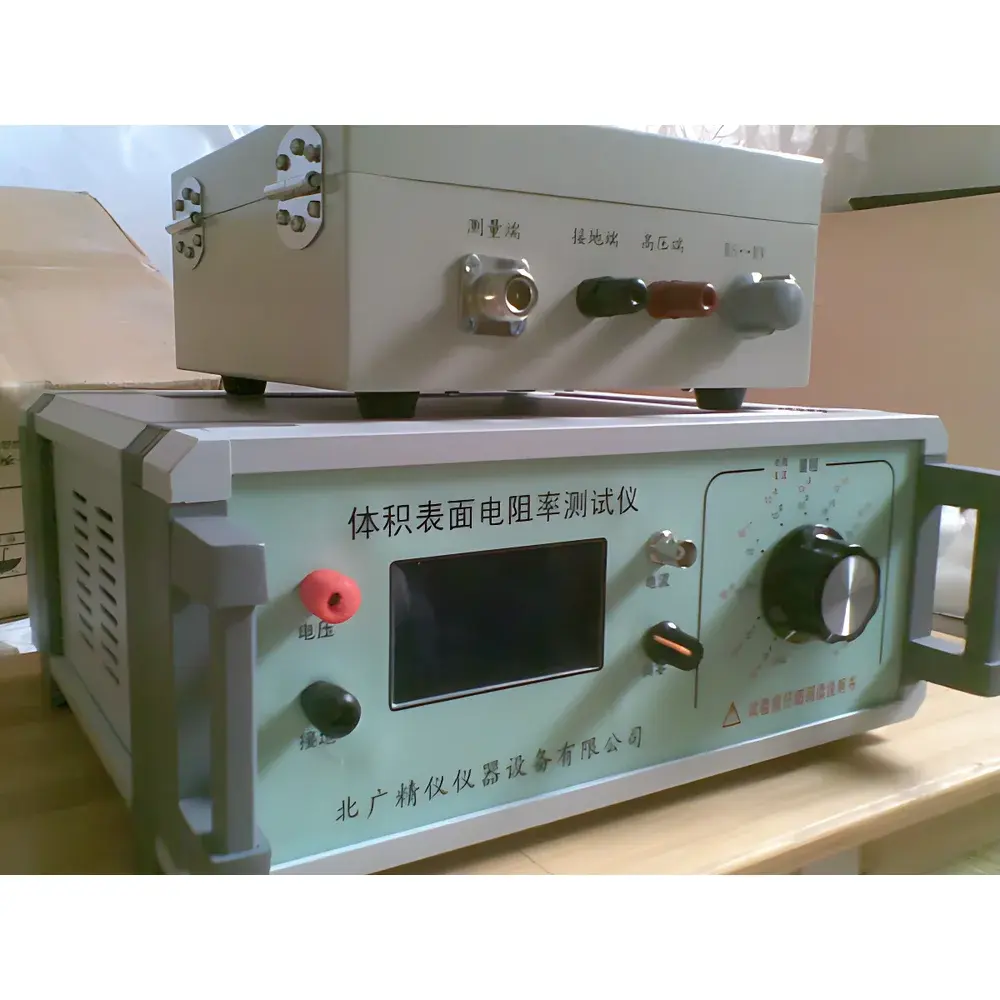
Beijing North Guang Precision Instruments BEST-121 Digital High-Resistance Meter for Volume Resistivity, Surface Resistivity, and Liquid Conductivity Testing
| Brand | Beijing North Guang Precision Instruments |
|---|---|
| Origin | Beijing, China |
| Manufacturer Type | Direct Manufacturer |
| Product Category | Domestic (PRC-Made) |
| Model | BEST-121 |
| Pricing | Upon Request |
| Resistance Range | 0.01 × 10⁴ Ω to 1 × 10¹⁸ Ω |
| Current Range | 2 × 10⁻⁴ A to 1 × 10⁻¹⁶ A |
| Display | Dual 3½-digit LED |
| Test Voltages | DC 10 V, 50 V, 100 V, 250 V, 500 V, 1000 V (selectable) |
| Basic Accuracy | ±1% (resistance), ±5% (voltage setting), ±10–20% (extended range) |
| Operating Environment | 0–40 °C, RH <80% |
| Power Supply | AC 220 V, 50 Hz, ~5 W |
| Dimensions | 285 mm × 245 mm × 120 mm |
| Weight | ~2.5 kg |
Overview
The BEST-121 Digital High-Resistance Meter is an engineered solution for precise measurement of volume resistivity (ρv), surface resistivity (ρs), and liquid conductivity in solid, powder, and liquid dielectric materials. Based on the standardized three-electrode method per IEC 62631-3-1 and ASTM D257, the instrument applies calibrated DC test voltages across defined electrode configurations—typically parallel-plate or concentric-ring arrangements—to quantify leakage current through or along a specimen. The resulting resistance values are converted into resistivity using geometric correction factors derived from electrode spacing and contact area. Designed for compliance-critical environments including QC labs, R&D centers, and electronics manufacturing facilities, the BEST-121 delivers traceable, reproducible measurements across 14 decades of resistance (10⁴–10¹⁸ Ω), supporting both high-resistance insulation evaluation and ultra-low-current characterization down to 10⁻¹⁶ A.
Key Features
- Wide dynamic range: 0.01 × 10⁴ Ω to 1 × 10¹⁸ Ω with dual 3½-digit LED display for simultaneous resistance and current readout
- Programmable DC test voltages: 10 V, 50 V, 100 V, 250 V, 500 V, and 1000 V—each calibrated to ±5% tolerance per ANSI C63.19 and GB/T 1410-2006
- Integrated current measurement channel enabling direct microcurrent analysis from 2 × 10⁻⁴ A to 1 × 10⁻¹⁶ A without external picoammeters
- Robust analog front-end architecture featuring Intel-based large-scale integration for low-noise signal conditioning and minimal zero drift (<±5% over 1–8 h under stable conditions)
- Compact benchtop form factor (285 × 245 × 120 mm; ~2.5 kg) optimized for space-constrained laboratories and production line integration
- Compliance-ready design supporting audit trails via manual logging—compatible with GLP/GMP documentation workflows when paired with calibrated reference standards
Sample Compatibility & Compliance
The BEST-121 supports standardized test configurations for solids (e.g., polymer sheets, ceramic substrates, elastomeric flooring), powders (e.g., conductive fillers, battery electrode materials), and liquids (e.g., transformer oils, solvents, electrolyte solutions). Electrode fixtures conform to ASTM D257 Annex A2 (guarded electrode system) and GB/T 1410-2006 Clause 6 (three-terminal configuration). It satisfies requirements for electrical safety testing of antistatic personal protective equipment (PPE) per GB 12014, GB 4385, and GB/T 22042; industrial flooring per GB 50515 and GB 50611; textile electrostatic performance per GB/T 12703.4 and GB/T 12703.6; and conductive/antistatic composites per GB/T 15738. All measurements align with ISO/IEC 17025 technical validity criteria when performed using certified reference resistors and documented environmental controls (20 ±2 °C, 35 ±10% RH recommended for highest accuracy).
Software & Data Management
The BEST-121 operates as a standalone analog-digital hybrid instrument with no embedded firmware or USB connectivity. Data acquisition relies on manual recording or optional third-party analog output interfaces (0–1 V or 4–20 mA scaling available upon request). For regulated environments requiring electronic records, users integrate the device into validated data capture systems compliant with FDA 21 CFR Part 11—using external DAQ hardware and audit-trail-enabled software (e.g., LabVIEW, MATLAB, or LIMS platforms). Calibration certificates include NIST-traceable verification at multiple voltage/resistance points, supporting periodic requalification per ISO/IEC 17025 clause 6.5.
Applications
- Quality control of insulating polymers, laminates, and encapsulants in aerospace and automotive electronics
- Resistivity screening of antistatic packaging films, cleanroom garments, and ESD-safe work surfaces
- R&D characterization of nanocomposite conductive fillers (e.g., carbon black, graphene, metal-coated particles) in polymer matrices
- Electrical safety validation of medical device housings, surgical drapes, and diagnostic consumables
- Dielectric integrity assessment of transformer oils and high-voltage cable compounds per IEC 60296 and GB/T 7595
- Research-grade microcurrent profiling in electrochemical sensors and organic semiconductor thin films
FAQ
Does the BEST-121 support automated data export or PC interface?
No—the instrument features analog-only operation with dual LED displays. External data logging requires optional analog output modules or manual transcription.
Is calibration traceable to national standards?
Yes—factory calibration includes NIST-traceable reference resistors and documented uncertainty budgets per ISO/IEC 17025 Annex A.
Can it measure resistivity of powders or pastes?
Yes—when used with a compliant powder resistivity cell (e.g., ASTM D7837-compliant die set), provided sample compaction and electrode contact are controlled per GB/T 15738.
What safety certifications does it carry?
It complies with GB 4793.1 (IEC 61010-1) for electrical safety in laboratory equipment; CE marking is not applicable as it is a domestically certified PRC-manufactured instrument.
How often should recalibration be performed?
Annual recalibration is recommended for routine QC use; more frequent intervals (e.g., quarterly) are advised for GMP/GLP applications or after mechanical shock or environmental exposure beyond specified limits.



