
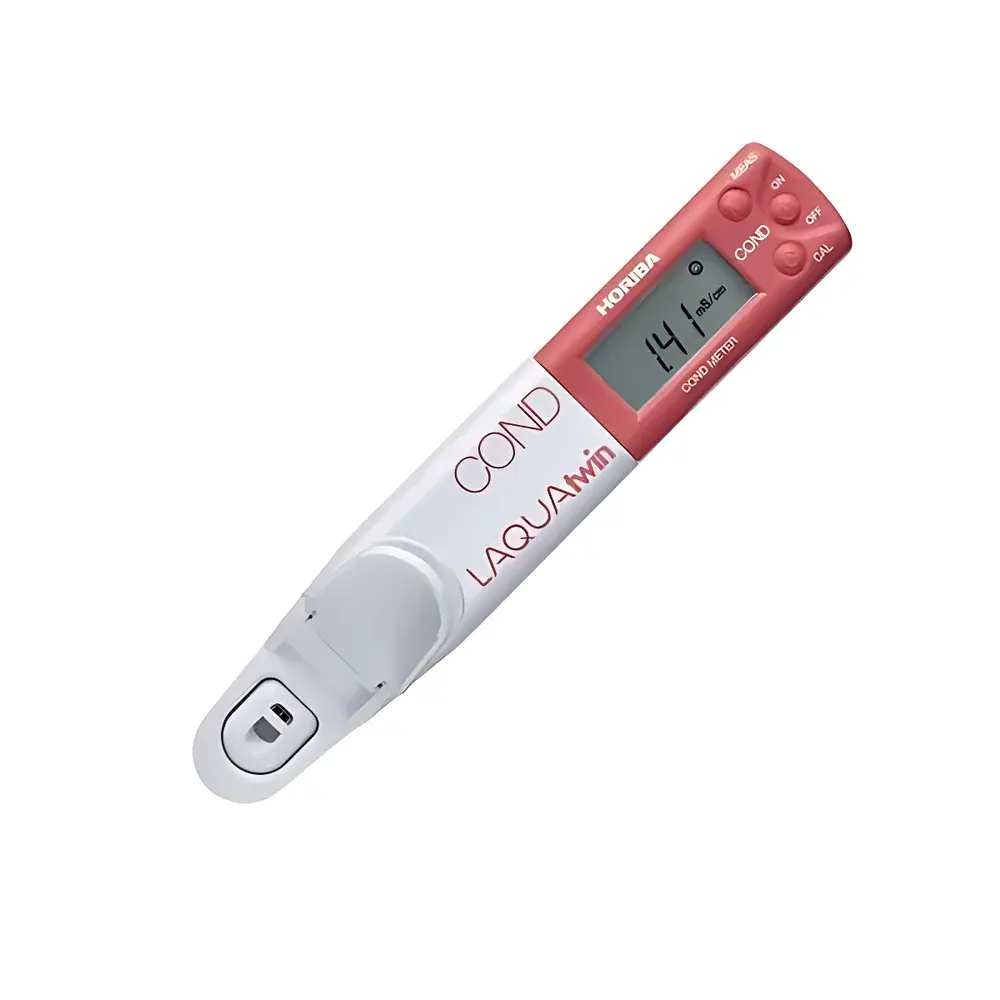
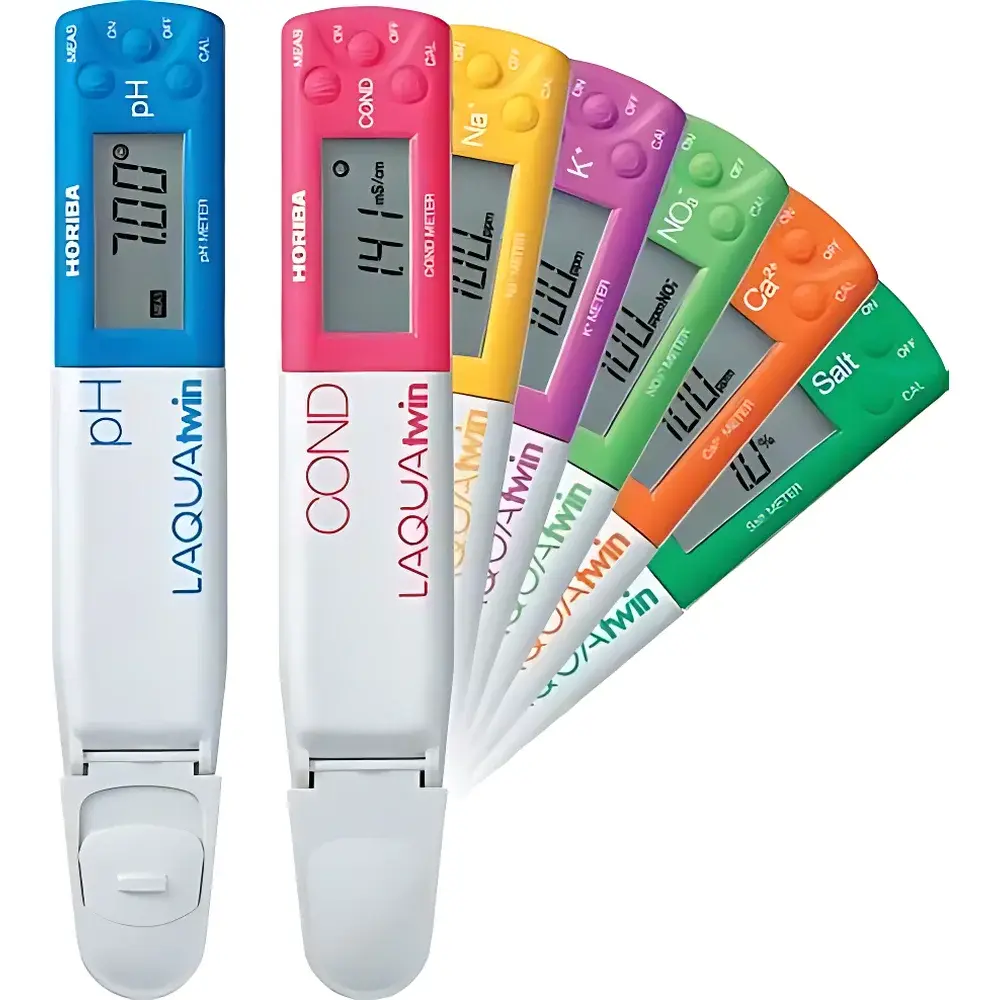
HORIBA EC11 Portable Conductivity Pen Tester
| Brand | HORIBA |
|---|---|
| Origin | Japan |
| Model | EC11 |
| Portability | Pen-type |
| Conductivity Range | 0–199 µS/cm |
| Temperature Range | 5–40°C |
| Accuracy | ±2% F.S. ±1 digit (per range) |
| Resolution | 1 µS/cm |
| Calibration | 2-point |
| IP Rating | IP67 |
| Temperature Compensation | Automatic (NTC thermistor) |
| Display | Monochrome LCD with Auto-Hold & Auto-Stabilize |
| Power | 2 × CR2032 batteries (≈400 h life) |
| Dimensions | 164 × 29 × 20 mm |
| Weight | ≈45 g (instrument only) |
Overview
The HORIBA EC11 Portable Conductivity Pen Tester is a compact, field-deployable electrochemical instrument engineered for rapid, reliable measurement of electrical conductivity (EC) and derived total dissolved solids (TDS) in aqueous samples. It operates on the principle of two-electrode AC conductometry using a platinum-black-coated titanium sensor — a configuration optimized for stability, low polarization error, and resistance to surface fouling in low-to-moderate ionic strength environments. Unlike benchtop meters requiring voluminous sample handling, the EC11 is designed for minimal sample volume (as low as 0.12 mL), making it suitable for spot-checking in confined or resource-limited settings. Its automatic range switching across three decades (µS/cm to mS/cm) eliminates manual scale selection errors, while built-in NTC-based temperature compensation ensures compliance with standard conductivity reporting at 25°C (DIN EN 27888, ISO 7888). The device meets the functional requirements of routine quality verification under GLP-aligned workflows but is not intended for regulated pharmaceutical release testing per USP without additional validation.
Key Features
- Three auto-ranging conductivity scales: 0–199 µS/cm, 200–1999 µS/cm, and 2.00–19.99 mS/cm — enabling seamless transition between freshwater, brackish, and mildly saline matrices
- Platinum-black-coated titanium dual-ring electrode — providing high surface area, corrosion resistance, and long-term signal reproducibility in non-aggressive media
- Integrated NTC temperature sensor with automatic linear compensation (0.0–2.5%/°C selectable via internal jumper) — minimizing thermal drift during ambient-temperature field use
- IP67-rated enclosure — certified dust-tight and submersible up to 1 m for 30 minutes, supporting operation in humid laboratories, aquaculture facilities, and outdoor soil moisture assessment
- Auto-Hold and Auto-Stabilize algorithms — locking readings once variance falls below ±0.5% over 2 seconds, reducing operator dependency in dynamic sampling conditions
- Low-power monochrome LCD with backlight-independent contrast — legible under direct sunlight or low-light storage environments
- CR2032 battery architecture (2×) delivering ~400 hours of continuous operation — compatible with globally distributed coin-cell supply chains and minimizing downtime in remote deployments
Sample Compatibility & Compliance
The EC11 is validated for use with deionized water, tap water, aquarium effluent, hydroponic nutrient solutions, leachates from soil columns, and low-conductivity cleaning rinse waters. It is not recommended for high-viscosity fluids (>10 mPa·s), strongly oxidizing solutions (e.g., >5% HNO₃), or samples containing suspended solids >50 mg/L without prior filtration, as these may impair electrode response time or induce coating artifacts. While not CE-marked for medical device applications, the instrument conforms to IEC 61010-1:2010 safety standards for electrical equipment used in laboratory environments. Its calibration protocol aligns with ASTM D1125-20 Annex A1 for conductivity meter verification using traceable KCl standards (1413 µS/cm and 12.88 mS/cm provided). Data output is non-archival; therefore, the EC11 does not implement FDA 21 CFR Part 11 electronic signature or audit trail functionality.
Software & Data Management
The EC11 operates as a standalone, firmware-embedded instrument with no Bluetooth, USB, or PC interface. All measurement data remain resident on-device only during active display and are not stored upon power-down. No proprietary software, drivers, or cloud synchronization is required or supported. This architecture prioritizes operational simplicity, electromagnetic immunity in industrial zones, and cybersecurity isolation — particularly advantageous in classified research labs or facilities governed by ITAR/EAR export control frameworks. Users record results manually or integrate readings into external LIMS via transcription. Firmware updates are not field-serviceable; functional enhancements are implemented exclusively through hardware revision cycles coordinated by HORIBA’s global service network.
Applications
- Aquaculture monitoring: Real-time tracking of conductivity shifts indicating salinity drift, osmotic stress, or feed residue accumulation in recirculating systems
- Freshwater ecology: Field screening of stream conductivity as a surrogate for base cation load, agricultural runoff, or acid mine drainage impact
- Horticulture and soil science: Estimating extractable salt content in saturated paste extracts (1:5 soil:water ratio) per USDA ARS protocols
- Industrial hygiene: Verifying conductivity of rinse baths used in semiconductor wafer cleaning or electroplating pre-treatment lines
- Education and training: Demonstrating fundamental electrochemical principles — including cell constant derivation, Kohlrausch’s law, and temperature dependence of ionic mobility — in undergraduate analytical chemistry laboratories
- Maintenance diagnostics: Assessing degradation of deionization resin beds or reverse osmosis membrane integrity via baseline conductivity creep analysis
FAQ
What is the cell constant of the EC11 sensor?
The EC11 employs a fixed-geometry two-electrode cell with a nominal cell constant of 1.0 cm⁻¹, factory-determined via KCl standardization and not user-adjustable.
Can the EC11 measure TDS directly?
No — TDS values are calculated internally using a fixed 0.65 conversion factor (µS/cm × 0.65 = ppm), consistent with common NaCl-based approximations per ASTM D5391-19. No ion-specific calibration is supported.
Is the electrode replaceable?
The sensor is integrated and non-field-replaceable; full unit replacement is required if electrode performance degrades beyond specification limits after cleaning and recalibration.
Does the EC11 support custom temperature compensation coefficients?
Only two preset coefficients (0.0%/°C for pure water reference, 2.0%/°C for general-purpose use) are available via internal hardware jumper — no software-accessible coefficient input is provided.
How often should calibration be performed?
HORIBA recommends two-point calibration before each daily use session when operating under ISO/IEC 17025-accredited conditions; for routine field checks, single-point verification against the 1413 µS/cm standard is sufficient.





