
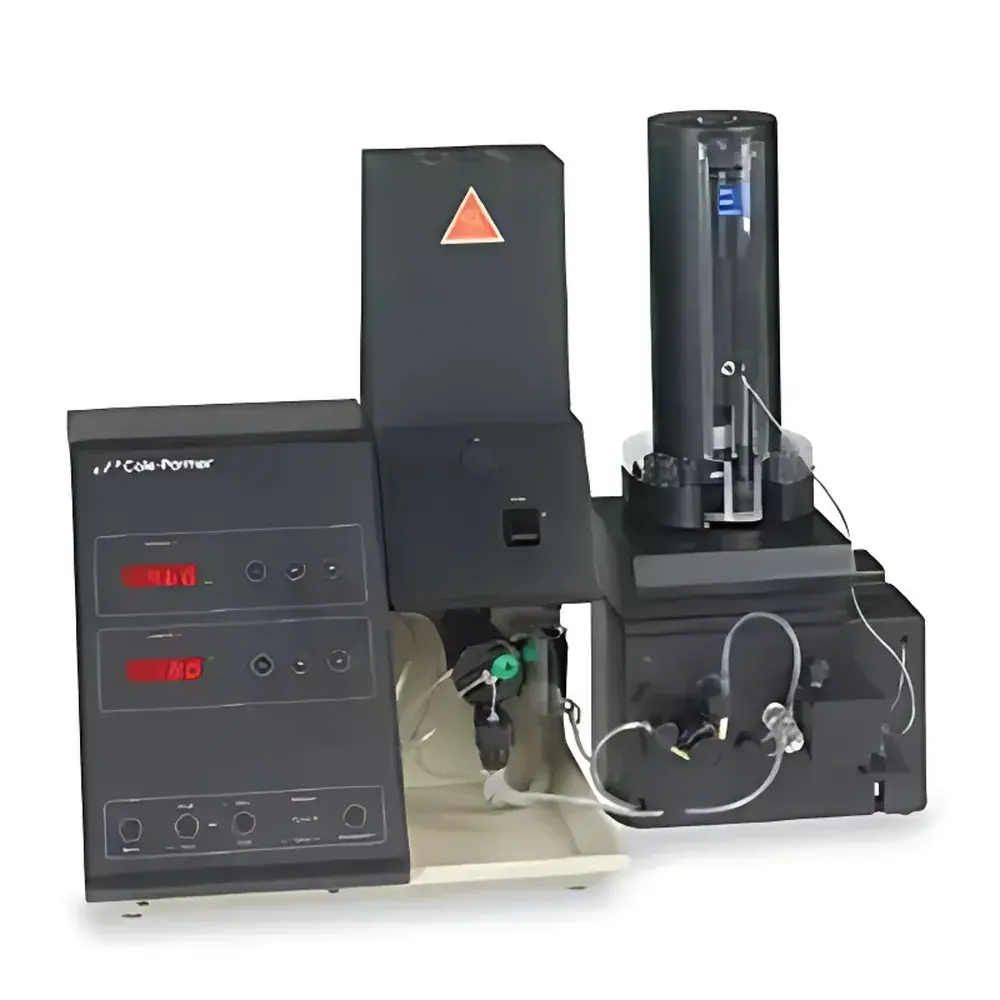
Sherwood M425 Quad-Element Flame Photometer
| Brand | Sherwood |
|---|---|
| Origin | United Kingdom |
| Model | M425 |
| Detection Elements | K, Na, Li, Ca |
Overview
The Sherwood M425 Quad-Element Flame Photometer is a benchtop atomic emission spectrometer engineered for quantitative analysis of alkali and alkaline earth metals—specifically potassium (K), sodium (Na), lithium (Li), and calcium (Ca)—in aqueous solutions. Based on the principle of flame atomic emission spectroscopy (FAES), the instrument atomizes and excites sample aerosols in a stable air-acetylene or air-propane flame; emitted characteristic radiation at element-specific wavelengths is isolated via interference filters and quantified by a photomultiplier tube. The M425 extends the architecture of the dual-channel M420 platform with an additional dedicated calcium channel, enabling flexible multi-element measurement strategies—including dual-element simultaneous readout from any two of the four calibrated elements, or three-element analysis using lithium as an internal standard for drift correction in K/Na/Ca determinations. Designed for routine laboratory environments, it delivers high reproducibility (RSD < 2% at 100 ppm for Na/K), robust thermal stability, and consistent flame geometry across extended operation cycles.
Key Features
- Dual-channel independent optical path design allows real-time, non-interfering measurement of two elements simultaneously—e.g., K and Na, Na and Ca, or Li and K—with individual calibration curves and zero-point adjustment.
- Integrated linearizer module compensates for inherent nonlinearity in flame photometric response, extending dynamic range up to 3–4 orders of magnitude without manual dilution.
- RS-232 serial interface enables direct communication with Windows-based data acquisition software, supporting automated calibration, sample sequencing, and audit-trail generation compliant with GLP documentation requirements.
- Built-in dual-stage gas regulator ensures precise, pulse-free fuel and oxidant delivery, minimizing flame flicker and improving signal-to-noise ratio during low-concentration measurements.
- Complete factory-integrated accessory suite includes air compressor, four certified interference filters (422.7 nm for Ca, 589.0/589.6 nm for Na, 670.8 nm for Li, 766.5 nm for K), and traceable 1000 ppm single-element standards (6 × 100 mL per element) prepared in 2% v/v HNO₃ matrix.
- Front-panel digital display with dual-line LED readout provides immediate visual confirmation of both channel outputs, eliminating reliance on external monitors during rapid screening workflows.
Sample Compatibility & Compliance
The M425 accepts clarified, filtered aqueous samples with total dissolved solids (TDS) ≤ 0.1% w/v. It accommodates standard 13 mm OD borosilicate glass tubes and supports direct aspiration of diluted biological fluids (serum, urine), digested plant/soil extracts, food homogenates, and industrial process liquors. All hardware and firmware comply with IEC 61010-1:2010 safety standards for electrical equipment used in laboratory environments. The included data acquisition software maintains full audit trail functionality—including user logins, method versioning, calibration history, and electronic signature support—aligning with FDA 21 CFR Part 11 expectations for regulated laboratories. Instrument validation protocols are compatible with ISO/IEC 17025 and ASTM D511, D1093, D2341, and D5016 for water, soil, and fertilizer analysis.
Software & Data Management
The bundled Windows-compatible software provides full control over instrument parameters (flame gas flow rates, integration time, gain, background subtraction), automated multi-point calibration (up to 8 standards), and batch reporting with customizable templates. Raw intensity values, concentration results, %RSD, and calibration curve statistics (r² ≥ 0.9995 typical) are stored in encrypted .csv and .pdf formats. Data export supports LIMS integration via ODBC drivers. Software-generated reports include instrument ID, operator name, date/time stamps, environmental conditions (ambient temperature, barometric pressure), and full traceability to NIST-traceable reference materials. Audit logs record all parameter modifications and result overrides with timestamped user IDs.
Applications
The M425 serves as a primary analytical tool in quality control and research settings where rapid, cost-effective quantification of major cations is required. It is routinely deployed for: monitoring Na⁺ leaching in cement hydration studies; assessing Ca²⁺ bioavailability in dairy and fortified beverages; evaluating K⁺ content in NPK fertilizers and hydroponic nutrient solutions; determining exchangeable Na⁺ in soil salinity assessments per USDA ARS protocols; quantifying Li⁺ in greases and lubricant additives; measuring residual Na⁺ in pharmaceutical excipients; and validating elemental composition in glass batch formulations. Its ruggedness and minimal maintenance make it suitable for field-deployable labs in agricultural extension services and mineral exploration sites.
FAQ
What flame gases are compatible with the M425?
The instrument operates optimally with compressed air (≥ 6 bar, oil-free, dew point ≤ −20°C) and propane or butane. Acetylene is not recommended due to excessive flame temperature and carbon deposition risk.
Can the M425 perform internal standardization?
Yes—lithium is pre-configured as the internal standard channel; users may select Li-normalized quantification for K, Na, or Ca measurements to correct for nebulization efficiency drift.
Is method validation support provided?
Sherwood supplies application notes aligned with ASTM D511 (water), ISO 11885 (wastewater), and BS EN 16177 (fertilizers), including LOD/LOQ determination protocols and spike recovery procedures.
How often does the nebulizer require cleaning?
Under normal use with filtered samples, the concentric glass nebulizer should be inspected weekly and ultrasonically cleaned in 5% HNO₃ for 10 minutes every 50 analyses.
Does the system meet GLP requirements out-of-the-box?
Yes—the combination of hardware interlocks, software audit trails, electronic signatures, and calibration certificate traceability satisfies core GLP principles as defined in OECD Series on Principles of Good Laboratory Practice.
Related Products




