
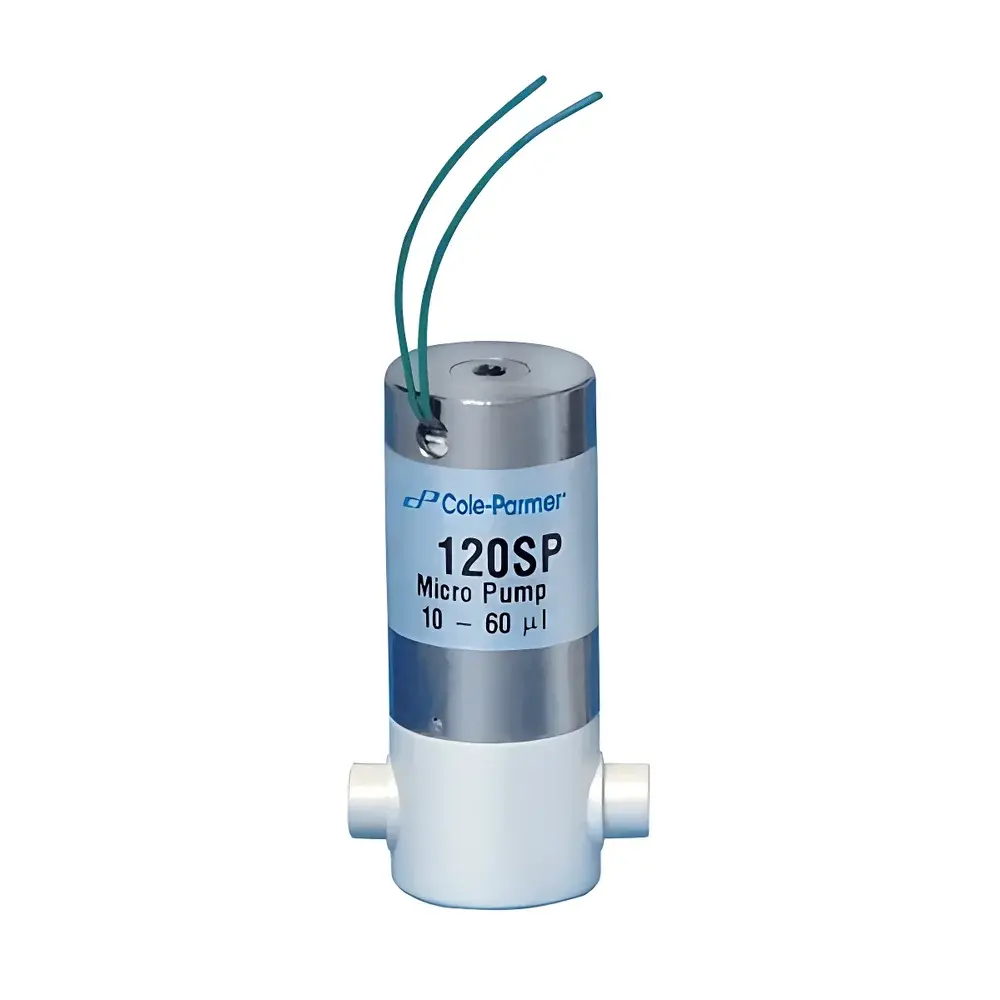
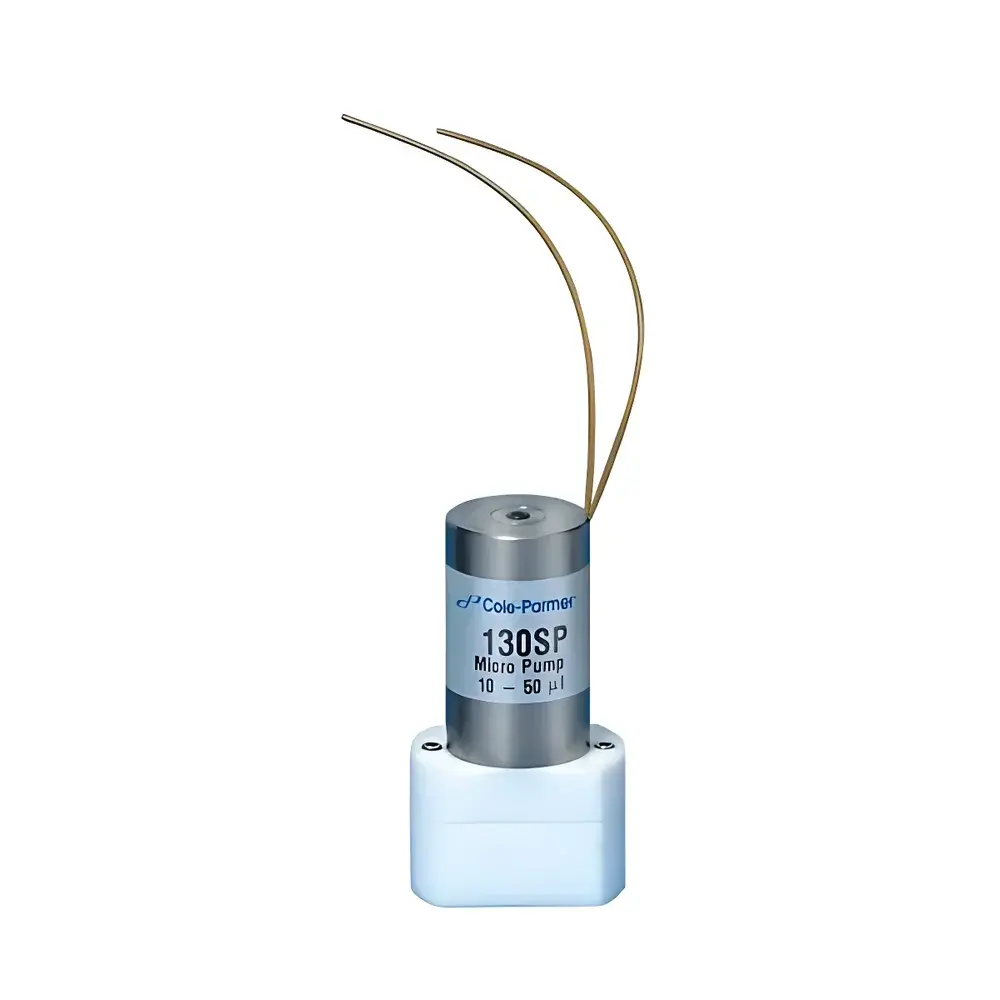
Cole-Parmer 73120-xx Series Self-Priming Miniature Diaphragm Pump
| Brand | Cole-Parmer |
|---|---|
| Origin | USA |
| Manufacturer Type | Authorized Distributor |
| Origin Category | Imported |
| Model | 73120-xx |
| Pricing | Available Upon Request |
| Self-Priming | Yes |
| Suction Lift | 4 ft (1.2 m) |
| Particle Handling | Not Suitable for Suspended Solids |
| Dry-Run Capability | Yes |
| Port Interface | 1/4"-28 UNF |
| Max Fluid Pressure | 5 psi (0.35 bar) |
| Max Fluid Temperature | 158°F (70°C) |
| Wetted Materials | PP/EPDM/PTFE/FKM Variants |
| Power Supply | 12 VDC or 24 VDC |
| Dimensions (L×W×H) | 64×36×25 mm or 69×38×25 mm |
| Cycle Life | Up to 200 million actuations |
| Flow Rate | Up to 25 mL/min |
| Accuracy | ±1% of setpoint for volumes ≥50 µL |
| Minimum Dispense Volume | 20–50 µL |
| Minimum On-Time | 150 ms |
| Minimum Off-Time | 350 ms |
| Max Frequency | 1.6–2.0 Hz |
Overview
The Cole-Parmer 73120-xx Series Self-Priming Miniature Diaphragm Pump is a precision-engineered, solenoid-driven positive displacement pump designed for low-volume, high-repeatability fluid handling in analytical instrumentation, microfluidic systems, and automated laboratory platforms. Operating on the principle of reciprocating diaphragm displacement, it delivers consistent volumetric output without reliance on external priming mechanisms or gravity feed. Its self-priming capability—achieving suction lift up to 4 ft (1.2 m) from an open, non-pressurized reservoir—enables flexible integration into compact or elevated fluid pathways. The pump’s fixed-displacement architecture ensures predictable per-cycle volume delivery, with calibrated accuracy better than ±1% for dispense volumes of 50 µL and above. Designed for continuous-duty operation under variable backpressure (up to 5 psi / 0.35 bar), it maintains stable performance across ambient-to-moderate thermal conditions (fluid temperature ≤70°C), making it suitable for aqueous, mildly aggressive, and low-viscosity organic media.
Key Features
- Solenoid-actuated diaphragm mechanism with no internal valves or rotating parts—ensuring long-term mechanical stability and minimal maintenance.
- True self-priming function: initiates liquid draw from unpressurized sources located up to 1.2 m below the pump head without manual intervention or auxiliary vacuum.
- High cycle endurance: rated for up to 200 million discrete actuation cycles, supporting multi-year deployment in unattended systems.
- Low-power consumption: compatible with both 12 VDC and 24 VDC supplies, enabling integration into battery-powered or embedded control architectures.
- Dry-run safe operation: engineered to withstand extended periods of air-only cycling without diaphragm degradation or thermal damage.
- Modular wetted material configurations: multiple variants available with PP/EPDM, PTFE/FKM, or PTFE/EPDM combinations to match chemical compatibility requirements per ISO 10993 and USP Class VI guidelines.
- Compact footprint: dimensions as small as 64 × 36 × 25 mm facilitate OEM integration into space-constrained analytical devices.
Sample Compatibility & Compliance
The 73120-xx series is intended for use with clean, particle-free liquids—including deionized water, buffer solutions, dilute acids/bases, and common organic solvents such as isopropanol and acetonitrile. It is not recommended for slurries, viscous fluids (>50 cP), or media containing suspended solids >10 µm. All wetted materials comply with FDA 21 CFR §177.2470 (for EPDM), §177.1550 (for PP), and §177.1550/§177.2470 (for PTFE/FKM). Electrical design conforms to IEC 61000-6-3 (EMI emission) and IEC 61000-6-2 (immunity) standards. The pump meets CE marking requirements for electromagnetic compatibility and low-voltage directive compliance (2014/35/EU). While not intrinsically safe, its low-energy operation supports use in Class I, Division 2 environments when installed per NEC Article 500.
Software & Data Management
As a hardware-level fluid actuator, the 73120-xx operates via TTL-compatible digital pulse input or analog voltage modulation (0–5 V or 0–10 V), enabling seamless synchronization with programmable logic controllers (PLCs), microcontroller units (MCUs), or host PC-based automation software (e.g., LabVIEW, Python with PySerial, or MATLAB). Pulse-width and inter-pulse timing are externally controlled—allowing precise regulation of dispense volume, frequency, and duty cycle. For traceability-critical applications, integration with audit-trail-capable supervisory systems (e.g., ISA-88 compliant SCADA) supports full cycle logging, including timestamped actuation count, power-on duration, and cumulative runtime. Firmware-independent operation eliminates dependency on proprietary drivers or cloud connectivity.
Applications
- Automated reagent dispensing in benchtop analyzers and point-of-care diagnostic instruments.
- Micro-volume calibration fluid transfer in gravimetric and photometric standardization workflows.
- Continuous low-flow perfusion in cell culture bioreactors and organ-on-chip platforms.
- Sample aspiration in portable gas chromatography preconcentrators and dissolved oxygen sensors.
- Fluid metering in environmental monitoring probes for pH, conductivity, and turbidity measurement loops.
- OEM integration into IVD devices requiring FDA 510(k)-compliant fluidics subsystems.
FAQ
What is the minimum dispense volume achievable with this pump?
The smallest calibrated dispense volume is 20 µL, achieved at a minimum on-time of 150 ms and maximum frequency of 2.0 Hz (for PP/EPDM variant). Accuracy remains within ±1% for volumes ≥50 µL.
Can the pump handle corrosive fluids such as hydrochloric acid or sodium hydroxide?
Yes—when configured with PTFE/FKM wetted components (models 73120-30 through 73120-40), it exhibits resistance to 10% HCl and 10% NaOH at temperatures ≤50°C; consult Cole-Parmer’s Chemical Compatibility Guide for extended exposure limits.
Is flow rate adjustable in real time during operation?
Flow rate is modulated exclusively via external pulse timing control; no onboard flow sensor or closed-loop feedback is integrated. Real-time adjustment requires synchronized command signals from the host controller.
Does the pump require periodic recalibration?
No—its fixed-displacement design provides inherent volumetric consistency. However, verification against gravimetric or timed-collect methods is recommended every 6 months in GLP/GMP-regulated environments.
How does the pump behave under zero-backpressure conditions?
It delivers nominal flow rates up to 25 mL/min at atmospheric discharge; flow linearity is preserved across 0–5 psi differential pressure, with no cavitation or pulsation amplification observed.



