
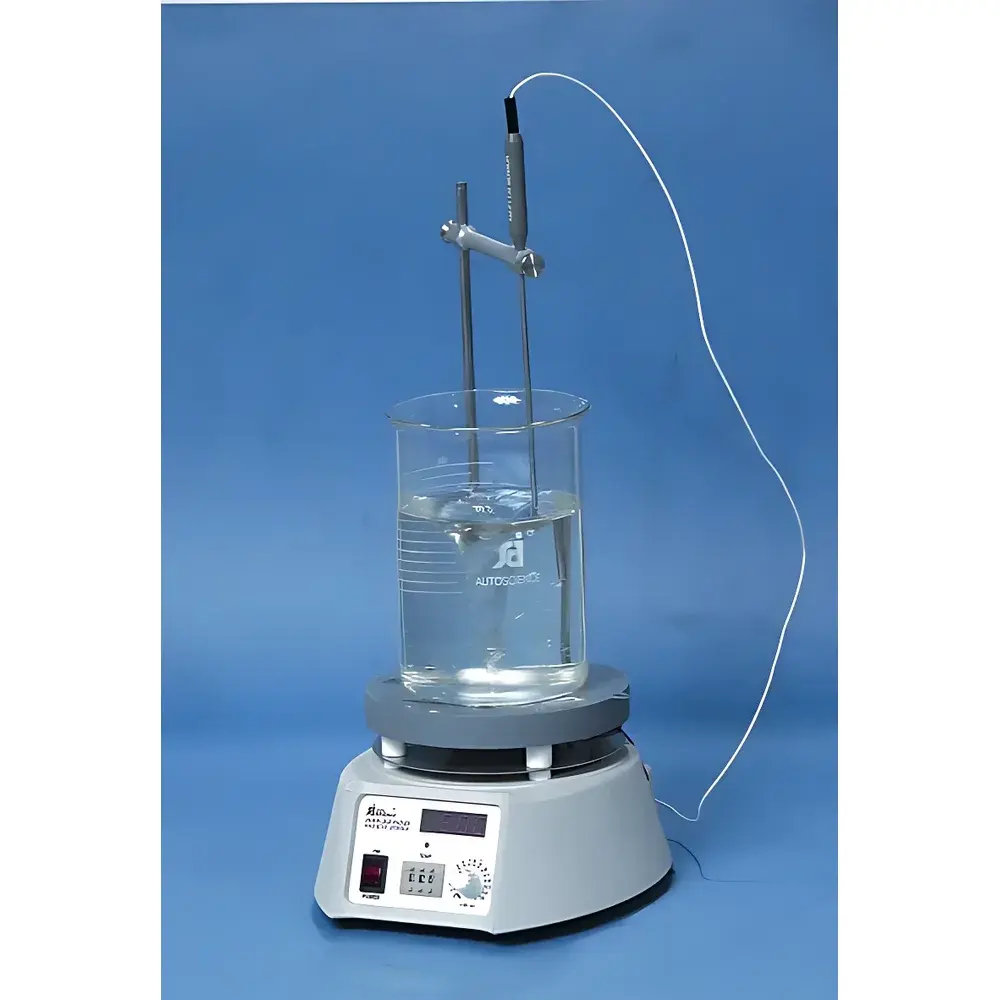
Otosen AM-5250A Magnetic Stirrer with Heating
| Brand | Otosen |
|---|---|
| Model | AM-5250A |
| Stirring Volume | 5–10 L |
| Speed Range | 0–1700 rpm |
| Temperature Control Range | Ambient to 300 °C |
| Heating Plate Max Temp | 300 °C |
| Control Method | Electronic PID |
| Temperature Accuracy | ±2 °C |
| Heating Power | 250 W |
| Plate Diameter | 150 mm |
| Dimensions (W×D×H) | 198 × 225 × 115 mm |
| Weight | 2.4 kg |
| Power Supply | 220 V / 50 Hz |
| External PT100 Sensor Port | Yes |
| Reverse Rotation | No |
Overview
The Otosen AM-5250A Magnetic Stirrer with Integrated Heating is a precision-engineered benchtop laboratory instrument designed for reliable, reproducible mixing and temperature-controlled sample preparation across analytical, synthetic, and quality control workflows. Based on the principle of magnetic coupling—where a rotating permanent magnet beneath the ceramic-coated aluminum heating plate induces synchronous rotation of a PTFE- or glass-coated stir bar immersed in the sample—the AM-5250A delivers consistent torque transmission without mechanical shaft penetration. Its integrated resistive heating system enables precise thermal management during stirring, supporting applications requiring simultaneous agitation and thermal equilibration, such as dissolution testing, buffer preparation, reagent synthesis, and pre-analytical sample conditioning. Engineered for daily use in ISO/IEC 17025-accredited labs and GLP-compliant environments, the unit features a robust aluminum heating plate with dual-layer thermal insulation and a chemically resistant PTFE coating to ensure long-term stability under repeated exposure to solvents, acids, and bases.
Key Features
- Microprocessor-based PID temperature control with auto-tuning capability—enables dynamic optimization of heating response based on vessel geometry, liquid volume, and thermal mass.
- Real-time digital LED display showing both setpoint and actual temperature; intuitive blue function key allows rapid switching between modes without menu navigation.
- DC motor-driven speed regulation ensures stable rotational output from 0 to 1700 rpm, independent of line voltage fluctuations—critical for viscosity-sensitive protocols.
- 150 mm diameter aluminum heating plate with PTFE surface coating provides uniform heat distribution and corrosion resistance; maximum surface temperature of 300 °C supports high-boiling-point solvent handling.
- Dual-stage thermal insulation beneath the plate minimizes heat loss to the chassis, improving energy efficiency and operator safety during extended operation.
- Optional external PT100 sensor port (standard configuration) permits direct in-solution temperature monitoring—essential for applications where bath temperature does not reflect actual sample temperature (e.g., viscous media or small-volume vessels).
Sample Compatibility & Compliance
The AM-5250A accommodates standard laboratory glassware including beakers (50 mL–10 L), Erlenmeyer flasks, and round-bottom flasks equipped with compatible magnetic stir bars (e.g., cross-shaped or elliptical designs up to 60 mm length). Its temperature and speed profiles comply with common method validation requirements outlined in USP , ASTM D1298 (density determination), and ISO 5725 (accuracy and precision of measurement methods). While not certified for hazardous location use, the unit meets IEC 61010-1 safety standards for electrical equipment used in laboratory settings. The absence of moving seals or exposed drive mechanisms eliminates contamination risk—making it suitable for sterile technique environments when paired with appropriate aseptic practices.
Software & Data Management
The AM-5250A operates as a standalone analog-digital hybrid controller with no embedded firmware or network interface. All operational parameters—including speed setpoint, temperature setpoint, real-time readings, and auto-tune status—are accessible via front-panel controls and the dual-line LED display. For traceability in regulated environments, users may integrate the unit into electronic lab notebook (ELN) systems via optional analog output modules (0–5 V or 4–20 mA) connected to external data loggers compliant with FDA 21 CFR Part 11 requirements. Audit trails, calibration records, and maintenance logs must be maintained externally per GLP/GMP documentation policies.
Applications
- Preparation of homogeneous aqueous and organic solutions for HPLC mobile phase formulation and titrant standardization.
- Controlled-temperature dissolution studies in pharmaceutical QA/QC labs (e.g., USP Apparatus II verification).
- Accelerated reaction kinetics experiments requiring constant agitation at elevated temperatures (e.g., esterification, hydrolysis).
- Cell culture media conditioning prior to sterilization, ensuring complete solute dissolution without foaming or localized overheating.
- Environmental sample digestion protocols involving acid mixtures (e.g., HNO₃/HF blends) under fume hood conditions.
FAQ
Does the AM-5250A support external temperature feedback using a PT100 probe?
Yes—the unit includes a dedicated BNC port for connecting an external PT100 sensor, enabling direct in-vessel temperature regulation.
Is the heating plate compatible with corrosive reagents such as concentrated sulfuric acid?
The PTFE-coated aluminum surface resists most common laboratory acids and bases; however, prolonged exposure to hot HF or molten alkalis is not recommended.
Can this stirrer maintain stable speed when stirring highly viscous solutions (>10,000 mPa·s)?
Performance depends on stir bar geometry and magnetic coupling strength; for viscosities above 5,000 mPa·s, use longer elliptical stir bars and reduce speed to ≤800 rpm to avoid decoupling.
What is the calibration interval recommendation for temperature accuracy?
Otosen recommends annual verification against a NIST-traceable thermometer; internal PID tuning should be repeated after any significant change in typical operating conditions.
Does the unit include over-temperature or dry-run protection?
No automatic dry-run cutoff is built in; however, the PID algorithm inherently limits overshoot, and the thermal cutoff fuse activates at ~320 °C to prevent damage.



